

Qwen vs DeepSeek: Which Open-Weights AI Model Wins in 2026?
The open-weights AI movement has produced two of the most impressive challengers to proprietary models: Qwen, developed by Alibaba Cloud, and DeepSeek, the research lab that shocked the industry with efficient, high-performance models. Both are freely available weights, both run on consumer and enterprise hardware, and both have attracted massive developer communities. But when you put Qwen vs DeepSeek side by side, important differences emerge in architecture, training philosophy, multilingual ability, coding performance, and cost.
This guide is for engineers, founders, researchers, and curious users who want a clear comparison of Qwen and DeepSeek in 2026. We cover model families, benchmark results, real-world coding ability, reasoning quality, context windows, deployment options, licensing, and pricing. By the end, you will know which model fits your use case — and how Chat-Sonic lets you test both without setting up infrastructure or juggling API keys.
Key Takeaways
- DeepSeek is widely recognized for exceptional reasoning and coding performance per dollar, with models like DeepSeek-V4 and DeepSeek-R2 competing with top proprietary systems.
- Qwen stands out for multilingual fluency, a massive model family spanning chat to vision to audio, and strong support for both Chinese and English.
- Both models are open weights, meaning you can download, fine-tune, and self-host them, which lowers cost and improves privacy compared to closed APIs.
- DeepSeek often leads on coding benchmarks such as HumanEval, MBPP, SWE-bench, and LiveCodeBench, while Qwen often leads on multilingual and multimodal tasks.
- Deployment complexity varies: Qwen has broader ecosystem tooling via Hugging Face, vLLM, and Alibaba Cloud; DeepSeek offers optimized inference kernels and strong quantization support.
- With Chat-Sonic, you can access both Qwen and DeepSeek through a single interface, compare outputs, and avoid managing multiple providers.
- Pricing is not just about API rates; self-hosting, hardware, quantization, and throughput all affect the total cost of ownership.
- Neither model is universally better. The right choice depends on whether your priority is coding depth, language breadth, multimodal reach, or operational simplicity.
What Is Qwen?
Qwen is a family of large language and multimodal models created by Alibaba Cloud. First released in 2023, the Qwen series has grown into one of the most comprehensive open-weights ecosystems in the world. In 2026, the family includes Qwen2.5, Qwen3, Qwen-VL for vision, Qwen-Audio for audio understanding, and specialized variants for coding and mathematics. Qwen models are designed from the ground up to be multilingual, and Alibaba Cloud has consistently released smaller, distilled, and quantized versions alongside the largest checkpoints.
Qwen models are released under permissive licenses that allow commercial use, research, and modification. They are trained on a diverse multilingual corpus with particularly strong coverage of Chinese, English, and dozens of other languages. This makes Qwen a popular choice for applications that need robust multilingual support without relying on Western cloud providers. Teams in Asia, the Middle East, Africa, and Latin America often gravitate toward Qwen because it handles local scripts, idioms, and mixed-language queries better than many English-centric alternatives.
Alibaba Cloud distributes Qwen through Hugging Face, ModelScope, GitHub, and its own platform. The models are compatible with popular inference engines such as vLLM, llama.cpp, TensorRT-LLM, and Ollama, which makes deployment relatively straightforward for experienced teams. The breadth of supported formats — including transformers, GGUF, AWQ, GPTQ, and EXL2 — means you can run Qwen on everything from a high-end laptop to a multi-GPU server.
Qwen Model Lineup in 2026
- Qwen3 / Qwen2.5 — General-purpose chat and instruction models in sizes from 0.5B to over 100B parameters, with dense and mixture-of-experts variants.
- Qwen-Coder — Specialized coding model optimized for software engineering tasks, code completion, and repository-level understanding.
- Qwen-Math — Fine-tuned for mathematical reasoning and problem solving, often used for education and scientific workflows.
- Qwen-VL — Vision-language model that understands images, diagrams, documents, and user interface screenshots.
- Qwen-Audio — Audio understanding and speech processing model for transcription, audio Q&A, and multimodal assistants.
- Qwen-Agent — Tool-use and agentic variants that can call APIs, browse the web, and orchestrate multi-step workflows.
What Is DeepSeek?
DeepSeek is an AI research lab that has become famous for producing high-capacity open-weights models at a fraction of the cost typically associated with frontier training. DeepSeek-V3, DeepSeek-V4, and the reasoning-focused DeepSeek-R1 and R2 models have repeatedly matched or exceeded the performance of much larger proprietary systems on coding, mathematics, and reasoning benchmarks. The lab's ability to train competitive models with relatively modest reported budgets has forced the industry to rethink assumptions about scale, efficiency, and openness.
DeepSeek's philosophy emphasizes efficiency and transparency. The lab publishes detailed technical reports explaining training recipes, mixture-of-experts architectures, data curation strategies, and reinforcement-learning fine-tuning. This transparency has made DeepSeek a favorite among researchers and engineers who want to understand how state-of-the-art models are built. Many engineering teams read DeepSeek papers not just for the weights, but for the reproducible training insights.
In 2026, DeepSeek offers both chat-tuned models and reasoning models. The reasoning variants, sometimes called DeepSeek-R, are designed to spend more compute at inference time to produce more accurate answers on hard problems. This makes DeepSeek particularly appealing for coding, math, and scientific workflows where correctness matters more than conversational speed.
DeepSeek Model Lineup in 2026
- DeepSeek-V4 — Large mixture-of-experts model optimized for general chat, coding, and analysis.
- DeepSeek-R2 — Reasoning specialist that uses extended chain-of-thought to solve hard problems in math, code, and logic.
- DeepSeek-Coder-V2 — Code generation and software engineering model trained on a vast corpus of programming languages.
- Distilled variants — Smaller models that retain much of the capability of larger ones for edge deployment and local IDEs.
Qwen vs DeepSeek: Quick Comparison
| Feature | Qwen | DeepSeek |
|---|---|---|
| Primary Strength | Multilingual fluency and broad model family | Reasoning and coding efficiency |
| Best For | Multilingual apps, multimodal apps, global products | Coding assistants, math, scientific research |
| Architecture | Dense and MoE variants | Mixture-of-Experts focused |
| Context Window | Up to 128K tokens | Up to 128K tokens |
| Languages | Strong Chinese, English, and 25+ languages | Strong English and Chinese |
| License | Permissive, commercial use allowed | Permissive, commercial use allowed |
| Deployment | Hugging Face, ModelScope, vLLM, Ollama, TensorRT-LLM | Hugging Face, vLLM, SGLang, custom kernels |
| Cost Focus | Balanced cost and capability | High capability per dollar |
| Multimodal | Qwen-VL and Qwen-Audio available | Primarily text and code focused |
| Tool Use | Strong function calling and agent support | Capable function calling |
Visual Comparison: Qwen vs DeepSeek
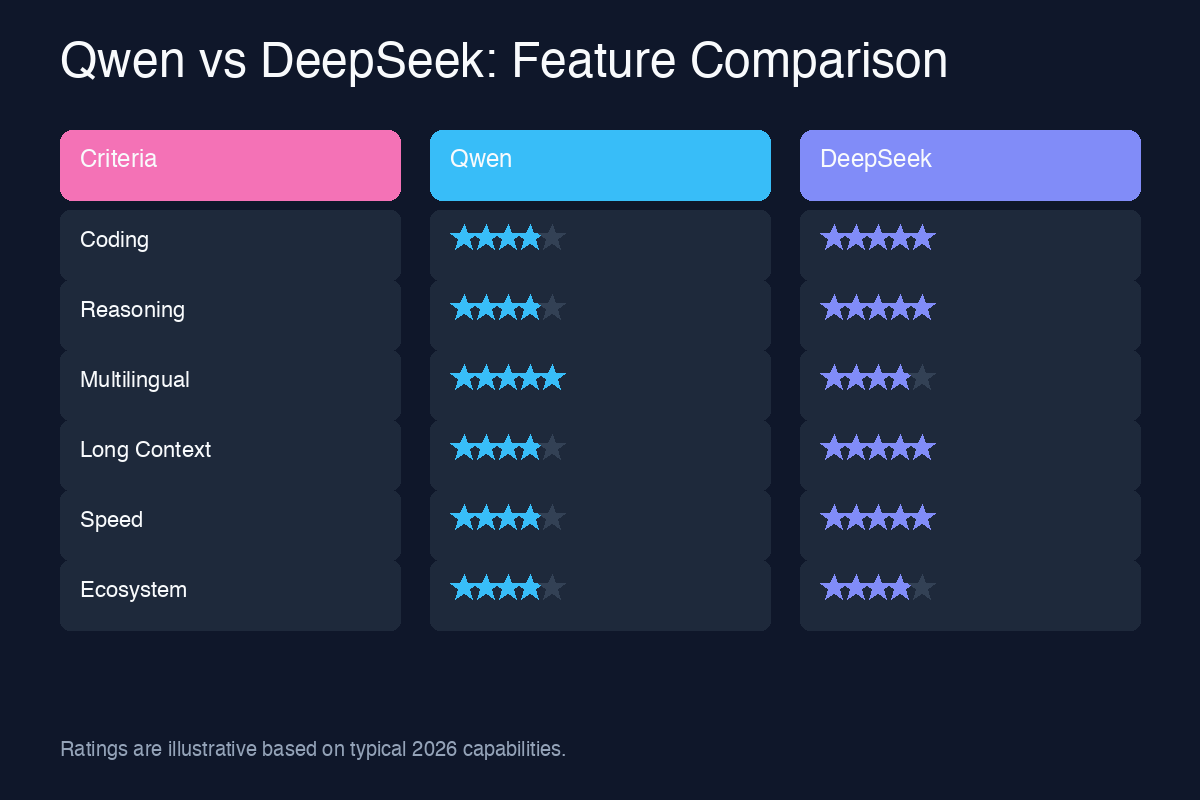
The comparison chart above summarizes how Qwen and DeepSeek compare across six practical dimensions. DeepSeek tends to lead in pure coding and reasoning power, while Qwen holds an advantage in multilingual breadth and multimodal coverage. Neither model dominates every category, which is why many teams run both. A startup building a code assistant might choose DeepSeek for the core engine and Qwen for internationalization. An enterprise building a global support bot might do the opposite.
Architecture and Training Philosophy
Qwen and DeepSeek are built on modern transformer backbones, but their design priorities differ. Qwen emphasizes breadth and accessibility. The Qwen team releases many sizes, from tiny 0.5B models suitable for edge devices to large 100B+ models for data-center deployment. This tiered approach makes it easy to prototype on a small model and promote the same prompt or fine-tune to a larger one.
DeepSeek, by contrast, has pushed mixture-of-experts architectures aggressively. DeepSeek-V4 activates only a fraction of its total parameters for any given token, which keeps inference costs low despite a very large parameter count. The lab has also invested heavily in reinforcement learning from human feedback and self-play-style reasoning training, giving DeepSeek-R2 its distinctive step-by-step problem-solving style.
Both projects publish model cards and technical reports, but DeepSeek's reports are often cited for their detailed ablations and training economics. Qwen's documentation is usually praised for its breadth of integration examples and multilingual benchmarks. Depending on whether you care more about reproducible research or fast deployment, each project has unique appeal.
Coding Performance
Both Qwen and DeepSeek are excellent coding models, but their strengths differ. DeepSeek-Coder and DeepSeek-V4 routinely rank among the best open coding models on benchmarks such as HumanEval, MBPP, LiveCodeBench, and SWE-bench. They produce idiomatic code in Python, JavaScript, TypeScript, C++, Go, and Rust, and they handle debugging and refactoring with surprising competence. On SWE-bench, which tests real GitHub issue resolution, DeepSeek's larger reasoning models have reached scores that were previously associated only with top closed models.
Qwen-Coder is also highly capable, especially for bilingual codebases and documentation. If your team writes comments, commit messages, or technical docs in Chinese and English, Qwen-Coder can switch between languages naturally. For pure algorithmic difficulty, DeepSeek often scores higher, but for multilingual engineering teams, Qwen can be more practical. Qwen-Coder also integrates smoothly with existing Hugging Face code-assistant toolchains, which can reduce setup friction.
In real-world use, DeepSeek tends to write more compact, efficient solutions, while Qwen tends to produce more verbose, well-commented code. The best choice depends on your team's style and review workflow. Some teams find that DeepSeek's output requires more post-editing for style, while Qwen's output is closer to production-ready documentation standards.
Code Completion vs Code Generation
For autocomplete-style suggestions inside an IDE, both models work well when distilled to smaller sizes. Qwen2.5-Coder-7B and DeepSeek-Coder-6.7B are popular choices for local completion. They are small enough to run on a laptop with quantization, yet large enough to suggest meaningful multi-token completions. For full function generation from prompts, larger variants such as Qwen2.5-Coder-32B and DeepSeek-V4 produce more reliable results, especially when the task spans multiple files or requires understanding existing abstractions.
Reasoning and Problem Solving
DeepSeek's reasoning models, especially DeepSeek-R2, are built for hard problems. They use extended inference-time computation to explore multiple solution paths, verify intermediate steps, and correct mistakes before producing a final answer. On mathematics benchmarks such as GSM8K, MATH, and Olympiad-level problems, DeepSeek-R2 is among the strongest open models available. The model's willingness to rethink an approach mid-generation often leads to correct answers on questions that stump chat-tuned models.
Qwen also reasons well, particularly Qwen-Math and the larger Qwen3 variants. However, Qwen's default chat models are optimized more for breadth and conversational fluency than for deep reasoning. If your primary need is solving complex proofs, competitive programming, or scientific modeling, DeepSeek is usually the better choice. Qwen-Math can narrow the gap on math-specific tasks, but DeepSeek-R2's general reasoning ability tends to transfer more broadly across domains.
Chain-of-Thought Quality
DeepSeek-R2 exposes a detailed chain of thought, which helps users understand how answers are reached. This is valuable for education, debugging, and high-stakes decision support. Qwen can be prompted to show reasoning, but its native chain-of-thought is generally less elaborate. Teams building tutoring products or scientific assistants often prefer DeepSeek because the intermediate reasoning can be shown to users as a learning aid.
Multilingual and Multimodal Abilities
This is where Qwen clearly differentiates itself. Qwen is trained on a broader multilingual corpus and performs strongly across Chinese, Japanese, Korean, Arabic, Spanish, French, German, Hindi, Vietnamese, Thai, and many other languages. For global applications, customer support, translation, content moderation across regions, and localized product descriptions, Qwen is often the preferred open model. It also handles code-switching — mixing multiple languages in one sentence — better than most alternatives.
DeepSeek is strongest in English and Chinese. It can handle other languages, but it does not match Qwen's breadth. If your user base is primarily English-speaking or Chinese-speaking, DeepSeek is perfectly adequate. If you need coverage for ten or more languages, or if you serve markets with complex scripts and low-resource languages, Qwen is the safer bet.
Qwen also offers dedicated multimodal models: Qwen-VL for images and Qwen-Audio for sound. Qwen-VL can read screenshots, charts, diagrams, and documents, making it useful for accessibility tools, content moderation, and visual agents. DeepSeek has focused primarily on text and code, so for vision or audio tasks, Qwen has a clear edge. If your roadmap includes image understanding or audio processing, starting with Qwen can prevent a later model migration.
Context Windows and Long Documents
Both Qwen and DeepSeek support context windows of 128,000 tokens or more in their largest variants. This is enough for long codebases, legal documents, research papers, and extended conversations. In practice, both models handle needle-in-a-haystack retrieval reasonably well, though the exact performance depends on the specific variant and quantization level. Larger unquantized models generally retain more fine-grained detail across long contexts.
For long-document Q&A, Qwen tends to produce more fluent summaries, while DeepSeek tends to extract precise technical details more reliably. The difference is usually small, so context handling is rarely the deciding factor between the two. When evaluating long-context performance, it is worth testing with your own documents rather than relying solely on benchmark claims, because real-world PDFs, codebases, and chat logs have different structures than benchmark passages.
Deployment Options and Operational Guidance
Because both models are open weights, you have flexibility in how you deploy them. You can run them on-premises, in a private cloud, through Alibaba Cloud, or via third-party inference providers. This flexibility is one of the biggest reasons teams choose open models over closed APIs. It enables air-gapped deployments, custom fine-tuning pipelines, and compliance with data residency requirements.
DeepSeek's MoE architecture is particularly efficient at inference. Only a subset of parameters is activated per token, which reduces memory bandwidth and compute requirements. This makes DeepSeek attractive for high-volume applications where cost per request matters. However, MoE models can be harder to serve efficiently on all inference engines, so you should verify that your chosen stack supports expert parallelism and good batching behavior.
Qwen's ecosystem is broader. You will find more ready-made integrations, quantization recipes, and community examples. If your team values ease of deployment and tooling, Qwen may save engineering time. If raw throughput and cost efficiency matter most, DeepSeek may win. For teams new to self-hosting, Qwen's smaller checkpoints are an excellent starting point because they run on cheaper hardware and have abundant tutorials.
Recommended Deployment Stacks
- High-throughput API serving: vLLM or SGLang on NVIDIA A100/H100 GPUs.
- Local development and prototyping: Ollama, llama.cpp, or LM Studio with quantized GGUF/AWQ models.
- Edge and mobile: Qwen 0.5B–3B distilled variants or DeepSeek distilled small models.
- Multi-modal: Qwen-VL with transformers and a vision preprocessor.
- Enterprise private cloud: TensorRT-LLM, Triton Inference Server, or Alibaba Cloud PAI.
Pricing and Total Cost of Ownership
Both Qwen and DeepSeek are open weights, so the headline price is zero if you self-host. In reality, total cost includes hardware, electricity, engineering time, inference-engine optimization, and maintenance. A 70B-parameter model running at full precision needs multiple high-end GPUs, while a quantized 7B model can run on a consumer GPU or even a CPU. The right cost model depends on traffic volume, latency requirements, and whether you already own GPUs.
Hosted API providers that offer Qwen and DeepSeek typically price per million input and output tokens. DeepSeek's MoE design often translates into lower per-token prices because less compute is used per forward pass. Qwen is competitively priced and widely available through Alibaba Cloud's international services. When comparing API prices, look at both input and output rates, because reasoning models like DeepSeek-R2 can produce very long outputs due to their chain-of-thought.
For startups, running a small quantized model locally or through a low-cost inference provider can keep monthly AI spending under a few hundred dollars. For enterprises with millions of requests, self-hosting on reserved GPU clusters is usually cheaper per token than API usage, but it requires upfront capital and dedicated ML infrastructure talent. A hybrid approach is common: use APIs for prototyping and spike traffic, and move high-volume workloads to self-hosted clusters once patterns stabilize.
When to Choose Qwen
Choose Qwen when your project needs broad multilingual coverage, multimodal capabilities, or a mature ecosystem with lots of deployment examples. Qwen is especially strong for:
- Global customer support chatbots that handle many languages.
- Multimodal applications involving images, documents, or audio.
- Teams that want extensive quantization and edge-deployment options.
- Products serving Chinese-speaking users alongside English-speaking users.
- Use cases where tooling and community support reduce time to market.
- Projects that need a smooth path from small prototype models to large production models.
When to Choose DeepSeek
Choose DeepSeek when reasoning, coding, and cost efficiency are the top priorities. DeepSeek excels at:
- AI coding assistants and software engineering agents.
- Mathematical and scientific problem solving.
- High-volume inference where cost per token matters.
- Research environments that need transparent, well-documented models.
- Applications that benefit from explicit chain-of-thought reasoning.
- Teams that want top-tier benchmark performance without proprietary API lock-in.
Qwen vs DeepSeek for Specific Use Cases
Startups Building AI Features
Startups often prefer DeepSeek for coding-heavy products because it delivers high capability without API fees. Qwen is attractive for startups targeting international markets because of its language coverage. A common pattern is to use DeepSeek for the core product logic and Qwen for localization and customer-facing content generation.
Enterprises with Compliance Needs
Both models can be self-hosted, which helps with data residency and compliance. Qwen's wider ecosystem may make private deployment faster, while DeepSeek's efficiency may reduce hardware costs. Enterprises in finance, healthcare, and government often run both in parallel during evaluation before standardizing on one.
Researchers and Academics
DeepSeek publishes detailed technical reports and is popular in research communities focused on reasoning and efficient training. Qwen is popular for multilingual and multimodal research. Both models have been used as base checkpoints for academic papers, domain-specific fine-tunes, and reproducibility studies.
Education and Tutoring
DeepSeek-R2's visible reasoning steps make it a strong tutor for math and computer science. Qwen's multilingual support makes it better for teaching students in non-English languages. Educational platforms sometimes route English STEM questions to DeepSeek and other-language questions to Qwen.
Practical Recommendations for Teams
Before committing to either model, run a focused internal evaluation. Pick ten to twenty prompts that reflect your real workload, including edge cases and failure modes from your current system. Test the same prompts on Qwen3 or Qwen2.5 and on DeepSeek-V4 or DeepSeek-R2 through a platform like Chat-Sonic. Measure not just correctness, but latency, output length, cost, and how much post-editing is required.
Start with the smallest model that meets your quality bar. A 7B or 14B quantized model is much cheaper to host and often sufficient for classification, summarization, and simple generation. Move to larger models only when you see clear quality gaps on tasks that matter to users. Also consider whether you need a chat model or a reasoning model; reasoning models are slower but more accurate on hard tasks, while chat models are faster and more conversational.
Plan for model updates. Both Qwen and DeepSeek release new versions regularly. Pin your production deployment to a specific checkpoint, maintain a regression test suite, and schedule time to evaluate new releases. Open-weights models improve quickly, and staying current can deliver significant capability gains with the same hardware budget.
How to Access Both Models on Chat-Sonic
Chat-Sonic gives you instant access to Qwen, DeepSeek, Claude, ChatGPT, Gemini, Grok, and many other models from a single dashboard. You do not need separate accounts, API keys, or billing setups for each provider.
Compare Side by Side
Send the same prompt to Qwen and DeepSeek and compare the outputs directly. This is the fastest way to learn which model fits your workflow. You can evaluate code quality, reasoning depth, multilingual fluency, and tone in one session.
Switch Models Instantly
With one click, you can move a conversation from Qwen to DeepSeek or any other model. This flexibility means you always use the right tool for the task. You can start a creative brainstorm with a fast chat model and then switch to a reasoning model for a tough technical question.
Unified Billing and History
Chat-Sonic handles provider integrations, usage tracking, and billing in one place. Your conversation history is preserved across models, making it easy to revisit and refine past work. For teams that want to experiment with multiple open and closed models without operational overhead, this aggregation removes a major barrier.
Frequently Asked Questions
Is Qwen or DeepSeek better for coding?
DeepSeek generally scores higher on coding benchmarks, especially on reasoning-heavy tasks and real-world software engineering. Qwen-Coder is still excellent, particularly for multilingual codebases. The best way to decide is to test both on your specific code and style.
Can I use these models commercially?
Yes. Both Qwen and DeepSeek release models under permissive licenses that allow commercial use, subject to the exact terms of each checkpoint. Always review the license file that accompanies the specific model version you download.
Which model is cheaper to self-host?
DeepSeek's MoE architecture often delivers lower cost per token at scale, but Qwen has more size options for small deployments. For low traffic, a small Qwen model may be cheaper overall. For high traffic, DeepSeek's efficiency tends to win.
Does Chat-Sonic support both models?
Yes. Chat-Sonic aggregates access to Qwen, DeepSeek, and many other models through a single interface with unified billing and conversation history.
Final Verdict: Qwen vs DeepSeek
There is no universal winner in the Qwen vs DeepSeek debate. DeepSeek leads in reasoning, coding efficiency, and cost per token. Qwen leads in multilingual breadth, multimodal support, and ecosystem maturity. The best model depends on what you are building.
Smart teams do not limit themselves to one open model. They use DeepSeek for hard coding and reasoning tasks, Qwen for multilingual and multimodal products, and proprietary models when needed. With Chat-Sonic, you can explore all of these options without managing infrastructure or multiple subscriptions. The real advantage in 2026 is not choosing a single winner — it is having the flexibility to route each task to the model that handles it best.