

Perplexity vs Claude: Research AI vs Conversational AI in 2026
Choosing the right AI assistant in 2026 is no longer about picking the biggest model. It is about matching the tool to the job. Two names dominate very different workflows: Perplexity, the search-first answer engine, and Claude, Anthropic’s conversation and reasoning specialist. On the surface both can answer questions, summarize text, and write code. Under the hood, they are built for opposite strengths. One is optimized for real-time retrieval with citations; the other is optimized for deep reasoning, long-form creation, and nuanced dialogue.
If you are a researcher, marketer, developer, or founder, the Perplexity vs Claude decision affects how fast you get accurate information, how confident you can be in that information, and how much creative or analytical heavy lifting the AI can do for you. This guide breaks down the comparison across search, citations, research workflows, writing, coding, reasoning, pricing, and available models. We will also explain how Chat-Sonic removes the need to choose by giving you access to both from one interface.
Key Takeaways
- Perplexity is a real-time search and answer engine. Its default behavior is to query the live web, synthesize results, and cite sources.
- Claude is a general-purpose conversational AI with exceptional long-context understanding, reasoning, coding, and writing abilities.
- Use Perplexity when you need current facts, source verification, and quick research summaries.
- Use Claude when you need long-form content, complex analysis, code generation, extended reasoning, or role-played assistance.
- Perplexity excels at retrieval transparency; Claude excels at reasoning depth and document-scale tasks.
- Both tools offer free tiers and premium subscriptions, but their pricing models and value propositions differ.
- On Chat-Sonic, you can switch between Perplexity and Claude models without leaving your workflow, compare answers side by side, and route each task to the best AI.
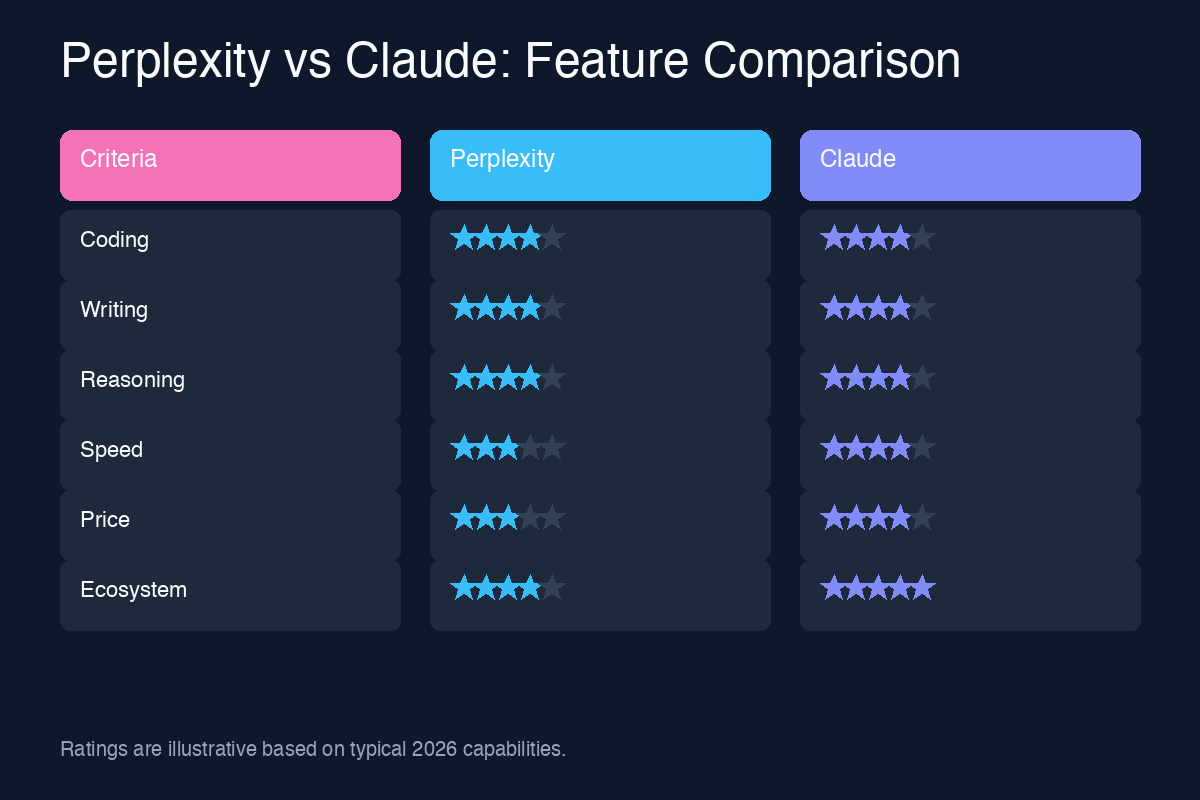
Quick Comparison Table
| Feature | Perplexity | Claude | Best For |
|---|---|---|---|
| Core design | Search-first answer engine | Conversational reasoning AI | Perplexity for lookup, Claude for dialogue |
| Live web access | Yes, native and real-time | No native live search; relies on knowledge cutoff and tool integrations | Perplexity for current events |
| Citations | Inline source links with every answer | Limited; no automatic citations unless plugins or retrieval are used | Perplexity for verified research |
| Context window | Moderate; optimized for query plus web results | Very large; supports hundreds of thousands of tokens and long documents | Claude for books, legal docs, codebases |
| Writing quality | Good for factual summaries and source-based drafts | Excellent for tone, structure, storytelling, and iterative editing | Claude for creative and long-form writing |
| Coding | Useful for finding snippets and explanations | Strong code generation, debugging, architecture, and terminal reasoning | Claude for software development |
| Reasoning | Factual synthesis across sources | Extended thinking, multi-step logic, math, and structured problem solving | Claude for hard reasoning tasks |
| Deep research mode | Built-in multi-step research with follow-ups | Available via Projects, long context, and extended thinking features | Perplexity for fast research; Claude for deep analysis |
| Privacy focus | Enterprise options with data controls | Anthropic emphasizes safety and responsible AI; enterprise controls available | Both for enterprise teams |
| Free tier | Limited searches per day | Limited messages and model access | Both for light usage |
| Premium plans | Perplexity Pro and Enterprise | Claude Pro, Team, and Enterprise | Depends on usage volume |
What Is Perplexity?
Perplexity is an AI-powered answer engine launched with a simple promise: give users direct answers to complex questions with sources attached. Instead of returning a list of links like a traditional search engine, Perplexity reads the web, summarizes what it finds, and presents a concise response with inline citations. You can click any citation to verify the original source.
By 2026, Perplexity has evolved from a neat search wrapper into a full research assistant. It offers multiple search modes, including quick answers, pro searches that run more thorough queries, and deep research features that conduct multi-step investigations. It also exposes its own search models under the Sonar family, allowing developers to build retrieval-augmented applications on top of Perplexity’s index.
The defining characteristic of Perplexity is transparency through citations. Every claim is tied to a source. That makes it especially valuable in academic, journalistic, legal, and enterprise settings where trust and verifiability matter as much as speed.
Perplexity strengths
- Real-time web search: Perplexity queries live sources, so its answers can include information that post-dates the training data of most foundation models.
- Inline citations: Each sentence or paragraph can be traced back to a webpage, paper, or document.
- Conversational follow-ups: You can ask clarifying questions and Perplexity retains context across a thread.
- Source filtering: You can restrict searches to academic papers, Reddit, YouTube, news sites, or your own uploaded files.
- Collections and organization: Save threads, share them, and build reusable research libraries.
- Developer access: The Sonar API lets applications consume Perplexity search and citation infrastructure programmatically.
What Is Claude?
Claude is Anthropic’s family of large language models designed to be helpful, harmless, and honest. It is best understood as a conversational reasoning engine. Rather than fetching live web pages, Claude relies on an enormous internal knowledge base and an industry-leading context window to read, understand, and reason over long documents, codebases, and conversations.
By mid-2026, Claude is available in multiple model tiers, typically including a lightweight instant model, a balanced workhorse model, and a powerful reasoning model for complex tasks. Anthropic has emphasized AI safety, constitutional AI, and long-context performance. For users who need to upload a hundred pages of contracts, analyze a codebase, or co-author a long report, Claude is often the first choice.
Claude does not search the live web by default. Its knowledge has a cutoff, and it will tell you when it does not know something. However, it can be paired with retrieval tools, browser integrations, or knowledge bases to fill that gap. Where Claude shines is everything that happens after retrieval: interpretation, synthesis, writing, coding, reasoning, and judgment.
Claude strengths
- Massive context window: Claude can process very long documents, multi-file codebases, and extended conversations in one shot.
- Advanced reasoning: Extended thinking modes let Claude work through complex logic, math, and strategy problems step by step.
- Writing and editing: Claude produces natural, nuanced prose and adapts tone, format, and structure on request.
- Coding and terminal tasks: It generates, debugs, explains, and refactors code across languages and frameworks.
- Artifacts and projects: Claude can create reusable documents, code files, and project workspaces.
- Safety and steerability: Anthropic’s focus on constitutional AI and user control makes Claude easier to align with specific instructions.
Search and Citations
Search is the clearest differentiator between Perplexity and Claude. Perplexity is built around search. Every query is an opportunity to gather fresh information from the web, academic databases, or user-uploaded files. The model then synthesizes the gathered material and appends citations so you can verify every claim.
This citation-first approach changes how you use the tool. You can ask Perplexity for breaking news, stock prices, sports scores, product launches, recent scientific papers, or legal developments and receive an answer grounded in current sources. Because the model is constrained by what it retrieved, hallucination risk is lower for factual questions. If the source is wrong, you can see exactly where the information came from and correct it.
Claude, in contrast, answers from its training knowledge. It does not browse the live web unless connected to a tool or integration. When you ask Claude about a current event beyond its knowledge cutoff, it will either decline or give you outdated information. That limitation is important but not fatal. For many tasks, you do not need live search. You need interpretation, synthesis, and creativity over material you already have.
When citations are required, Claude users typically pair the model with a retrieval system or manually paste source text into the prompt. Claude can then summarize, compare, and quote the material. The difference is workflow. Perplexity automates retrieval and citation. Claude expects you to bring the sources or connect a retrieval pipeline.
When Perplexity wins on search
- Finding the latest news, trends, or product updates.
- Verifying claims with primary sources.
- Compiling competitive intelligence from public websites.
- Researching academic topics with arXiv or PubMed filters.
- Exploring niche communities such as Reddit or specialized forums.
When Claude wins on search
- You already have the documents and need deep analysis.
- You want to compare internal reports, contracts, or research notes.
- You need to extract insights from a large codebase or PDF archive.
- You prefer a single conversational thread over multiple search tabs.
Research Workflows
Research is more than search. It is the process of asking the right questions, gathering evidence, organizing findings, and synthesizing conclusions. Perplexity and Claude approach research differently because they are built on different assumptions about where the work happens.
Perplexity treats research as a retrieval and synthesis loop. You ask a question, the engine gathers sources, and you follow up with more specific queries. The Pro and deep research modes extend this by running multiple searches automatically, comparing results, and producing a structured report with citations. This is ideal for early-stage research when you are exploring a topic and want a fast, sourced overview.
Claude treats research as a reasoning and writing loop. You feed it documents, data, or detailed prompts, and it helps you analyze, structure, and argue. Claude’s Projects feature lets you create persistent workspaces with uploaded files, instructions, and conversation history. This is ideal for mature research tasks where you already have a corpus and need to produce a final deliverable such as a white paper, strategy memo, or legal brief.
The two tools can complement each other. Many researchers use Perplexity to gather sources quickly, then paste the relevant findings into Claude for deeper synthesis and writing. Others use Chat-Sonic to run both in parallel and compare outputs instantly.
Perplexity research workflow
- Enter a research question.
- Review the synthesized answer and inline citations.
- Click sources to verify claims.
- Ask follow-up questions to drill deeper.
- Save the thread to a collection for future reference.
- Export or share the final summary.
Claude research workflow
- Create a Project or open a long conversation.
- Upload documents, code, or data files.
- Ask Claude to summarize, compare, or extract themes.
- Iterate on structure, argument, and tone.
- Use extended thinking for hard analytical questions.
- Export the final artifact as a document or code.
Writing and Content Creation
For writers, marketers, and content teams, Claude is usually the stronger default. Its prose is natural, its grasp of tone is sophisticated, and it handles long-form documents without losing coherence. You can ask Claude to draft a blog post in the style of a specific publication, rewrite a landing page for a different audience, or turn bullet points into a polished report. Because Claude maintains context across a long conversation, it can iterate on a draft many times while preserving voice and structure.
Perplexity can write too, but its writing is more factual and source-driven. It is excellent at turning a set of web sources into a concise summary or a draft that cites its claims. If your goal is to produce a research brief, a fact-checked article, or a literature review, Perplexity reduces the time spent on sourcing. If your goal is to produce persuasive, creative, or brand-aligned content, Claude is the better partner.
By 2026, both tools support file uploads and can reference uploaded content. Claude still leads on total context capacity and stylistic control. Perplexity still leads on real-time facts and citations. The choice depends on whether the blank page problem is harder for you, or the source verification problem is harder.
Writing tasks that favor Claude
- Long-form blog posts, essays, and reports.
- Brand copy, email sequences, and landing pages.
- Fiction, scripts, and creative experimentation.
- Iterative editing and style refinement.
- Translating technical content for non-technical audiences.
Writing tasks that favor Perplexity
- News summaries and current event briefs.
- Research-backed articles with inline citations.
- Product comparisons based on recent reviews.
- FAQ generation from official sources.
- Literature reviews with links to papers.
Coding and Technical Tasks
Developers and technical users consistently rank Claude among the best coding assistants available. Claude can read entire repositories, understand APIs, write tests, debug errors, and explain trade-offs. Its large context window means you can paste multiple files, stack traces, or documentation pages into a single prompt and ask Claude to reason across them. Anthropic has also introduced features for extended thinking and tool use that make Claude effective for architecture decisions and multi-step debugging.
Perplexity is useful for coding in a different way. It helps you discover libraries, find code snippets, read documentation, and understand error messages by searching the web. If you encounter a bug in a recently released framework, Perplexity can retrieve the latest GitHub issues, Stack Overflow threads, and release notes. The answer comes with sources, so you can see whether a fix is official or community-suggested.
In short, Claude is the pair programmer. Perplexity is the technical researcher. For a complete workflow, use Perplexity to find the latest information, then use Claude to implement, refactor, and explain the code.
Coding tasks that favor Claude
- Writing complete features or modules from scratch.
- Refactoring large codebases with many files.
- Debugging complex errors with long logs.
- Explaining design patterns and trade-offs.
- Generating tests, documentation, and deployment configs.
Coding tasks that favor Perplexity
- Finding the latest library documentation or API changes.
- Searching for solutions to newly reported bugs.
- Comparing frameworks or tools with recent reviews.
- Learning a new language or platform with sourced examples.
- Checking release notes and migration guides.
Reasoning and Problem Solving
Reasoning is where Claude traditionally separates itself from search-first tools. Claude can perform multi-step logical analysis, evaluate arguments, solve math problems, and think through strategic decisions. Extended thinking modes allow Claude to spend more compute on difficult problems, showing its work or at least producing more reliable conclusions.
Perplexity’s reasoning is more about cross-source synthesis. It retrieves multiple perspectives, weighs them, and presents a balanced answer. This is a form of reasoning, but it is reasoning over retrieved evidence rather than reasoning from first principles. For questions where the answer is disputed or evolving, Perplexity’s ability to show multiple sources is a strength. For questions that require deep logical deduction, mathematical proof, or strategic planning, Claude is usually stronger.
The best approach is to match the reasoning type to the tool. Use Perplexity when the problem is what do people know and say about this? Use Claude when the problem is given these constraints, what is the best decision?
Reasoning tasks that favor Claude
- Mathematical proofs and quantitative analysis.
- Strategic planning and scenario modeling.
- Legal argument evaluation and contract risk analysis.
- Algorithm design and system architecture.
- Ethical reasoning and policy analysis.
Reasoning tasks that favor Perplexity
- Fact-checking conflicting claims.
- Compiling expert opinions on emerging topics.
- Tracking how a narrative or market sentiment is evolving.
- Summarizing public debates with citations.
- Building evidence maps for research questions.
Pricing and Models
Both Perplexity and Claude operate on freemium models, but the value proposition differs. Perplexity’s free tier gives you a limited number of searches per day and access to a standard answer model. Upgrading to Perplexity Pro unlocks more searches, more powerful underlying models, deeper research, file upload limits, and API access through Sonar.
Claude’s free tier gives you limited messages and access to a subset of models. Claude Pro increases usage limits and adds access to more capable models. Claude Team and Enterprise add collaboration features, admin controls, and priority support. Pricing varies by region and updates over time, so check the official Anthropic website for current rates.
When comparing cost, think in terms of tasks, not tokens. If your daily work involves dozens of factual lookups, Perplexity Pro may pay for itself quickly. If your work involves long documents, coding sessions, or content creation, Claude Pro or Team may deliver more value. For users who need both, an aggregator like Chat-Sonic can simplify budgeting by letting you pay for one platform while accessing multiple models.
Perplexity typical tiers
- Free: Limited daily searches, standard sources, core answer engine.
- Pro: Higher search limits, advanced models, deep research, file uploads, and Sonar API credits.
- Enterprise: Team collaboration, enhanced security, admin controls, and usage analytics.
Claude typical tiers
- Free: Limited messages, access to standard models, basic conversation features.
- Pro: Higher message limits, priority access to newer models, extended thinking, and larger context.
- Team: Shared workspaces, billing management, and collaboration tools.
- Enterprise: Advanced security, SSO, audit logs, and dedicated support.
When to Use Perplexity
Perplexity is the right choice when speed and verifiability matter more than creative depth. It is the tool you open when you need an answer now and you want to know where that answer came from. Journalists use it to verify breaking news. Investors use it to track market movements. Students use it to find papers. Product managers use it to research competitors. Developers use it to find the latest documentation.
Any workflow that begins with I need to know what is true about X today is a Perplexity workflow. The inline citations mean you can move from question to verified insight quickly, without opening twenty browser tabs.
When to Use Claude
Claude is the right choice when the task requires interpretation, creativity, or deep analysis. It is the tool you open when you have a pile of material and need to turn it into something new. Authors use it to draft chapters. Lawyers use it to summarize cases. Engineers use it to debug systems. Strategists use it to model scenarios. Founders use it to refine pitch decks.
Any workflow that begins with Help me think through this or Turn this into a polished deliverable is a Claude workflow. The long context and reasoning capabilities make it feel like a knowledgeable collaborator rather than a search box.
Access Perplexity and Claude Together on Chat-Sonic
You do not have to choose one tool and abandon the other. Chat-Sonic is an AI model aggregator that brings Perplexity, Claude, and other leading models into a single chat interface. Instead of maintaining separate subscriptions, switching tabs, and copying prompts, you can route each question to the model best suited for it.
Chat-Sonic makes the Perplexity vs Claude debate practical. Start a research question with Perplexity to get cited, up-to-date sources. Then hand the same thread to Claude to summarize, analyze, or rewrite the findings into a long-form document. Compare answers side by side to see which model produces the more useful result. Save your favorite prompts and workflows so your team can reuse them.
For teams, Chat-Sonic simplifies license management, security, and cost tracking. You get unified billing, role-based access, and the ability to switch models as your needs evolve. As new versions of Perplexity and Claude are released, they are added to the platform, so you are never locked into a single provider.
The real advantage is not just convenience. It is model routing intelligence. Perplexity queries belong to Perplexity. Writing and coding tasks belong to Claude. Comparison and fallback tasks belong to whichever model performs best. Chat-Sonic lets you make those assignments in one place, turning two powerful but different tools into a single, flexible AI workforce.
Final Verdict
Perplexity and Claude are not direct competitors. They are complementary AI systems with different strengths.
Choose Perplexity if your priority is real-time information, source citations, and fast research. It is the best answer engine for questions about current events, products, papers, and public knowledge.
Choose Claude if your priority is reasoning, writing, coding, and long-context analysis. It is the best conversational AI for turning information into insight and insight into deliverables.
Choose both if you want a complete AI workflow. Use Perplexity to gather and verify facts, then use Claude to analyze, write, and build. On Chat-Sonic, that workflow lives in one interface, giving you the speed of Perplexity and the depth of Claude without the friction of switching tools.
Conclusion
The Perplexity vs Claude comparison in 2026 comes down to a simple principle: match the model to the task. Perplexity dominates retrieval, citations, and current research. Claude dominates conversation, reasoning, writing, and coding. Both are excellent. Neither is perfect for everything.
Smart users do not force one tool to do the other’s job. They build workflows that use Perplexity for what Perplexity does best and Claude for what Claude does best. With Chat-Sonic, building that workflow is easier than ever. Sign up, connect your account, and start routing your questions to the right AI from day one.