

Perplexity vs ChatGPT: Search-First AI vs Conversational AI in 2026
By 2026, artificial intelligence has moved far beyond novelty. For professionals, students, developers, and marketers, AI is now the default starting point for research, writing, coding, and decision-making. Two tools dominate very different corners of that workflow: Perplexity, the search-first answer engine built for factual discovery, and ChatGPT, the conversational assistant that helped popularize generative AI.
Choosing between Perplexity vs ChatGPT is not a question of which tool is "smarter." It is a question of what you are trying to accomplish. Do you need up-to-the-minute citations for a report? Perplexity is engineered for that. Do you need a flexible partner to brainstorm copy, debug Python, or simulate a customer interview? ChatGPT still leads on depth and versatility.
In this Model Guide, we compare Perplexity vs ChatGPT across search accuracy, citations, research workflows, writing, coding, pricing, and the underlying models each platform uses in 2026. We will also explain how Chat-Sonic merges the best of both approaches by combining ChatGPT-level conversation with live web search and source citations, so you do not have to choose.
Key Takeaways
- Perplexity is a search engine with an AI brain. It reads the web in real time and returns concise, cited answers, making it ideal for research and fact-checking.
- ChatGPT is a general-purpose conversational AI. It excels at writing, coding, analysis, brainstorming, and long-form content creation.
- Citations are Perplexity's signature. Every answer links to sources, which is essential for academic, professional, and publishing workflows.
- ChatGPT offers deeper reasoning. Its longer context windows, custom instructions, and memory make it better for complex projects.
- Pricing differs by value. Perplexity's Pro plan is cheaper and search-centric. ChatGPT Plus/Pro is more expensive but unlocks stronger models, image generation, voice, and advanced data analysis.
- Models matter. Perplexity uses models from OpenAI and Anthropic behind the scenes. ChatGPT runs OpenAI's latest GPT series natively.
- You can combine both on Chat-Sonic. Chat-Sonic gives you access to ChatGPT plus real-time web search, citations, and multiple models including GPT-4, Claude, Gemini, Grok, and DeepSeek in one aggregator.
What Is Perplexity AI?
Perplexity AI launched as an "answer engine" rather than a chatbot. Its mission is simple: take a question, search the open web, synthesize the results, and present a concise response with inline citations. In 2026, Perplexity has expanded into a full research workspace with features like Perplexity Pages, Pro Search, file uploads, and focused search modes including Academic, Reddit, YouTube, and Social.
Core Features of Perplexity
- Real-time web search: Queries are not answered from a static training cutoff. Perplexity retrieves current pages, news, and databases before generating a response.
- Inline citations: Every significant claim is footnoted with a numbered link to the original source. You can click through and verify information instantly.
- Copilot / Pro Search: The paid tier can ask clarifying questions, run multi-step searches, and reason through complex queries using advanced models.
- Perplexity Pages: Users can turn research threads into shareable, formatted articles with embedded sources and visuals.
- Focus modes: Narrow searches to academic papers, discussion forums, videos, or the broader web.
- Mobile and browser integration: Perplexity is available on iOS, Android, and as a browser extension, with voice input and quick summaries.
Who Should Use Perplexity?
Perplexity is best for users who prioritize accuracy and attribution over creative flair. Journalists verifying facts, students writing literature reviews, analysts tracking market trends, and consultants compiling briefs all benefit from its search-first architecture. If your first question is "What does the latest source say?" Perplexity is designed for you.
What Is ChatGPT?
ChatGPT is OpenAI's flagship conversational AI. Built on the Generative Pre-trained Transformer architecture, it is designed to hold context, follow nuanced instructions, generate creative content, and assist with tasks ranging from email drafting to software engineering. In 2026, ChatGPT is available in multiple tiers and includes web browsing, code execution, image generation, voice conversations, and custom GPTs.
Core Features of ChatGPT
- Conversational memory: ChatGPT can remember instructions, project context, and preferences across long sessions, making it feel like a collaborative partner.
- Long context windows: Premium models support very large context lengths, allowing users to paste entire reports, codebases, or transcripts for analysis.
- Creative and analytical writing: From blog posts to legal briefs, ChatGPT can adapt tone, structure, and complexity for any audience.
- Code generation and debugging: It can write, explain, refactor, and debug code in dozens of languages and frameworks.
- Multimodal capabilities: ChatGPT can process images, generate images with DALL·E, analyze spreadsheets, and hold voice conversations.
- Custom GPTs: Users can build tailored agents with specific instructions, knowledge files, and tool access.
Who Should Use ChatGPT?
ChatGPT is the right choice for anyone who needs a flexible, all-purpose assistant. Content marketers, software developers, product managers, educators, and entrepreneurs use it for brainstorming, drafting, coding, tutoring, and automation. If your work benefits from iteration, creativity, and extended context, ChatGPT is hard to beat.
Perplexity vs ChatGPT: Head-to-Head Comparison Table
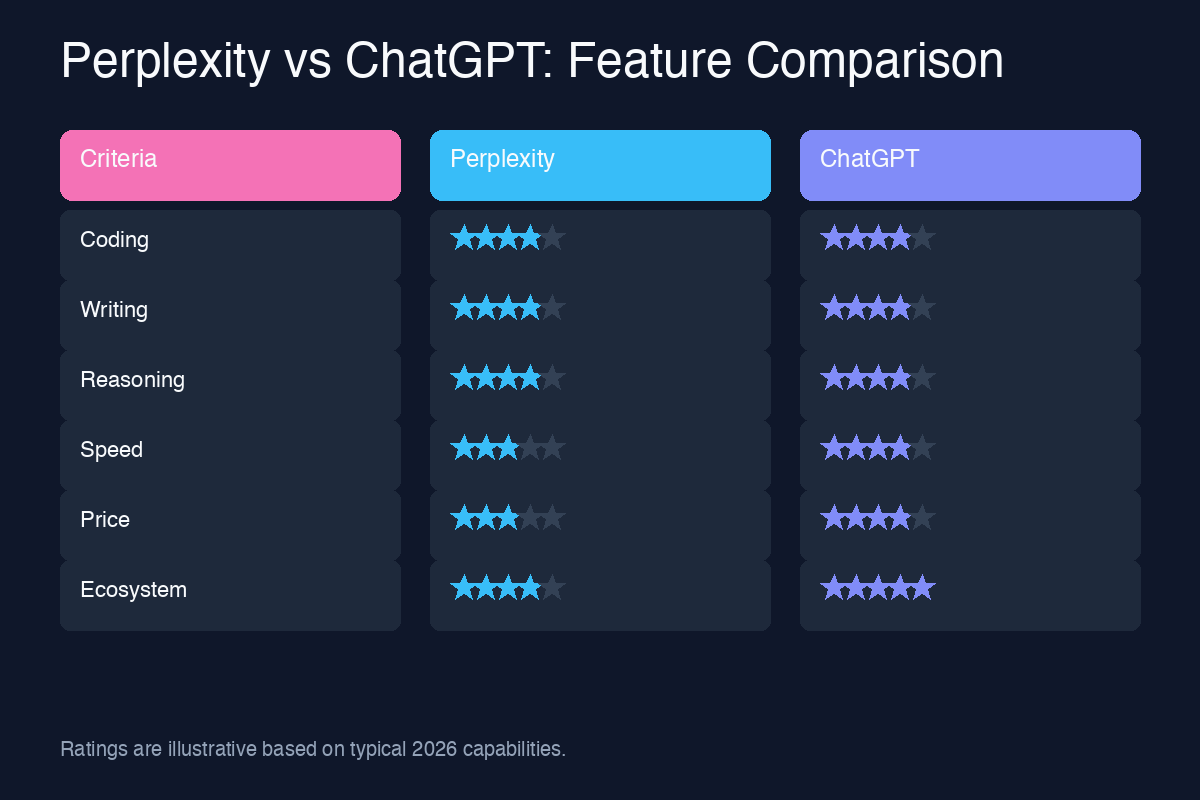
| Feature | Perplexity | ChatGPT |
|---|---|---|
| Primary strength | Real-time search with cited answers | Conversational reasoning, writing, and coding |
| Web access | Built in by default; search is core | Available in Plus/Pro via web browsing tool |
| Citations | Inline, numbered links for every answer | Browsing responses include source links; not always cited inline |
| Source transparency | High; source list always visible | Moderate; depends on the tool being used |
| Answer style | Concise, summary-first, factual | Conversational, detailed, adaptable to tone |
| Research workflows | Excellent for discovery, briefs, and verification | Excellent for synthesis, analysis, and ideation |
| Writing quality | Good for factual summaries and reports | Excellent for creative, persuasive, and long-form writing |
| Coding support | Helpful for code explanations and documentation lookup | Advanced generation, debugging, refactoring, and architecture |
| Reasoning depth | Strong with Pro Search; optimized for search synthesis | Very strong with latest GPT models and extended thinking |
| Multimodality | Text and image search; limited generation | Text, image generation, image analysis, voice, file upload |
| Memory and personalization | Limited personalization across sessions | Robust custom instructions, memory, and project context |
| Pricing (2026) | Free tier; Pro around $20/month | Free tier; Plus ~$20/month; Pro ~$200/month |
| Underlying models | OpenAI GPT, Anthropic Claude, plus custom retrieval stack | OpenAI GPT-4 series, o-series reasoning models |
Search Accuracy and Real-Time Information
Search is the most important differentiator in the Perplexity vs ChatGPT debate. Perplexity was built from the ground up to retrieve fresh information. When you type a query, Perplexity does not immediately generate an answer from memory. It first queries its search index, evaluates the top results, and then composes a response grounded in what it found.
How Perplexity Handles Search
Perplexity uses a retrieval-augmented generation pipeline. The system sends your question to multiple search providers, ranks sources by relevance and authority, extracts key passages, and feeds those passages into a large language model. The model is instructed to summarize the evidence rather than invent facts. Because the sources are attached as numbered citations, you can verify every claim.
For breaking news, stock prices, product releases, policy changes, or scientific preprints, Perplexity generally returns more current and verifiable answers than a standalone language model. Pro Search adds the ability to ask follow-up clarification questions and perform multi-step searches, which is useful for ambiguous or layered queries.
How ChatGPT Handles Search
ChatGPT, historically, answered from a fixed training cutoff. In recent versions, OpenAI added a web browsing tool that allows the model to search the internet when needed. When browsing is enabled, ChatGPT can retrieve current pages and cite them in its response. However, the experience is not as tightly integrated as Perplexity's. Browsing may be slower, source formatting is less consistent, and the model sometimes forgets to browse when it should.
For many queries, ChatGPT does not need the web. Its internal knowledge is sufficient for explaining concepts, generating ideas, or rewriting content. But if your task depends on facts that change daily or weekly, you need to be deliberate about enabling and verifying web access.
Verdict on search accuracy: Perplexity wins on immediacy, citation consistency, and source transparency. ChatGPT wins when search is only one part of a larger, context-heavy conversation.
Citations and Source Transparency
Citations are not a minor feature. They determine whether an AI answer can be trusted in professional, academic, or publishing contexts. Perplexity makes citations central to the product. Every answer includes numbered references, and the sources are displayed prominently. You can click a citation to open the original page, check the date, and assess authority.
ChatGPT's browsing mode can include source links, but the format varies. Sometimes sources appear as footnotes; sometimes they are embedded as hyperlinks. In non-browsing responses, ChatGPT provides no citations at all, which forces users to manually fact-check.
If your workflow requires defendable sourcing, Perplexity is the safer default. If you are producing first drafts, internal notes, or creative concepts where attribution is less critical, ChatGPT is faster and more fluid.
Research Workflows
Research is where the two tools show the clearest philosophical split. Perplexity treats research as a directed search process. ChatGPT treats research as a thinking partner that can help you refine questions and synthesize what you already know.
Using Perplexity for Research
A typical Perplexity workflow starts with a focused question. The user receives a concise answer with citations, clicks into the strongest sources, and then asks follow-up questions to drill deeper. Perplexity Pages lets you turn that thread into a polished document with headers, images, and a bibliography. This is ideal for literature reviews, competitive intelligence, market briefs, and journalism.
The academic focus mode is particularly valuable for students and scientists. It restricts sources to peer-reviewed papers and preprints, reducing the noise from marketing blogs and forums. The Reddit and YouTube focus modes help when you need human opinions, tutorials, or community sentiment.
Using ChatGPT for Research
ChatGPT excels at the earlier and later stages of research. In the beginning, it can help you brainstorm research questions, build frameworks, and identify variables you had not considered. In the middle, you can paste articles, data sets, or interview transcripts and ask it to compare arguments, find gaps, or generate themes. At the end, it can help you write, format, and rewrite your findings for different audiences.
ChatGPT's memory and custom instructions also allow you to build persistent research assistants. For example, you can configure a custom GPT with your style guide, preferred citation format, and project background so that every response is pre-aligned with your goals.
Verdict on research: Use Perplexity when you need to discover and verify external facts quickly. Use ChatGPT when you need to synthesize, analyze, and communicate complex ideas.
Writing and Content Creation
Writing is ChatGPT's home turf. Its training emphasizes fluency, tone control, rhetorical structure, and creativity. You can ask ChatGPT to write a LinkedIn post in the voice of a seasoned executive, draft a product landing page, generate email sequences, or rewrite technical documentation for non-experts. It remembers your brand voice, follows style guides, and can iterate through many drafts without losing context.
Perplexity can write, but its writing is usually summary-driven. It is good at producing factual paragraphs, executive briefs, and outlines based on sources. It is less effective at persuasion, storytelling, humor, or highly branded content. If you ask Perplexity to write a blog post, it will often give you a well-organized but dry article that reads like a research summary.
For content marketers, copywriters, and authors, ChatGPT remains the stronger tool. For journalists and analysts who need source-backed summaries, Perplexity is more appropriate. Many professionals use both: Perplexity to gather verified facts, ChatGPT to turn those facts into compelling prose.
Coding and Technical Tasks
ChatGPT is widely used as a coding assistant. It can generate functions, write unit tests, explain algorithms, translate between languages, debug error messages, and review pull requests. With its long context window, it can ingest multiple files and suggest architectural changes. The latest reasoning models can even work through complex debugging steps methodically.
Perplexity is useful for coding in a different way. Because it searches the web, it can retrieve the latest documentation, library versions, Stack Overflow threads, and GitHub issues. If you are struggling with a new API or an obscure error, Perplexity may surface more current answers than ChatGPT's training memory. It is also good for explaining why a particular approach is recommended based on community discussion.
However, Perplexity is not designed for iterative code generation. It will not hold a 5,000-line codebase in context or help you refactor across files. For serious software engineering, ChatGPT or a dedicated coding tool is preferable. For documentation lookups, error research, and quick explanations, Perplexity is a strong complement.
Pricing and Models Used in 2026
Both platforms offer free tiers, but the paid experiences diverge significantly. Understanding what you are paying for helps determine which tool delivers the better return on investment.
Perplexity Pricing
- Free: Unlimited basic searches with standard models and ads in some contexts.
- Pro: Approximately $20 per month. Unlocks Pro Search, more daily searches, access to more powerful underlying models, file upload analysis, and API access.
- Enterprise / Teams: Per-seat plans with admin controls, higher usage limits, and security features.
Perplexity's value proposition is straightforward: pay for better search, deeper reasoning, and more sources. It is one of the most affordable ways to access top-tier models behind a search interface.
ChatGPT Pricing
- Free: Access to a capable base model with limited messages, no browsing in some regions, and restricted peak-time availability.
- Plus: Approximately $20 per month. Includes access to the latest GPT-4 class models, browsing, code interpreter, image generation, voice, higher message limits, and custom GPTs.
- Pro: Approximately $200 per month. Unlocks the most powerful models, extended thinking, very high usage limits, and priority access to new features.
- Team / Enterprise: Per-seat plans with shared workspaces, admin dashboards, and data retention controls.
ChatGPT's higher tiers are significantly more expensive than Perplexity's, but they offer a broader set of capabilities including multimodal generation, deep reasoning, and extensive context.
Models Under the Hood
Perplexity does not train its own foundational model from scratch for consumer use. Instead, it routes queries to leading models such as OpenAI's GPT-4 series and Anthropic's Claude models, combined with its proprietary retrieval, ranking, and citation layer. This means the quality of a Perplexity answer depends both on the model chosen and the quality of the sources retrieved.
ChatGPT runs OpenAI's own models natively, including GPT-4 class models and specialized reasoning models in the o-series. These models are optimized for conversation, instruction following, and long-context coherence. Because OpenAI controls the entire stack, ChatGPT can integrate tools such as browsing, code execution, and image generation more tightly.
Perplexity vs ChatGPT: When to Use Which
The simplest way to decide is to match the tool to the task. Here is a practical guide.
Choose Perplexity when you need to:
- Verify facts for a news article, essay, or report.
- Find the latest data, prices, announcements, or research.
- Compile a cited brief or executive summary.
- Explore academic papers or community discussions.
- Answer a specific question where source authority matters.
Choose ChatGPT when you need to:
- Draft long-form content, emails, proposals, or scripts.
- Brainstorm ideas, frameworks, or campaign concepts.
- Write, debug, refactor, or explain code.
- Analyze long documents, spreadsheets, or transcripts.
- Build a persistent assistant with custom instructions and memory.
Many power users keep both open. They use Perplexity as a real-time research layer and ChatGPT as a thinking and writing layer. The real efficiency gain comes from routing each query to the right brain.
How Chat-Sonic Combines ChatGPT with Real-Time Web Search
The Perplexity vs ChatGPT debate assumes you have to pick one. Chat-Sonic rejects that premise. As an AI model aggregator, Chat-Sonic gives users access to GPT-4, Claude, Gemini, Grok, DeepSeek, and more from a single interface. More importantly, it layers real-time web search and citations on top of conversational AI, so you get the depth of ChatGPT plus the factual grounding of Perplexity.
On Chat-Sonic, you can start a conversation with a powerful model like GPT-4, ask it to research a topic live, and receive answers with source citations. You can compare how different models answer the same question, switch between search-first and reasoning-first modes, and continue the conversation with full context. This means you do not need to copy facts from Perplexity into ChatGPT or lose citations when you move from research to writing.
For agencies, marketing teams, developers, and researchers, this aggregation removes the subscription juggling. Instead of paying for Perplexity Pro, ChatGPT Plus, Claude Pro, and Gemini Advanced separately, you can centralize your AI workflow in one platform. You also gain the ability to choose the best model for each task rather than forcing every task into a single tool's strengths and weaknesses.
If your ideal workflow is "ChatGPT for conversation and creativity, plus Perplexity for live search and citations," Chat-Sonic is built to deliver exactly that combination.
Final Verdict
Perplexity and ChatGPT are both outstanding AI tools, but they optimize for different outcomes. Perplexity is the better answer engine. It is faster at finding current information, more transparent about sources, and more disciplined about factual claims. ChatGPT is the better creative and analytical partner. It writes better, reasons deeper, codes more effectively, and adapts to your personal style over time.
In 2026, the smartest approach is not to choose one but to understand when each shines. Build a workflow where Perplexity handles discovery and verification, and ChatGPT handles synthesis, writing, and execution. If you prefer an integrated experience, platforms like Chat-Sonic bring both capabilities together with access to multiple top models under one roof.
Whatever you choose, the goal is the same: let AI handle information retrieval and first-draft thinking so you can focus on judgment, strategy, and human creativity.
Frequently Asked Questions
Is Perplexity better than ChatGPT?
Perplexity is better for real-time search and cited answers. ChatGPT is better for conversation, writing, coding, and complex reasoning. The best choice depends on your task.
Can ChatGPT search the web like Perplexity?
Yes, ChatGPT includes web browsing in paid tiers, but the experience is less integrated and less consistently cited than Perplexity's search-first design.
Does Perplexity use ChatGPT?
Perplexity uses models from OpenAI and Anthropic, which may include GPT-family models similar to those powering ChatGPT. However, Perplexity adds its own retrieval, ranking, and citation systems.
Which is better for students: Perplexity or ChatGPT?
Students often benefit from both. Perplexity is excellent for research and citations. ChatGPT is excellent for explaining concepts, drafting essays, and brainstorming.
What is the best alternative that combines both?
Chat-Sonic combines conversational AI with real-time web search and citations, giving you access to GPT-4, Claude, Gemini, Grok, DeepSeek, and other models in one platform.