

OpenCode vs Claude Code: Open Source vs Anthropic Coding Agent 2026
AI coding agents have become essential infrastructure for modern software teams. What started as autocomplete suggestions has evolved into terminal-native agents that read entire codebases, plan multi-file changes, run tests, and even open pull requests. In 2026, two tools sit at opposite ends of this spectrum: OpenCode, the community-built, model-agnostic open-source agent, and Claude Code, Anthropic's polished, proprietary terminal agent powered by Claude Sonnet and Opus.
If you are weighing open-source flexibility against a first-party vendor experience, this guide is for you. We compare OpenCode and Claude Code across every dimension that matters for professional developers: open-source vs proprietary architecture, code generation quality, debugging power, agentic workflows, IDE support, privacy, pricing, community, and enterprise readiness. We also explain how Chat-Sonic lets you access Claude, OpenCode-compatible models, and dozens of other AI providers from a single aggregator, so you can test both philosophies without juggling multiple subscriptions.
By the end of this article, you will know which tool fits your stack, your budget, your compliance requirements, and your preferred way of working.
Key Takeaways
- OpenCode is a fully open-source, terminal-native AI coding agent built in Go by the SST team. It supports 75+ model providers, including Anthropic Claude, OpenAI GPT, Google Gemini, DeepSeek, and local models through Ollama.
- Claude Code is Anthropic's official terminal-first coding agent. It runs on Claude Sonnet 4.6 and Opus 4.7, with native VS Code, JetBrains, and web interfaces, plus enterprise support from Anthropic.
- OpenCode wins on model choice, vendor independence, air-gapped deployment, and cost transparency. You bring your own keys and can switch models with a config change.
- Claude Code wins on out-of-the-box reasoning quality, first-party IDE integration, enterprise compliance certifications, and seamless Anthropic model optimization.
- OpenCode is ideal for privacy-sensitive teams, open-source contributors, multi-model power users, and organizations that want to avoid vendor lock-in.
- Claude Code is ideal for developers who want a polished terminal agent with deep Claude reasoning, official support, and managed billing.
- Both tools support MCP servers, multi-file editing, shell execution, git workflows, and persistent project context.
- Chat-Sonic aggregates Claude, GPT, Gemini, DeepSeek, and many other models, letting you compare outputs and choose the best model for each coding task.
What Is OpenCode?
OpenCode is an open-source AI coding agent that launched publicly in 2025 and rapidly became one of the most popular alternatives to proprietary tools like Claude Code, Cursor, and GitHub Copilot. By mid-2026, it had crossed 160,000 GitHub stars and reached over 7.5 million monthly active developers, according to community reports. The project was originally built by the team behind Serverless Stack (SST), an established name in the serverless and cloud infrastructure community, and is maintained under the Anomaly Innovations umbrella.
The core pitch of OpenCode is simple: a model-agnostic, terminal-native coding agent that works with virtually any large language model you already have access to. Instead of locking you into a single provider's models and pricing, OpenCode connects to 75+ providers through a unified interface. You can route simple tasks to cheap models like DeepSeek or GLM, complex reasoning to Claude Sonnet or GPT-5.5, and even run entirely offline with local models through Ollama or LM Studio.
OpenCode runs as a TUI (Terminal User Interface), a desktop application, or an IDE extension. It ships with two primary agents:
- Build agent: The default agent with full tool access. It reads files, writes code, executes shell commands, runs tests, and completes multi-step engineering tasks.
- Plan agent: A read-only agent that analyzes your codebase and proposes changes without modifying anything. This is useful for safe exploration, code reviews, and architectural discussions.
One of OpenCode's most distinctive features is its LSP (Language Server Protocol) integration. While many AI coding agents treat code as plain text, OpenCode connects to real language servers for TypeScript, Python, Rust, Go, Java, C/C++, Swift, and 18+ other languages. This gives the model access to live type information, function signatures, import paths, and compiler diagnostics, enabling smarter self-correction during agentic tasks.
What Is Claude Code?
Claude Code is Anthropic's official coding agent, released in 2024 and matured significantly through 2025 and 2026. Unlike chatbots that merely suggest code, Claude Code is an agentic terminal tool that can read your codebase, plan changes, edit multiple files, run tests, execute shell commands, and even commit to git. It is powered by Anthropic's flagship coding models, primarily Claude Sonnet 4.6 and Claude Opus 4.7, with context windows up to 1 million tokens on Opus.
Claude Code is terminal-first but not terminal-only. In 2026, it is available as a CLI, a native VS Code extension, a JetBrains plugin for IntelliJ, PyCharm, WebStorm, and GoLand, a desktop application, and through the web at claude.ai/code. This multi-interface strategy makes it accessible to developers who prefer different workflows, though the terminal remains its spiritual home.
The agent loop in Claude Code follows a clear pattern: you describe a goal in natural language, Claude Code reads relevant files, reasons about the next step, calls the appropriate tool, observes the result, and repeats until the task is complete or it reaches a checkpoint requiring your approval. Permission gating ensures that destructive actions like shell execution or large-scale file edits require explicit confirmation.
Claude Code also supports CLAUDE.md, a project-level markdown file that stores persistent context about your stack, conventions, and preferences. This means every session starts with shared understanding rather than starting from zero, which is especially valuable for teams working on large or long-lived codebases.
OpenCode vs Claude Code: Side-by-Side Comparison
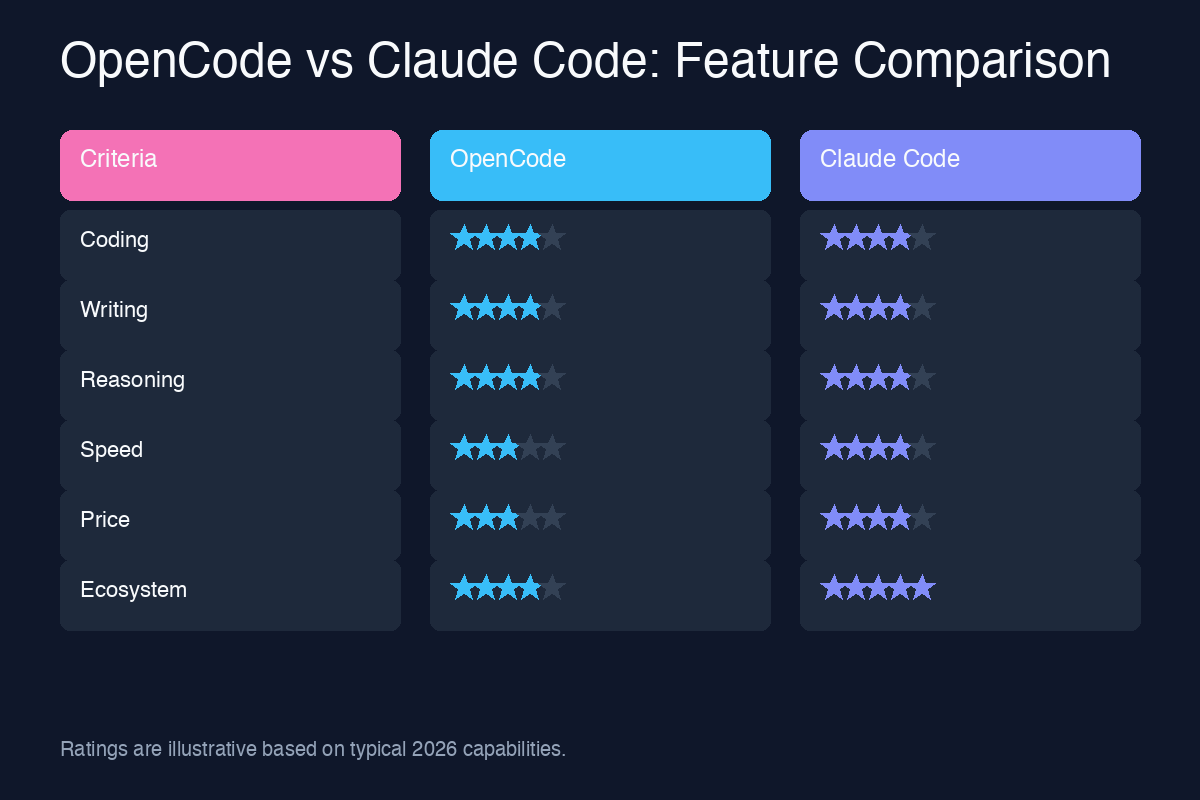
| Feature | OpenCode | Claude Code |
|---|---|---|
| License & Source | Open source (MIT), full source on GitHub | Proprietary, closed-source Anthropic product |
| Primary Interface | Terminal TUI, desktop app, IDE extension | Terminal CLI, VS Code, JetBrains, desktop, web |
| Model Support | 75+ providers: Claude, GPT, Gemini, DeepSeek, Grok, local models | Anthropic Claude Sonnet 4.6 and Opus 4.7 only |
| Context Window | Depends on chosen model | Up to 1 million tokens with Opus 4.7 |
| LSP Integration | Yes, native LSP for 20+ languages | Limited, relies on IDE plugins for rich language intelligence |
| Air-Gapped Mode | Yes, via Ollama or LM Studio with local models | No, requires Anthropic API or subscription |
| Agent Modes | Build and Plan agents, custom agents via Markdown config | Interactive agent loop, background agents, sub-agents |
| MCP Server Support | Yes, local and remote MCP servers with OAuth | Yes, deeply MCP-native with broad ecosystem support |
| Persistent Context | AGENTS.md generated via /init command | CLAUDE.md for project context and session resume |
| Pricing Model | Free software; pay only for model API usage | Subscription + token usage; API billed separately |
| Starting Cost | $0 for the tool; varies by provider | $20/month Pro, up to $200/month Max 20x |
| Privacy | No code storage, fully auditable, local-first | Anthropic data policy, no training on customer data |
| Enterprise Certifications | None; self-hosted and self-audited | SOC 2 Type II, HIPAA available via Enterprise |
| Commercial Support | Community-driven, no formal SLA | Anthropic enterprise support with SLAs |
| Best For | Model flexibility, compliance, cost control, vendor independence | Deep Claude reasoning, polished UX, enterprise procurement |
Open Source vs Proprietary: The Core Philosophical Divide
The biggest difference between OpenCode and Claude Code is not a feature. It is philosophy. OpenCode represents the open-source belief that AI coding infrastructure should be transparent, auditable, portable, and free from single-vendor control. Claude Code represents the proprietary belief that a tightly integrated, vendor-managed experience delivers better reasoning, reliability, and support.
OpenCode: Freedom and Flexibility
With OpenCode, you get the full source code under the MIT license. You can inspect how the agent loop works, modify behavior, self-host internally, fork the project, or contribute improvements back to the community. This matters for teams with strict procurement policies, security researchers, and developers who simply refuse to be locked into another SaaS subscription.
The model-agnostic design is the practical expression of this philosophy. You are not forced to use Claude. You are not forced to use GPT. You can mix providers based on price, quality, availability, or compliance. If Anthropic changes pricing tomorrow, you can switch to Gemini or DeepSeek in minutes. If a new frontier model ships, you can try it immediately. This optionality is itself a form of risk management in a market where AI tool pricing changes frequently.
Claude Code: Integration and Optimization
Claude Code is a closed-source product built by the same company that makes the models. That vertical integration has real advantages. Anthropic can optimize the agent loop, tool definitions, context retrieval, and prompt engineering specifically for Claude Sonnet and Opus. The result is a more polished experience out of the box, especially for complex reasoning tasks and large-codebase work.
You also get official support, predictable release cadence, enterprise compliance certifications, and a vendor relationship that procurement teams understand. For organizations that need SOC 2 Type II reports, HIPAA business associate agreements, or contracted SLAs, Claude Code is a much easier sell than an open-source project without formal certifications.
Which Philosophy Wins?
There is no universal winner. If you prioritize control, transparency, and portability, OpenCode is the clear choice. If you prioritize reasoning quality, vendor support, and enterprise readiness, Claude Code is the safer bet. Many experienced developers in 2026 actually use both: Claude Code for complex Anthropic-optimized tasks, and OpenCode for provider flexibility, compliance-limited environments, and cost-sensitive workflows.
Code Generation and Refactoring
Both OpenCode and Claude Code can generate code from natural language descriptions, edit multiple files, and refactor existing code. The difference lies in how they approach these tasks and which models power them.
OpenCode Code Generation
OpenCode's code generation quality depends heavily on the model you choose. With Claude Sonnet 4.6 connected, OpenCode can match Claude Code on many tasks because it is calling the same underlying model. With GPT-5.5, it can match or exceed Claude on certain benchmark tasks. With DeepSeek or local models, quality drops but cost drops dramatically.
The standout advantage is LSP integration. Because OpenCode reads type information, import paths, and compiler diagnostics from language servers, it generates code that is more likely to compile and integrate cleanly with your existing codebase. In some head-to-head tests, this LSP feedback loop has produced more thorough test coverage and fewer type errors compared to agents that treat the codebase as plain text.
However, OpenCode's agent loop is younger and less refined than Claude Code's. You may need to spend more time configuring prompts, choosing the right model, and reviewing output. The flexibility is powerful, but it comes with a steeper learning curve.
Claude Code Code Generation
Claude Code leverages Claude's strong reasoning abilities to handle complex, multi-step code generation tasks. It excels at understanding existing patterns across a large codebase, generating code that follows those patterns, and making coordinated changes across many files. The extended thinking mode available on Claude Sonnet gives it unusually strong performance on algorithmic problems and tricky system interactions.
Claude Code is particularly good at multi-file refactoring. Framework migrations, API surface changes, type-system overhauls, and large-scale renames are where the tool shines. The 1-million-token context window on Opus 4.7 allows it to hold entire modules or even medium-sized codebases in memory, which reduces the need for repeated context fetching.
The trade-off is that you are limited to Anthropic models. If your task happens to be something that GPT-5.5 or Gemini 2.5 Pro handles better, you cannot easily switch. You also pay Anthropic's prices, which can be higher than some competitors for comparable output quality.
Debugging and Error Correction
Debugging is where agentic coding tools prove their value or expose their limits. Both tools can read error output, trace failures, and suggest fixes, but they handle the debugging loop differently.
OpenCode Debugging
OpenCode's debugging strength comes from LSP diagnostics and multi-model routing. When a test fails or a type error appears, OpenCode can feed that diagnostic back to the model through the language server, often correcting the issue before surfacing it to you. This tight feedback loop is unique among major coding agents.
You can also route debugging tasks to the model best suited for them. Some developers use cheap models for initial error triage and reserve Claude or GPT for the hardest bugs. This keeps costs down while preserving quality where it matters.
The weakness is that OpenCode's debugging experience is less guided than Claude Code's. You may need to manually inspect diffs, approve shell commands, and manage the debugging workflow more actively. The tool gives you control, but it also gives you responsibility.
Claude Code Debugging
Claude Code approaches debugging as a reasoning task. It reads stack traces, examines relevant files, hypothesizes about root causes, and tests fixes iteratively. Claude's strong performance on reasoning benchmarks translates into real debugging capability, especially for bugs that span multiple files or require understanding subtle system interactions.
The agent loop is more autonomous. You can hand Claude Code a failing test and let it investigate, propose a fix, run the test, and iterate until the test passes. The permission gating keeps risky actions under your control, but the tool is designed to need minimal babysitting.
Claude Code also benefits from Anthropic's investment in tool use and context retrieval. The model is trained to interact with filesystem, shell, and web tools in a coherent way, which makes the debugging loop feel more natural than many competitors.
Agentic Capabilities and Autonomy
Agentic capabilities refer to how well the tool can plan and execute multi-step tasks without constant human input. This is the defining feature of the 2026 generation of coding tools.
OpenCode Agentic Features
OpenCode ships with two built-in agents: Build and Plan. Build has full tool access and acts as the autonomous developer. Plan is read-only and acts as the cautious architect. You can also define custom agents as Markdown configuration files, creating specialized roles like Code Reviewer, Security Auditor, or Documentation Writer.
Recent updates have added multi-session support, allowing multiple agents to work on the same project in parallel. For example, one agent can research an API while another implements a feature. This parallelism is powerful but requires careful coordination to avoid conflicts.
OpenCode supports MCP servers for connecting to GitHub, PostgreSQL, Slack, Sentry, Linear, and hundreds of other tools. The agent can pull context from these systems, update tickets, and even draft pull requests. OAuth support for remote MCP servers expands what is possible with cloud services.
Claude Code Agentic Features
Claude Code has one of the most mature agentic loops in the industry. The tool does not just generate code; it explores, plans, edits, runs tests, observes results, and iterates. This autonomy is what makes Claude Code effective on large tasks like framework migrations and feature implementations that touch many files.
In 2026, Claude Code added background agents and sub-agents. Background agents can work on tasks asynchronously while you do other work. Sub-agents allow parallel investigation of different parts of a problem, with results converging into a single solution. These features push Claude Code closer to a true engineering teammate than a simple assistant.
Claude Code is also deeply MCP-native. It can read design docs from Google Drive, update Linear tickets, pull context from Slack, query observability platforms like Sentry and Datadog, and fetch documentation from MCP-aware hosts. This ecosystem integration makes Claude Code particularly strong on tasks that span code, operations, and documentation.
IDE Support and Developer Experience
How and where you interact with an AI coding agent matters as much as what the agent can do.
OpenCode Interface Options
OpenCode is fundamentally a terminal-native tool. The TUI is built with Bubble Tea and provides a clean, keyboard-driven interface for running agents, reviewing diffs, and managing sessions. It shows code changes in git-diff format, which many developers find familiar and reviewable.
OpenCode also offers a desktop application, currently in beta for macOS, Windows, and Linux, and an IDE extension for developers who prefer a more graphical workflow. However, the terminal experience remains the primary interface and the most mature part of the product.
For developers who already live in the terminal, OpenCode feels natural. For developers who expect rich GUI features like inline autocomplete, visual debugging, or integrated file trees, OpenCode may feel sparse compared to full IDE-based tools.
Claude Code Interface Options
Claude Code started as a terminal tool but expanded aggressively into IDEs. The native VS Code extension and JetBrains plugin mean you can use Claude Code without leaving your favorite editor. This is a significant advantage for developers who do not want to switch contexts between a terminal and an IDE.
The web interface at claude.ai/code provides another option for quick access without installing anything. The desktop application rounds out the portfolio for users who want a standalone app experience.
Claude Code's multi-interface strategy makes it more accessible to a broader range of developers. You can start in the terminal for deep agentic work and switch to VS Code for lighter tasks, all using the same underlying agent and context.
Privacy, Security, and Compliance
For many teams, privacy and compliance are deciding factors. This is where the open-source vs proprietary distinction becomes concrete.
OpenCode Privacy Advantages
OpenCode's biggest privacy advantage is local-first architecture. The tool does not store your code or conversation context on external servers. When paired with Ollama or LM Studio and a local model, OpenCode can run in fully air-gapped mode, meaning no API calls leave your machine. This makes it suitable for defense contractors, healthcare organizations, financial institutions, and any environment where cloud processing is restricted by policy or regulation.
Because the source code is open, security teams can audit exactly how data flows through the tool. You can inspect what is sent to model providers, how MCP credentials are handled, and where logs are stored. This transparency is impossible with closed-source tools.
The trade-off is that OpenCode lacks formal compliance certifications like SOC 2 or HIPAA. For enterprise procurement teams that require certified vendors, this can be a barrier regardless of technical capability.
Claude Code Privacy Advantages
Claude Code is backed by Anthropic's enterprise-grade security and privacy infrastructure. Anthropic's data policy states that customer data is not used to train models, and the company has achieved SOC 2 Type II compliance. HIPAA-eligible configurations are available through Anthropic's Enterprise tier.
For organizations that need vendor-backed security assurances, Claude Code is a much easier sell than self-hosted open-source software. You get a single vendor relationship, audit logs, admin controls, and contractual protections that OpenCode cannot currently match.
The limitation is that Claude Code requires sending code context to Anthropic's servers or running through API keys. It cannot run fully offline. For air-gapped environments or projects under strict NDAs, this may be disqualifying.
Pricing and Total Cost of Ownership
Pricing models for OpenCode and Claude Code are fundamentally different, and the best choice depends on your usage patterns.
OpenCode Pricing
OpenCode itself is free and open source. You pay nothing for the tool. Your costs come entirely from the model providers you connect. If you use a local model via Ollama, your marginal cost is effectively zero beyond hardware. If you connect Claude or GPT APIs, you pay those providers' token rates.
This model gives you enormous cost control. You can route simple tasks to cheap providers, use frontier models only when necessary, and avoid monthly subscriptions entirely. For budget-conscious developers and small teams, this can reduce monthly AI coding costs from $20–$100 down to single digits.
The downside is complexity. You must manage API keys, monitor usage across providers, and choose models yourself. Teams without the time or expertise for this may prefer the simplicity of a flat subscription.
Claude Code Pricing
Claude Code requires a paid Anthropic subscription or API usage. As of mid-2026, pricing tiers include:
- Pro: $20 per month, or $17 per month with annual billing. Includes access to Claude Sonnet 4.6 and Opus 4.7 for interactive Claude Code sessions.
- Max 5x: $100 per month, designed for larger codebases and heavier daily usage.
- Max 20x: $200 per month, for intensive daily agentic use and maximum model access.
- API: Standard token pricing through Anthropic Console, billed separately from subscriptions.
It is important to note Anthropic's June 2026 billing change: interactive Claude Code terminal use continues to draw against subscriptions, but programmatic use including the claude -p command and GitHub Actions integrations is billed separately at full API rates. Teams running automated pipelines should factor this into cost planning.
For most professional developers doing daily agentic work, realistic costs fall in the $50–$150 per month range on Pro, with heavy users reaching Max tiers. This is predictable and simple, but often more expensive than an optimized OpenCode setup.
Community and Ecosystem
The health of a tool's community determines how quickly it improves, how many integrations are available, and how easy it is to get help.
OpenCode Community
OpenCode has a vibrant and rapidly growing open-source community. With over 160,000 GitHub stars, 700+ contributors, and active daily commits, the project benefits from broad visibility and fast iteration. Community-driven plugins, MCP servers, custom agents, and configuration templates are multiplying quickly.
Support comes primarily through GitHub issues, Discord communities, and documentation. There is no formal commercial support or SLA, which is the standard trade-off for open-source software. For teams with internal expertise, this is acceptable. For teams that need guaranteed response times, it may not be.
Claude Code Community
Claude Code benefits from Anthropic's resources, official documentation, conference presence, and enterprise sales team. The user community is large, with active discussions on Hacker News, Reddit, and Discord. The ecosystem around Claude Code includes official IDE extensions, enterprise deployment templates, and integrations with major observability and ticketing platforms.
Because Claude Code is a single-vendor product, the community is more focused on usage patterns and prompting strategies than on core development. You cannot fork Claude Code or submit a pull request, but you can rely on a professional product team for updates, security patches, and support.
When to Choose OpenCode
OpenCode is the better choice when any of the following are true:
- You want vendor independence and the ability to switch models freely.
- You need to run in an air-gapped or compliance-restricted environment.
- You prefer open-source software for auditability and transparency.
- You want to optimize costs by routing tasks to cheaper providers.
- You work with multiple model providers and do not want to learn a different tool for each.
- You value LSP integration and code intelligence over chat-style interaction.
- You are comfortable with terminal-first workflows and self-managed configuration.
When to Choose Claude Code
Claude Code is the better choice when any of the following are true:
- You want the best possible Claude reasoning without configuration overhead.
- You prefer a polished, vendor-managed experience with official support.
- You need native IDE integration in VS Code or JetBrains.
- You work on large codebases that benefit from Opus 4.7's 1-million-token context.
- You need enterprise compliance certifications like SOC 2 or HIPAA.
- You want background agents and sub-agents for asynchronous engineering work.
- You are already invested in the Anthropic ecosystem and want a single vendor relationship.
Can You Use Both?
Yes, and many developers do. A common 2026 pattern is to use Claude Code for complex, multi-file agentic tasks where Claude's reasoning shines, and OpenCode for flexible, cost-sensitive, or compliance-limited work. Because OpenCode can connect to Claude APIs, you can even run Claude-powered coding through OpenCode when you want model flexibility with Anthropic quality.
This dual-tool approach treats AI coding agents as infrastructure rather than apps. You choose the right engine for each task instead of committing to one provider. The downside is managing two tools and multiple billing relationships, which is a reasonable trade-off for power users but unnecessary for casual developers.
Try OpenCode and Claude Code Models on Chat-Sonic
Choosing the right AI coding agent is hard when every vendor claims to be the best. Chat-Sonic makes the decision easier by aggregating Claude, GPT, Gemini, DeepSeek, Grok, and many other leading models in one place. Instead of subscribing to multiple providers, you can compare outputs side by side and pick the model that performs best for your specific coding task.
With Chat-Sonic, you can:
- Compare coding models like Claude Sonnet 4.6, Opus 4.7, GPT-5.5, Gemini 2.5 Pro, and DeepSeek Coder in a single interface.
- Switch models instantly without changing tools or rewriting prompts.
- Reduce subscription clutter by centralizing access to multiple AI providers.
- Find the best model for each task, whether you need reasoning, speed, cost efficiency, or code quality.
- Experiment with prompts before committing to a specific coding agent or provider.
For developers evaluating OpenCode vs Claude Code, Chat-Sonic offers a practical way to test the underlying models first. If Claude consistently outperforms on your codebase, Claude Code may be worth the subscription. If cheaper or local models are good enough, OpenCode becomes even more attractive. Visit chat-sonic.ai to explore the models and find the right fit for your workflow.
Final Verdict
OpenCode and Claude Code are both excellent AI coding agents, but they serve different masters. OpenCode is the champion of freedom, flexibility, and cost control. It gives you access to the best models from every major provider, runs offline when needed, and keeps your code under your control. Claude Code is the champion of reasoning quality, polish, and enterprise trust. It delivers a tightly integrated experience built specifically for Anthropic's strongest models.
If you are a solo developer, an open-source contributor, or part of a team with strict compliance requirements, OpenCode is probably the smarter long-term bet. If you work in a fast-moving engineering organization that values support, certifications, and the best Claude experience, Claude Code is likely worth the price.
The good news is that you do not have to choose blindly. Use Chat-Sonic to test the models behind both tools, compare real outputs on your code, and build a workflow that combines the best of open-source flexibility with the best of proprietary intelligence.
Frequently Asked Questions
Is OpenCode completely free?
Yes, OpenCode itself is free and open source under the MIT license. You only pay for the model providers you connect, such as Anthropic, OpenAI, or Google API usage. Local models via Ollama can be used at no marginal cost.
Can OpenCode use Claude models?
Yes. OpenCode supports Anthropic Claude through API keys, including Claude Sonnet and Opus models. This means you can get Claude-quality output inside a model-agnostic, open-source agent.
Is Claude Code better than OpenCode?
Claude Code is better for users who want a polished, Anthropic-optimized experience with native IDE support and enterprise backing. OpenCode is better for users who want provider flexibility, lower costs, air-gapped deployment, and open-source transparency. Neither is universally superior.
Does OpenCode work offline?
Yes, when paired with local models through Ollama or LM Studio, OpenCode can run entirely offline with no API calls leaving your machine. Claude Code requires an internet connection to Anthropic's services.
What is the best model for OpenCode?
Community feedback suggests Claude Sonnet 4.5 and Gemini 2.5 Pro are the most reliable for agentic coding in OpenCode. DeepSeek Coder and GLM models offer cheaper alternatives for simpler tasks. Local models like Qwen2.5 Coder work well for privacy-sensitive projects.
Can enterprises use OpenCode?
Enterprises can self-host and audit OpenCode, but the project currently lacks SOC 2, HIPAA, or formal commercial support. Claude Code is usually a better fit for organizations that require certified vendors and contracted SLAs.
Does Chat-Sonic replace Claude Code or OpenCode?
No. Chat-Sonic is an AI model aggregator that lets you access the models behind tools like Claude Code and OpenCode from one interface. It is useful for comparing models and finding the right engine before committing to a specific coding agent.