

Grok vs ChatGPT: xAI vs OpenAI Comparison 2026
Choosing the right AI assistant in 2026 is harder than ever. OpenAI's ChatGPT remains the household name, but xAI's Grok has evolved from a rebellious newcomer into a serious contender. Both models can write essays, debug code, answer questions, and brainstorm ideas, yet they approach problems with very different philosophies. Grok was built with real-time access to X (formerly Twitter) and a self-proclaimed "rebellious streak," while ChatGPT was engineered for broad versatility, safety, and a polished user experience.
In this comprehensive Grok vs ChatGPT comparison, we examine every angle that matters: real-time data from X, response speed, personality and content filters, coding ability, writing quality, pricing, availability, and the best use cases for each. By the end, you will know which model fits your workflow, and how Chat-Sonic lets you access both from a single subscription without juggling multiple accounts.
Key Takeaways
- Grok, developed by xAI, specializes in real-time information pulled from X and a bold, witty personality with fewer guardrails on sensitive topics.
- ChatGPT, developed by OpenAI, offers broader general-purpose capabilities, deeper reasoning with GPT-4o and o-series models, and stronger safety alignment.
- Grok is ideal for live news, social media context, unfiltered analysis, and users who want an AI that "feels" more human and irreverent.
- ChatGPT is ideal for long-form writing, complex coding, structured brainstorming, education, and enterprise workflows that demand consistency.
- Speed is comparable in premium tiers, but Grok often feels snappier for short queries while ChatGPT can be slower on deep reasoning tasks.
- Pricing structures differ: ChatGPT has a well-known Plus subscription; Grok is bundled with X Premium+ and also offered as a standalone subscription.
- Chat-Sonic aggregates both models (plus GPT-4, Claude, Gemini, DeepSeek, and more) under one account, making it easy to switch and compare outputs side by side.
What Is Grok? The xAI Challenger
Grok is the flagship large language model family developed by xAI, Elon Musk's artificial intelligence company. First announced in late 2023 and rolled out to X Premium+ subscribers, Grok was positioned as an anti-boring alternative to the cautious, sanitized responses common among earlier AI assistants. The name itself is taken from Robert A. Heinlein's science fiction novel Stranger in a Strange Land, where "grok" means to understand something deeply and intuitively.
Grok's Core Philosophy
xAI has been vocal about Grok's design goals: maximize truth-seeking, minimize political correctness, and embrace humor. Unlike models that refuse to engage with controversial questions out of caution, Grok is programmed to answer almost anything it can, often with sarcasm or wit. This approach has made it popular among journalists, researchers, and power users who want raw, unfiltered answers instead of carefully hedged responses.
Another defining feature is Grok's native integration with X (Twitter). Because xAI and X share ownership, Grok can read public posts, trends, and conversations in near real time. This gives Grok a unique advantage when the topic is breaking news, viral memes, sports events, or market-moving social sentiment.
Grok Model Variants in 2026
By mid-2026, the Grok family includes multiple variants optimized for different tasks. Grok-2 and Grok-3 improved significantly over the original, narrowing the gap with frontier models from OpenAI and Anthropic. There are versions tuned for coding, versions tuned for long-context reasoning, and lightweight versions embedded inside the X mobile app for quick replies. xAI continues to iterate rapidly, often releasing updates with less fanfare than OpenAI but with noticeable performance jumps.
What Is ChatGPT? The OpenAI Standard
ChatGPT is the conversational AI service built on OpenAI's GPT (Generative Pre-trained Transformer) family. Launched in November 2022, it became the fastest-growing consumer application in history and has since become synonymous with AI chat itself. In 2026, ChatGPT runs on multiple models, including GPT-4o for general tasks and the o-series models for advanced reasoning, coding, and math.
ChatGPT's Core Philosophy
OpenAI designed ChatGPT to be helpful, harmless, and honest. In practice, this means the model avoids hate speech, refuses instructions for illegal activities, and often declines to produce explicit, dangerous, or heavily polarizing content. For most users, this creates a safe and predictable experience. For others, especially those exploring edgy or controversial topics, the guardrails can feel overly restrictive.
Beyond the chat interface, ChatGPT powers plugins, custom GPTs, voice conversations, image generation through DALL·E, advanced data analysis, and deep research tools. The ecosystem is broad, making ChatGPT a one-stop productivity hub for millions of professionals, students, developers, and creators.
ChatGPT Model Variants in 2026
OpenAI's model lineup now includes GPT-4o, GPT-4o-mini for faster and cheaper tasks, and the o-series reasoning models that spend more computation on hard problems. ChatGPT Plus subscribers can usually choose which model to use, while free-tier users are limited to lighter models and stricter rate caps. This tiered approach gives power users flexibility but can confuse newcomers who just want the "best" answer every time.
Grok vs ChatGPT: Head-to-Head Comparison
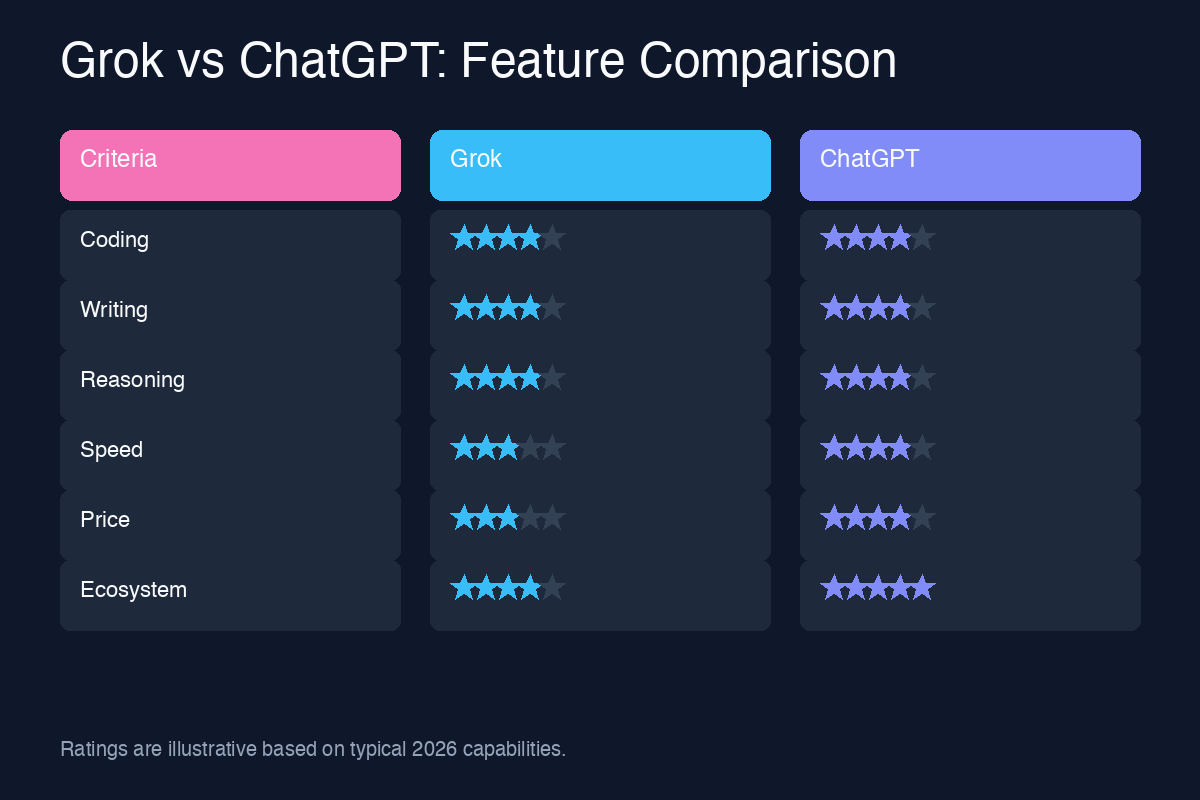
The following table summarizes how Grok and ChatGPT compare across the most important dimensions for everyday and professional use.
| Feature | Grok (xAI) | ChatGPT (OpenAI) |
|---|---|---|
| Real-time data | Native access to live X posts and trending topics | Knowledge cutoff with limited live browsing on select plans |
| Response speed | Very fast for short, conversational replies | Fast on GPT-4o; slower on deep reasoning o-series tasks |
| Personality | Witty, sarcastic, rebellious, less filtered | Polite, balanced, safety-aligned, sometimes cautious |
| Content filters | Minimal; answers more controversial questions | Stronger guardrails; refuses sensitive or risky requests |
| Coding ability | Strong, especially for quick scripts and debugging | Excellent, with deep reasoning and extensive language support |
| Writing quality | Conversational, punchy, opinionated when asked | Polished, structured, ideal for long-form and business content |
| Reasoning and math | Good and improving rapidly | Excellent, especially with o-series reasoning models |
| Image generation | Limited or third-party integrations | Native DALL·E integration for ChatGPT subscribers |
| Voice and multimodal | Available in some tiers | Advanced voice mode, vision, file uploads, and data analysis |
| Context window | Large and growing across Grok-2 and Grok-3 | Very large on GPT-4o; supports extensive document analysis |
| Availability | X app, xAI app/site, Chat-Sonic, select third parties | Web, iOS, Android, macOS, Windows, API, Chat-Sonic |
| Pricing | X Premium+ bundle or standalone Grok subscription | Free tier, ChatGPT Plus, ChatGPT Pro, Team, Enterprise |
Real-Time Data from X: Grok's Signature Advantage
The most obvious differentiator in any Grok vs ChatGPT comparison is access to real-time information. Grok was built with X at its center. When a major event happens, whether it is an election, a celebrity scandal, a stock market swing, or a sporting upset, Grok can scan recent public posts and synthesize what people are saying right now.
How Grok Uses X Data
Grok queries X in real time to find relevant posts, trending hashtags, and authoritative accounts discussing a topic. It does not rely on static training data cut off months ago. This makes Grok uniquely useful for:
- Breaking news: Get a quick summary of what is happening as events unfold.
- Market sentiment: Gauge how traders and commentators are reacting to earnings, crypto moves, or macro news.
- Social trends: Understand memes, viral debates, and cultural moments while they are still relevant.
- Live events: Follow sports matches, award shows, or political debates through the lens of public reaction.
For example, if you ask Grok, "What are people saying about today's Federal Reserve decision?" it can pull recent X posts and summarize the prevailing mood. ChatGPT, unless it has live browsing enabled and the feature is working, will likely tell you it has a knowledge cutoff and cannot access current social media.
Limitations of Real-Time Access
Real-time X access is not perfect. X data can be noisy, biased, and filled with misinformation. Grok's summaries reflect what is being said, not necessarily what is true. Users must cross-check important claims. Additionally, X access may be limited in regions where the platform is restricted, and private accounts are off-limits.
ChatGPT's Approach to Fresh Information
ChatGPT has improved its browsing capabilities over time, especially for Plus and Pro subscribers. It can fetch web pages, search Bing, and summarize current events. However, the experience is less integrated than Grok's native X pipeline. ChatGPT's browsing can also be slower and less reliable for rapidly changing social conversations. For live social sentiment, Grok holds a clear edge.
Speed: Which AI Feels Faster?
Latency matters. When you are iterating on code, drafting an email, or bouncing ideas around, waiting several seconds for each response breaks your flow. Both Grok and ChatGPT have made speed a priority, but they feel different in practice.
Grok's Speed Profile
Grok is tuned for fast, snappy replies. Short questions often receive near-instant answers, and the model streams tokens quickly. This makes Grok feel responsive in casual conversation. xAI has optimized inference aggressively, especially for Grok's lighter variants. If your workflow involves lots of short, back-and-forth queries, Grok can feel faster than ChatGPT.
ChatGPT's Speed Profile
ChatGPT on GPT-4o is also fast for most everyday tasks. Where it slows down is on the o-series reasoning models, which deliberately "think longer" to solve complex math, logic, and coding problems. That extra latency is a trade-off for higher accuracy. For simple prompts, the difference between GPT-4o and Grok is usually negligible. For deep reasoning, ChatGPT can take noticeably longer but often produces more reliable results.
Throughput and Rate Limits
Both services impose rate limits, but the exact caps depend on your subscription tier. X Premium+ users historically received generous Grok usage, while ChatGPT Plus users have standard message caps that can be reached during heavy use. ChatGPT Pro and Team plans offer higher limits. If you are a high-volume user, compare the specific limits of your chosen plan rather than assuming one service is universally faster.
Personality and Filters: Rebellious Wit vs Polished Safety
Personality is where Grok and ChatGPT differ most dramatically. The right choice depends on whether you prefer a professional assistant or a conversational partner with edge.
Grok's Personality
Grok is famous for its sarcasm, humor, and willingness to tackle questions other models dodge. It can roast users, make pop-culture references, and adopt a rebellious tone. For creative writers, comedians, and users tired of overly sanitized AI, this personality is refreshing. Grok can also discuss politically charged topics, conspiracy theories, and adult themes with fewer refusals, though it still avoids illegal instructions.
This openness has trade-offs. Grok may produce offensive, biased, or factually shaky content if prompted. It is less suitable for children, sensitive corporate environments, or any use case where a neutral tone is required.
ChatGPT's Personality
ChatGPT aims for helpful, neutral, and consistently polite responses. It is designed to be trustworthy and inoffensive. This makes it excellent for professional communication, educational content, customer service, and enterprise deployments. The downside is that ChatGPT can feel bland, overly agreeable, or frustratingly evasive when you want a strong opinion or edgy humor.
OpenAI has gradually given users more control over tone through custom instructions and custom GPTs, but the underlying safety layer remains. ChatGPT will still refuse requests that violate its usage policies, even when the refusal feels excessive.
Filter Trade-Offs
Grok's minimal filters enable broader exploration but increase the risk of harmful outputs. ChatGPT's stricter filters protect users and brands but can block legitimate creative or research inquiries. Neither approach is objectively better; they serve different audiences. If you need an AI for a public-facing product, ChatGPT is safer. If you are a power user exploring controversial ideas, Grok offers more freedom.
Coding: Grok vs ChatGPT for Developers
Software developers are among the heaviest AI users, and both Grok and ChatGPT compete fiercely for this audience. Each has strengths and weaknesses in the coding workflow.
Grok for Coding
Grok performs well on common coding tasks: generating Python scripts, debugging JavaScript, explaining regex, and writing SQL queries. Its fast response time makes it pleasant for quick lookups. Grok also tends to give direct, no-fluff answers, which developers appreciate when they just want working code.
Where Grok can fall short is on large, multi-file architecture problems and very niche frameworks. Its training data and tooling integrations are not as broad as OpenAI's, so it may struggle with obscure libraries or complex refactoring across a big codebase.
ChatGPT for Coding
ChatGPT, especially with GPT-4o and the o-series reasoning models, is widely regarded as one of the best coding assistants available. It handles algorithmic challenges, system design explanations, test generation, documentation, and debugging with high accuracy. The larger context window makes it possible to paste substantial chunks of code and ask for targeted changes.
ChatGPT also integrates with tools like the Canvas editor, code interpreter, and third-party plugins that can run code, visualize data, and manage files. For professional developers working on complex projects, ChatGPT's ecosystem advantage is significant.
Which Is Better for Coding?
For quick scripts and casual coding, Grok is more than adequate and may feel faster. For complex engineering, architecture decisions, and long-context work, ChatGPT is the stronger choice. Many developers keep both open and switch depending on the task, which is exactly the flexibility Chat-Sonic provides.
Writing and Content Creation
Both models can write blog posts, emails, social media captions, and marketing copy, but their outputs have different flavors.
Grok as a Writing Assistant
Grok excels at punchy, conversational, and opinionated writing. It can mimic internet slang, draft witty tweets, and produce content with attitude. If your brand voice is bold, sarcastic, or meme-friendly, Grok can capture that tone better than most models. It is also useful for drafting content tied to current trends because it understands what is happening on X right now.
However, Grok can be inconsistent with structure and may include unverified claims pulled from social media. For long-form articles, white papers, or formal business documents, you will likely need to edit heavily.
ChatGPT as a Writing Assistant
ChatGPT is the safer choice for structured, polished writing. It produces well-organized drafts with clear introductions, transitions, and conclusions. It is excellent for SEO articles, proposals, reports, educational materials, and any content where accuracy and professionalism matter. Custom instructions let you define brand voice and formatting preferences, making output more consistent.
ChatGPT's main writing weakness is occasional blandness. It can default to generic phrasing and overused transitions. Skilled users overcome this by providing detailed prompts and examples.
Best Use Cases for Each
- Choose Grok for: social copy, viral content, trend commentary, satire, casual blog posts, and reaction pieces.
- Choose ChatGPT for: long-form SEO content, technical documentation, academic writing, business emails, and formal reports.
Pricing and Availability in 2026
Cost and access shape which model you can realistically use every day. Both companies have adjusted pricing over time, so it is worth comparing current plans.
Grok Pricing
Grok is most commonly accessed through X Premium+, the top tier of X's subscription service. This bundle includes Grok access along with blue checkmark features, ad reduction, and other X perks. For users already active on X, this can be good value. xAI has also experimented with standalone Grok subscriptions for users who want the AI without the social media bundle.
Because Grok is tied to X, availability depends on whether X operates in your region. In countries with X restrictions, accessing Grok can be more complicated than using ChatGPT.
ChatGPT Pricing
ChatGPT offers a free tier with access to lighter models and limited usage. The ChatGPT Plus subscription unlocks GPT-4o, higher rate limits, browsing, image generation, and advanced voice. ChatGPT Pro adds even more reasoning compute and priority access. Business users can choose Team or Enterprise plans with admin controls, data privacy options, and centralized billing.
This tiered structure makes ChatGPT accessible to casual users while scaling up for professionals. The free tier is a major advantage over Grok, which generally requires a paid subscription.
Regional Availability
ChatGPT is available in most countries and supports dozens of languages. Grok's availability is more limited, primarily serving markets where X Premium+ is sold. If you travel frequently or work with international teams, ChatGPT's wider availability is a practical benefit.
Best Use Cases: When to Choose Grok or ChatGPT
The best model depends on what you are trying to accomplish. Here is a practical breakdown.
Choose Grok When You Need
- Live social context: Real-time reactions, trends, and sentiment from X.
- Unfiltered exploration: Honest takes on controversial or polarizing topics.
- Fast casual answers: Quick lookups and conversational brainstorming.
- Witty or edgy content: Social posts, satire, and meme-style writing.
- X-centric tasks: Drafting posts, analyzing replies, or summarizing threads.
Choose ChatGPT When You Need
- Deep reasoning: Complex math, logic, coding, and step-by-step analysis.
- Polished writing: Long-form content, reports, emails, and documentation.
- Safe professional use: Content that must be neutral and inoffensive.
- Multimodal features: Image generation, voice conversations, and document analysis.
- Enterprise deployment: Admin controls, data privacy, and scalable pricing.
Access Both Grok and ChatGPT with Chat-Sonic
You do not have to choose just one. Chat-Sonic is an AI model aggregator that gives you access to Grok, ChatGPT, GPT-4, Claude, Gemini, DeepSeek, and many more models inside a single platform. Instead of maintaining separate subscriptions and switching between tabs, you can compare outputs, pick the best model for each task, and manage everything from one dashboard.
Why Use an Aggregator?
Each AI model has its own strengths. Grok is unbeatable for live X data and rebellious analysis. ChatGPT is the gold standard for polished writing and deep reasoning. Claude shines at long-document analysis. Gemini integrates tightly with Google services. DeepSeek offers strong reasoning at competitive pricing. Subscribing to each one individually is expensive and inefficient.
Chat-Sonic solves this by bringing the leading models together under one subscription. You can ask the same question to Grok and ChatGPT side by side, compare their answers instantly, and learn which model fits your workflow best.
Key Chat-Sonic Features
- Multi-model chat: Switch between Grok, GPT-4, Claude, Gemini, DeepSeek, and others without leaving the app.
- Side-by-side comparison: Run the same prompt across multiple models and compare responses.
- Unified history: All your conversations are stored in one place, regardless of which model you used.
- Cost control: Transparent usage tracking helps you avoid surprise bills.
- No platform lock-in: Access the latest models as they are released without managing separate accounts.
Who Benefits Most?
Chat-Sonic is ideal for content creators, developers, marketers, researchers, and anyone who wants the best AI for every job. If you have ever been frustrated because ChatGPT refused a request or Grok was too blunt, having both at your fingertips gives you the flexibility to get the answer you need.
Final Verdict: Grok vs ChatGPT in 2026
So which AI wins the Grok vs ChatGPT battle? The honest answer is that neither is universally better. They are designed for different priorities.
Grok is the better choice if you live on X, value real-time information, want an AI with personality, and prefer minimal content filters. It is fast, witty, and refreshingly direct. Its weaknesses are consistency, safety, and availability outside the X ecosystem.
ChatGPT is the better choice if you need a reliable, versatile assistant for writing, coding, reasoning, and professional work. Its safety alignment, broad availability, and deep ecosystem make it the safest default for most users. Its weaknesses are occasional blandness and stricter refusals.
The smartest approach is not to commit to one model but to use both. Sign up for Chat-Sonic and access Grok, ChatGPT, and the rest of the top AI models from one place. That way, you get Grok's real-time edge and ChatGPT's depth whenever you need them.