

Gemini vs Claude: Google vs Anthropic AI Comparison 2026
The artificial intelligence landscape in 2026 is dominated by a handful of powerful foundation models, and two names consistently rise to the top of every comparison: Gemini, Google's flagship AI family, and Claude, Anthropic's safety-focused assistant. Both represent billions of dollars in research, massive compute infrastructure, and fundamentally different philosophies about what an AI assistant should be. Yet for everyday users, developers, writers, and business teams, the question remains simple: which one is better for your specific needs?
Google's Gemini is engineered from the ground up to be a native multimodal model. It processes text, images, audio, video, and code within a single architecture, and it is tightly woven into the Google ecosystem. For users who live inside Gmail, Google Docs, Sheets, Drive, Meet, and Search, Gemini offers a level of convenience that competitors struggle to match. It can summarize your inbox, draft documents in the apps you already use, answer questions about videos and images, and reason across modalities in ways that feel increasingly natural.
Anthropic's Claude, by contrast, has built its reputation on helpfulness, honesty, and harmlessness. Claude is widely regarded as one of the best writing and reasoning assistants available today. Its responses tend to be nuanced, well-structured, and thoughtfully calibrated. It excels at long-form writing, complex analysis, coding assistance, and tasks that require careful judgment. Anthropic has also pushed the boundaries of context window size and agentic capabilities with features like Claude Code and computer use, making Claude a favorite among technical professionals.
Choosing between Gemini and Claude is not about finding a single winner. It is about understanding the trade-offs between ecosystem integration and raw reasoning quality, between multimodal breadth and writing refinement, and between Google's scale and Anthropic's safety focus. In this guide, we compare Gemini and Claude across every category that matters in real-world use, including coding, writing, reasoning, multimodal features, context windows, pricing, Google Workspace integration, safety, and more. We also explain how Chat-Sonic lets you access both models, along with many others, from a single platform without juggling multiple subscriptions.
By the end of this article, you will know exactly when to choose Gemini, when Claude is the better fit, and how to combine the strengths of both models to get more done.
Key Takeaways
- Gemini is Google's native multimodal AI and is tightly integrated with Google Workspace, Search, YouTube, and Android, making it ideal for users who rely on Google's ecosystem.
- Claude is Anthropic's reasoning and writing-focused assistant, known for nuanced responses, long-context handling, strong coding skills, and a safety-first design philosophy.
- For coding, Claude generally leads in debugging, refactoring, and architectural reasoning, while Gemini offers strong code generation and tight integration with developer tools.
- For writing, Claude often produces more polished, human-like prose with better tone control, while Gemini excels at research-heavy drafts and real-time information retrieval.
- For multimodal tasks, Gemini has the edge in native image, audio, and video understanding, while Claude's vision capabilities are strong but more limited in scope.
- For Google Workspace integration, Gemini is the clear winner, with native side panels in Gmail, Docs, Sheets, Drive, and Meet.
- For context windows, both models support very long contexts, but implementation details vary by tier and specific model version.
- For safety and alignment, Anthropic emphasizes constitutional AI and cautious behavior, while Google balances capability, usefulness, and broader deployment at scale.
- With Chat-Sonic, you can use Gemini, Claude, GPT, DeepSeek, Grok, and other leading models in one interface, eliminating the need to choose just one.
Gemini vs Claude: At a Glance
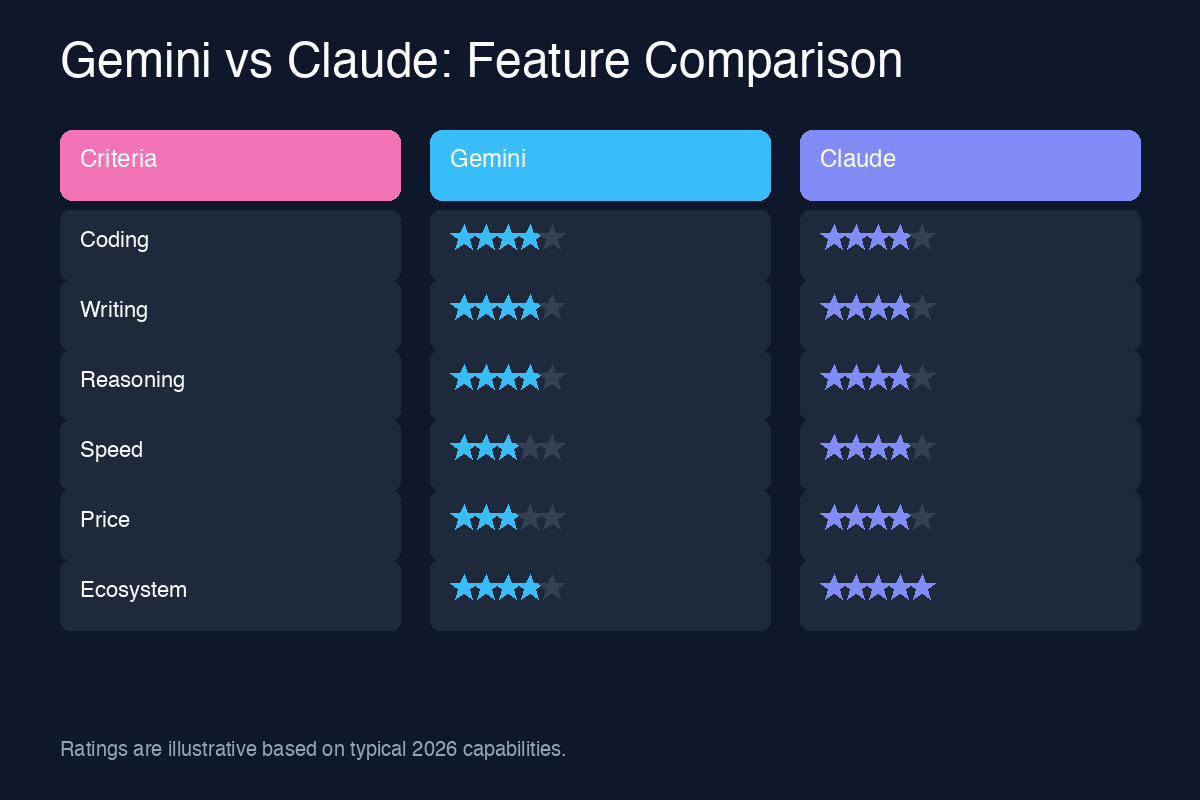
Before diving into detailed comparisons, the following table summarizes how Gemini and Claude stack up across the most important dimensions in 2026.
| Feature | Gemini | Claude |
|---|---|---|
| Developer | Google DeepMind | Anthropic |
| Primary Strength | Multimodality and Google ecosystem integration | Reasoning, writing, and coding quality |
| Best For | Google Workspace users, researchers, multimedia tasks | Writers, developers, analysts, safety-conscious users |
| Multimodal Input | Text, images, audio, video, code, documents | Text, images, documents, limited audio and video |
| Coding Ability | Strong code generation and tool integration | Excellent debugging, refactoring, and reasoning |
| Writing Style | Informative, research-driven, direct | Nuanced, human-like, structured, refined |
| Context Window | Very large, up to millions of tokens on some tiers | Very large, up to hundreds of thousands of tokens |
| Google Workspace | Native integration across Gmail, Docs, Sheets, Drive, Meet | Limited; requires third-party connectors |
| Real-Time Web Access | Deep Google Search integration | Available through tools and integrations |
| Pricing Model | Free tier plus Google One AI Premium and enterprise plans | Free tier plus Pro and Team/Enterprise subscriptions |
| Safety Focus | Responsible AI at scale with broad deployment | Constitutional AI, cautious refusals, harm reduction |
| Agentic Features | Gems, extensions, Workspace agents | Claude Code, computer use, projects, artifacts |
This table only scratches the surface. The real differences become clear when you look at how each model performs in specific tasks and workflows.
What Is Gemini?
Gemini is Google's family of large-scale multimodal AI models, developed by Google DeepMind. First introduced in late 2023 and continuously upgraded since, Gemini was designed to be multimodal from the start. Unlike earlier models that bolted vision or audio capabilities onto a text-only foundation, Gemini's architecture natively handles text, images, audio, video, and code within a single model. This design choice enables more seamless reasoning across different types of input.
In 2026, Gemini powers a wide range of Google products and services. It appears inside the Gemini app on Android and iOS, as a side panel in Gmail, Google Docs, Google Sheets, Google Drive, and Google Meet, and as an assistant on Pixel devices and select Android phones. It also underpins AI Overviews in Google Search, summarizes YouTube videos, helps with Google Photos queries, and supports developers through tools like Gemini in Android Studio, Firebase, and Google Cloud.
Google offers several Gemini model tiers. The Gemini Pro and Ultra variants serve consumer and power users, while enterprise and developer-focused versions such as Gemini 1.5 Pro and the experimental Gemini 2.0 family offer larger context windows, stronger reasoning, and advanced agentic capabilities. Gemini Advanced, included in the Google One AI Premium plan, unlocks the most capable consumer model and deeper Workspace integration.
Gemini's core value proposition is convenience at scale. If you already use Google's products, Gemini can access your emails, documents, calendar, and files with permission, answer questions based on your data, and take actions across apps. That level of integration is difficult for any competitor to replicate.
What Is Claude?
Claude is an AI assistant created by Anthropic, a San Francisco-based AI safety company founded by former OpenAI researchers. Anthropic's mission centers on building AI systems that are helpful, honest, and harmless, with a strong emphasis on constitutional AI and interpretability. Claude is the public-facing product of that research, and it has earned a devoted following among writers, developers, researchers, and business analysts.
Claude is available through the Claude web app, mobile apps, API, and integrations with platforms like Amazon Bedrock and Google Cloud Vertex AI. Anthropic offers several model families. Claude Haiku is optimized for speed and low cost. Claude Sonnet balances capability and efficiency. Claude Opus is the most powerful model, designed for the hardest reasoning, coding, and analysis tasks. In 2026, Anthropic has also expanded Claude with agentic features such as Claude Code, which can write and edit code in a terminal environment, and computer use capabilities that allow Claude to interact with desktop interfaces.
Claude's defining characteristic is the quality of its reasoning and communication. Users often describe Claude's writing as more natural, thoughtful, and nuanced than competing models. Claude is also known for being willing to say "I don't know" rather than hallucinating an answer, and for refusing requests that could cause harm even when prompted cleverly. This makes Claude a trusted partner for sensitive or high-stakes tasks.
Unlike Gemini, Claude does not come with a built-in ecosystem of productivity apps. Anthropic has focused on making Claude a best-in-class assistant and providing robust API access, leaving integrations to third parties and partners. For users who prioritize quality over convenience, this trade-off is often worth it.
Multimodal Features: How Gemini and Claude Handle Images, Audio, and Video
Multimodality is one of the biggest differentiators between Gemini and Claude, and it is the area where Gemini's native architecture shines brightest.
Gemini's Multimodal Strengths
Gemini was built as a multimodal model from day one. It can accept text, images, audio, video, PDFs, and other document types in the same prompt and reason across them jointly. In practical terms, this means you can upload a screenshot of a chart, ask Gemini to explain it, then follow up with a voice question about the underlying data. You can point your camera at a product label and ask for a summary of ingredients. You can share a YouTube video link and ask Gemini to summarize the key arguments, identify speakers, or extract timestamps.
Gemini's image understanding is particularly strong for everyday use. It can read text within images, interpret diagrams, compare visual layouts, and answer questions about photos. For students, researchers, marketers, and field workers, this capability turns a smartphone camera into an intelligent research assistant.
Gemini's audio and video processing is also more advanced than Claude's in most consumer scenarios. It can transcribe speech, answer questions about audio recordings, summarize video content, and even process lengthy video files in some configurations. Because Google owns YouTube, Gemini can often access and summarize public video content with permission, which is a unique advantage for content creators and researchers.
Claude's Multimodal Strengths
Claude has added vision capabilities in recent versions, allowing it to analyze images, read documents, and interpret charts. Claude's image reasoning is strong for technical and analytical tasks. For example, Claude can read a screenshot of a code error, analyze a wireframe, or interpret a complex diagram with surprising accuracy. It can also process PDFs and extract structured information from long documents.
However, Claude's multimodal capabilities are more limited than Gemini's. Native audio and video input are not as deeply integrated, and Claude does not have the same breadth of real-time multimedia tools. Where Claude excels is in cross-modal reasoning with text and images. If you upload a technical diagram and ask Claude to write a detailed explanation, refactor the associated code, or identify inconsistencies, it often performs at a very high level.
Which Is Better for Multimodality?
For users who need comprehensive multimodal support, including audio, video, and seamless camera-based interaction, Gemini is the better choice. For users who primarily work with text and images and value deep reasoning over breadth, Claude is highly competitive. Your choice should depend on the types of media you interact with most often.
Coding: Gemini vs Claude for Developers
Coding is one of the most demanding AI use cases, and both Gemini and Claude have invested heavily in winning over developers. Each model brings different strengths to the table.
Claude for Coding
Claude has developed a reputation as one of the best AI coding assistants in the industry. In benchmark tests and real-world developer feedback, Claude consistently ranks near the top for tasks that require understanding complex codebases, debugging tricky errors, refactoring legacy code, and designing software architecture.
Several factors contribute to Claude's coding strength. Its long context window allows it to ingest entire repositories, large files, or extensive documentation and reason about them holistically. Its natural reasoning style helps it trace through logic, identify subtle bugs, and explain why a fix works. Its Claude Code feature turns the model into an autonomous coding agent that can run shell commands, edit files, and iterate on solutions within a terminal environment.
Claude is also strong at code review. It can read pull requests, spot potential issues, suggest improvements, and explain trade-offs. For teams that value code quality and maintainability, Claude is often the preferred assistant.
Gemini for Coding
Gemini is also a capable coding assistant, especially for developers already embedded in the Google ecosystem. Gemini in Android Studio helps mobile developers generate code, fix issues, and understand documentation. Gemini in Firebase accelerates backend development. Gemini in Google Cloud supports infrastructure, DevOps, and data analysis tasks. These integrations make Gemini convenient for developers who already use Google's tools.
In terms of raw coding ability, Gemini performs well on standard code generation tasks. It can write functions, explain APIs, generate test cases, and help with learning new languages. Gemini also benefits from Google's deep index of documentation, Stack Overflow discussions, and open-source code, which helps it provide relevant, up-to-date suggestions.
Where Gemini sometimes falls short compared to Claude is in deep reasoning and large-context refactoring. Claude tends to handle more complex, ambiguous coding problems with greater consistency, while Gemini can occasionally produce superficially correct code that misses deeper architectural issues.
Which Is Better for Coding?
For complex software engineering, debugging, refactoring, and architecture, Claude generally has the edge. For developers using Google tools, mobile development, or cloud workflows, Gemini offers compelling integration advantages. Many advanced developers use both, selecting Claude for hard reasoning tasks and Gemini for quick, ecosystem-connected coding help.
Writing: Gemini vs Claude for Content Creation
Writing is one of the most common AI use cases, and the differences between Gemini and Claude are especially noticeable here.
Claude for Writing
Claude is widely regarded as one of the best AI writing assistants available. Its prose tends to be nuanced, well-structured, and naturally human-like. Claude understands tone, audience, and intent better than most competitors, and it can adapt its voice to match a brand, a genre, or a specific publication style.
Claude excels at long-form writing. Whether you are drafting a blog post, a white paper, a marketing email sequence, or a research report, Claude can maintain coherence across thousands of words. It is also excellent at editing. You can ask Claude to tighten a paragraph, rewrite it for a different audience, or improve clarity without losing meaning.
Another Claude strength is resistance to fluff. Claude tends to avoid generic, buzzword-heavy language and instead produces specific, substantive content. For professional writers, editors, and marketers, this quality makes Claude a trusted drafting partner.
Gemini for Writing
Gemini is a solid writing assistant, particularly for users who want research-driven content. Because Gemini is connected to Google Search, it can incorporate current information, statistics, and references into drafts. This makes Gemini useful for writing news articles, research summaries, reports, and content that benefits from up-to-date facts.
Gemini's writing style is generally direct, informative, and efficient. It produces clear drafts quickly and can adapt to different formats. However, some users find that Gemini's prose can feel more generic or less polished than Claude's, especially for creative or emotionally resonant writing.
Where Gemini truly shines in writing is within Google Workspace. You can draft an email in Gmail, expand a bullet list into a full document in Google Docs, or generate formulas and summaries in Google Sheets without leaving the app. That workflow integration is unmatched.
Which Is Better for Writing?
For creative writing, long-form content, editing, and tone-sensitive work, Claude is generally the better choice. For research-heavy writing, quick drafts, and content creation inside Google apps, Gemini has clear advantages. As with coding, many professionals use both depending on the project.
Reasoning and Problem-Solving
Reasoning is where the underlying intelligence of a model becomes most visible. It includes logical deduction, mathematical problem-solving, planning, causal analysis, and handling ambiguous or multi-step tasks.
Claude's Reasoning Style
Claude is known for deliberate, careful reasoning. When presented with a complex problem, Claude often breaks it into steps, considers multiple angles, and explains its thinking clearly. This makes Claude particularly valuable for tasks like strategic analysis, legal reasoning, financial modeling, scientific explanation, and decision support.
Claude is also more likely to acknowledge uncertainty. If a question is ambiguous or the answer is not clear, Claude will often say so rather than guessing. This honesty reduces hallucination risk and makes Claude suitable for high-stakes analysis.
Gemini's Reasoning Style
Gemini's reasoning is fast, broad, and well-connected to real-world information. It performs well on factual reasoning, research synthesis, and questions that benefit from recent data. Gemini's integration with Google Search means it can ground answers in current sources, which improves accuracy for time-sensitive topics.
On pure logic puzzles and complex multi-step problems, Gemini is highly capable but can occasionally be less consistent than Claude. Some users report that Gemini is more prone to overconfidence or superficial answers when the problem requires deep, sustained reasoning.
Which Is Better for Reasoning?
For deep, careful reasoning and analysis of complex, ambiguous problems, Claude has a slight advantage. For fast, research-grounded reasoning and questions requiring current information, Gemini is often the better choice.
Context Window and Long Document Handling
Context window size determines how much information a model can consider in a single conversation. In 2026, both Gemini and Claude offer very large context windows, but their implementations differ.
Gemini Context Window
Google has aggressively expanded Gemini's context capabilities, with some versions supporting millions of tokens of context. This allows Gemini to process entire books, long video transcripts, extensive codebases, or large document collections in a single prompt. Gemini's long-context abilities are tightly integrated with Google Drive and Google Docs, making it easy to analyze large volumes of personal or organizational content.
Claude Context Window
Claude also offers industry-leading context windows, with hundreds of thousands of tokens available on higher tiers. Claude's strength is not just the raw token count but how effectively it uses long context. Users report that Claude can retrieve specific details from the middle of long documents, maintain coherence over extended conversations, and reason across multiple large files with high accuracy.
Which Is Better for Context?
Both models are excellent for long-context tasks. Gemini may offer larger raw context limits in some configurations, while Claude is often praised for more reliable retrieval and reasoning within long documents. For most users, either model will handle long content well, but Claude's accuracy in needle-in-a-haystack retrieval gives it an edge for detailed document analysis.
Pricing and Value
Pricing is a practical concern for both consumers and businesses. Both Gemini and Claude offer free tiers and paid plans, but the value proposition differs.
Gemini Pricing
Google offers a generous free tier for Gemini with access to capable models and basic features. For power users, Gemini Advanced is bundled with the Google One AI Premium plan, which also includes expanded cloud storage and other Google benefits. For businesses, Gemini for Workspace adds AI features across Google Workspace apps with enterprise-grade security and admin controls. Google's pricing is competitive, especially for users who already pay for Google services.
Claude Pricing
Anthropic offers a free tier with limited access, a Claude Pro plan for individual power users, and Team and Enterprise plans for organizations. API pricing is based on input and output tokens, with higher rates for the most capable Opus model. Claude's paid plans unlock higher usage limits, priority access, and the most advanced models.
Which Is Better for Value?
For users already invested in Google's ecosystem, Gemini Advanced offers strong bundled value. For users who prioritize the highest-quality reasoning, writing, and coding, Claude Pro or Team can be worth the premium. Businesses should evaluate both based on actual usage patterns, integration needs, and security requirements.
Google Workspace Integration
This is perhaps the most lopsided category in the entire comparison. If you rely on Google Workspace, Gemini is built specifically for your workflow.
Gemini appears as a side panel inside Gmail, Google Docs, Google Sheets, Google Drive, and Google Meet. In Gmail, it can summarize long email threads, draft replies, and help you manage your inbox. In Google Docs, it can draft content, rewrite sections, summarize documents, and suggest improvements. In Google Sheets, it can generate formulas, analyze data, create pivot tables, and build charts. In Google Drive, it can search across your files and answer questions about their contents. In Google Meet, it can summarize meetings and generate action items.
These features are not just convenient; they can fundamentally change how you work. Instead of switching between an AI chatbot and your productivity apps, Gemini lives inside the apps you already use.
Claude does not have native Google Workspace integration. To use Claude with Google apps, you typically need to copy and paste content, use third-party connectors, or build custom API workflows. While these workarounds are feasible, they do not match the seamless experience Gemini provides.
If Google Workspace integration is important to you, Gemini is the clear winner.
Safety, Alignment, and Trust
Safety is a core differentiator between Google and Anthropic. Both companies have responsible AI programs, but their approaches reflect different organizational cultures.
Anthropic's Safety Approach
Anthropic was founded with AI safety as a central mission. Claude is trained using constitutional AI, a method that teaches the model to follow a set of principles designed to make it helpful, honest, and harmless. Anthropic invests heavily in red-teaming, interpretability, and alignment research.
In practice, Claude is often more cautious than competitors. It may refuse requests that could be used for harm, push back on misleading premises, and provide nuanced answers to sensitive questions. Some users find this caution frustrating when it leads to over-refusals, but others appreciate the conservatism, especially for high-stakes or regulated industries.
Google's Safety Approach
Google also has extensive responsible AI policies and safety teams. Gemini is designed to avoid generating harmful content, protect user privacy, and comply with legal and ethical guidelines. Because Google operates at massive scale across many products, its safety approach tends to balance caution with broad utility and accessibility.
Gemini generally refuses harmful requests and provides safety disclaimers where appropriate. Some users feel that Gemini is more willing to engage with controversial or ambiguous topics than Claude, while others prefer Claude's more conservative stance.
Which Is Safer?
Both models are designed with safety in mind. Anthropic's approach is more explicitly safety-focused and research-driven, making Claude appealing to users who prioritize alignment and cautious behavior. Google's approach emphasizes scalable safety across a vast product ecosystem, making Gemini suitable for organizations that need broad deployment with strong governance.
When to Choose Gemini
Gemini is the best choice when:
- You rely heavily on Google Workspace, YouTube, Google Search, Android, or Pixel devices.
- You need strong native multimodal support, including audio, video, and camera-based interaction.
- You want AI features embedded directly in the apps you already use.
- You need research-driven answers with real-time web access.
- You are a mobile developer or cloud developer using Google's platforms.
- You value bundled pricing with Google services.
When to Choose Claude
Claude is the best choice when:
- You prioritize writing quality, nuance, and human-like tone.
- You need help with complex coding, debugging, refactoring, or software architecture.
- You want careful, structured reasoning for analysis and decision support.
- You value honesty and cautious responses for high-stakes tasks.
- You need strong long-context document analysis.
- You prefer a safety-first AI assistant and are comfortable with fewer native app integrations.
Why You Do Not Have to Choose: Use Chat-Sonic for Both
The biggest limitation of choosing between Gemini and Claude is that you do not actually have to choose. Both models are powerful, and each has moments where it outperforms the other. Switching between them based on the task at hand gives you the best of both worlds, but managing separate subscriptions, interfaces, and billing systems is inconvenient and expensive.
Chat-Sonic solves this problem by bringing Gemini, Claude, GPT, DeepSeek, Grok, and many other leading AI models together in one unified platform. With Chat-Sonic, you can:
- Access Gemini and Claude from a single dashboard without multiple subscriptions.
- Compare model responses side by side for the same prompt.
- Choose the best model for each task, whether you need Gemini's Workspace integration or Claude's writing and reasoning power.
- Save money by using one platform instead of paying for several separate AI tools.
- Switch models mid-conversation to get different perspectives on complex problems.
- Enjoy a consistent interface, conversation history, and workflow across all supported models.
For power users, developers, writers, and business teams, Chat-Sonic removes the friction of multi-model workflows. You can use Gemini for research and Google-connected tasks, then switch to Claude for deep writing or coding analysis, all within the same session. That flexibility is the future of AI productivity.
If you are still debating Gemini vs Claude, the real answer is to try both and let the task decide. Chat-Sonic makes that not only possible but practical.
Final Verdict: Gemini vs Claude in 2026
Gemini and Claude are both exceptional AI assistants, but they are built for different strengths. Gemini is the multimodal, Google-integrated productivity engine that excels when convenience, real-time information, and ecosystem connectivity matter most. Claude is the reasoning, writing, and coding specialist that excels when depth, nuance, and careful analysis are the priority.
For most users, the best strategy is not to commit to one model but to use both strategically. Start with Gemini for tasks inside Google apps, multimedia queries, and research. Turn to Claude for writing, coding, and complex reasoning. And use Chat-Sonic to manage both from a single subscription.
The AI landscape will keep evolving, but one thing is clear: the users who get the most value from AI in 2026 are the ones who match the right model to the right job. With Gemini, Claude, and Chat-Sonic, you have everything you need to do exactly that.