

Gemini vs ChatGPT: Which AI is Better in 2026?
The artificial intelligence landscape in 2026 is more competitive than ever. Two names dominate the conversation: Google Gemini and OpenAI ChatGPT. Whether you are a developer writing production code, a marketer crafting campaigns, a researcher hunting for real-time data, or a curious professional exploring AI workflows, choosing the right model can significantly impact your productivity.
In this comprehensive Model Guide from Chat-Sonic, we compare Gemini and ChatGPT across the features that matter most in 2026: search and real-time data, multimodal abilities, coding, writing, pricing, ecosystem integration, context windows, enterprise features, security, and real-world performance. By the end, you will know which AI fits your needs — and how Chat-Sonic lets you use both without juggling multiple subscriptions.
Both models have evolved rapidly. What was true a year ago may no longer apply today. New architectures, larger context windows, deeper integrations, and better alignment techniques have narrowed the gap in some areas while widening it in others. This article is written for decision-makers, developers, content creators, and everyday users who want a clear, balanced comparison based on the latest capabilities available in 2026.
Key Takeaways
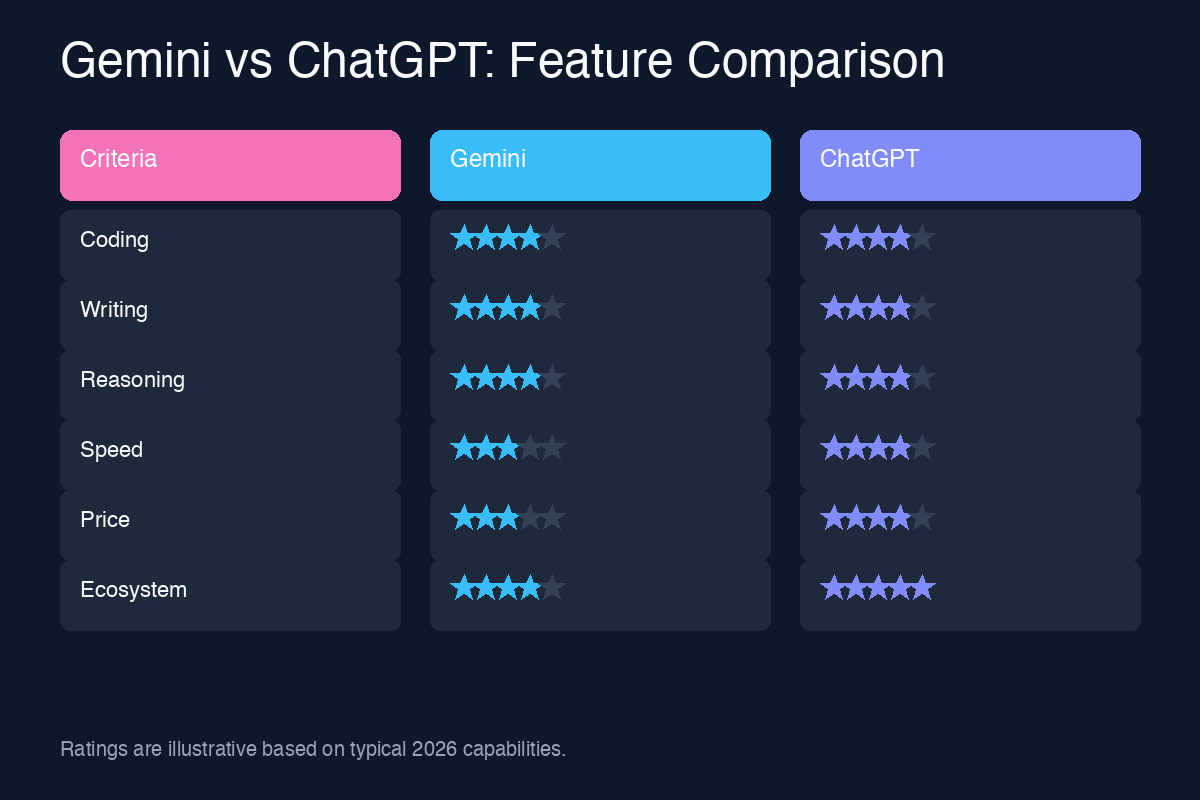
- ChatGPT remains the leader in conversational fluency, creative writing, and developer mindshare, with deep plugin and custom GPT support.
- Gemini excels in Google ecosystem integration, native multimodal reasoning, and real-time access to Google Search, Maps, YouTube, and Workspace apps.
- Both models offer multimodal input and output in 2026, but their strengths differ: Gemini emphasizes video and native audio, while ChatGPT emphasizes image generation and voice conversation polish.
- Pricing is similar at the consumer level, but Gemini Advanced bundles Google Workspace benefits, while ChatGPT Plus offers more third-party integrations.
- Context windows have grown dramatically on both sides; Gemini supports up to 2 million tokens in advanced tiers, while ChatGPT offers up to 128K or more depending on the model.
- Neither AI is universally "better" — the best choice depends on your workflow, budget, and existing tools.
- With Chat-Sonic, you do not have to choose: access Gemini, ChatGPT, Claude, Grok, DeepSeek, and more in a single platform.
What Is Google Gemini?
Google Gemini is a family of large language and multimodal models developed by Google DeepMind. Launched in late 2023 and significantly expanded through 2024 and 2025, Gemini is now the backbone of Google's consumer and enterprise AI strategy. In 2026, Gemini powers everything from the Gemini chatbot app to Google Search AI Overviews, Gmail Smart Compose, Google Docs brainstorming, Android AI features, and cloud APIs used by enterprises worldwide.
Gemini is built on a Mixture-of-Experts (MoE) architecture that activates only the most relevant parameters for each task. This design allows Google to train extremely large models while keeping inference costs manageable. Gemini models are multimodal from the ground up, meaning they can process and reason across text, images, audio, video, and code within a single context rather than stitching separate models together.
Google positions Gemini as an "AI assistant for everyone." It is designed to be helpful across search, productivity, creativity, and enterprise workloads. Because Google owns the data layer behind Search, Maps, YouTube, and Workspace, Gemini can offer contextual assistance that rivals struggle to match without partnerships.
Key Gemini Models in 2026
- Gemini 2.5 Pro / Ultra — Flagship reasoning model for complex tasks, coding, and long-context research.
- Gemini 2.5 Flash / Nano — Faster, cost-efficient variants optimized for high-volume and on-device use.
- Gemini Advanced — Consumer subscription that unlocks Pro/Ultra access, 2M-token context, and Workspace integration.
What Is ChatGPT?
ChatGPT is the conversational AI product from OpenAI, built on the GPT (Generative Pre-trained Transformer) family of models. It launched in November 2022 and quickly became the fastest-growing consumer application in history. By 2026, ChatGPT has evolved into a full AI assistant platform with web search, image generation, voice conversations, code execution, custom GPTs, and a massive third-party plugin ecosystem.
ChatGPT's strength lies in its polished user experience and natural dialogue quality. OpenAI has invested heavily in reinforcement learning from human feedback (RLHF), giving ChatGPT a human-like tone that is particularly valuable for writing, tutoring, brainstorming, and customer-facing applications.
ChatGPT is not just a single model; it is a platform. Users can choose from different models depending on the task, build custom GPTs for specialized workflows, and connect external tools through plugins. This flexibility has made ChatGPT the default AI assistant for millions of professionals.
Key ChatGPT Models in 2026
- GPT-5 / GPT-4o successor — Flagship model for reasoning, coding, and multimodal tasks.
- o-series reasoning models — Specialized for math, science, and multi-step problem solving.
- ChatGPT Plus / Pro / Team / Enterprise — Tiers offering higher usage limits, faster responses, and admin controls.
Gemini vs ChatGPT: Detailed Comparison Table
| Feature | Google Gemini | OpenAI ChatGPT |
|---|---|---|
| Developer | Google DeepMind | OpenAI |
| Flagship model (2026) | Gemini 2.5 Pro / Ultra | GPT-5 / GPT-4o successor |
| Real-time search | Native Google Search, Maps, YouTube, Flights | Bing search integration; web browsing |
| Multimodal input | Text, image, audio, video, PDFs | Text, image, audio, video, documents |
| Multimodal output | Text, audio, images (via Imagen) | Text, audio, images (via DALL-E 3) |
| Coding performance | Excellent; strong at reasoning and large codebases | Excellent; broad language support and tools |
| Writing quality | Strong, factual, structured | Best-in-class creativity and tone control |
| Context window | Up to 2 million tokens (Advanced) | Up to 128K+ tokens (varies by tier) |
| Free tier | Gemini with limited requests | ChatGPT with limited GPT-4o access |
| Paid consumer plan | Gemini Advanced (~$19.99/month) | ChatGPT Plus (~$20/month) |
| Ecosystem | Google Workspace, Android, Search, Cloud | Microsoft 365, Windows, GitHub Copilot |
| API availability | Google AI Studio, Vertex AI | OpenAI API, Azure OpenAI Service |
| Voice / audio | Native audio conversations | Advanced Voice Mode |
| Image generation | Imagen integration | DALL-E 3 integration |
Search and Real-Time Data
One of the biggest practical differences between Gemini and ChatGPT is how they handle current information. Training data has a cutoff, so any AI assistant needs a search or browsing capability to answer questions about today's news, stock prices, sports scores, or newly released products.
How Gemini Handles Search
Gemini is tightly integrated with Google Search. When you ask about current events, Gemini can retrieve live results, summarize web pages, and cite sources. Because Google controls the world's largest search index, Gemini often provides broader coverage of breaking news, local businesses, maps, flights, and YouTube videos. In 2026, Gemini can also pull structured data from Google's Knowledge Graph, making its answers especially useful for factual lookups.
Beyond search, Gemini integrates with Google Maps for location queries, Google Flights for travel planning, and YouTube for video summaries. If you live inside Google's ecosystem, this level of integration is hard to beat.
How ChatGPT Handles Search
ChatGPT uses a partnership with Microsoft Bing to browse the web. The browsing experience is smooth and well-integrated into the chat interface. ChatGPT can retrieve recent articles, summarize web pages, and provide citations. In 2026, ChatGPT's search is faster and more reliable than ever, and it often excels at understanding nuanced queries thanks to OpenAI's conversational training.
However, because Bing's index is smaller than Google's, ChatGPT may occasionally miss niche or very recent pages. For most everyday queries, the difference is negligible. For deep research, local business searches, or video-heavy topics, Gemini's Google integration can be more comprehensive.
Multimodal Capabilities: Image, Video, and Audio
Multimodality — the ability to understand and generate more than just text — is where both Gemini and ChatGPT have made major strides. In 2026, both platforms are far more than text bots.
Gemini's Multimodal Strengths
Gemini was designed as a native multimodal model from the beginning. This means it can process combinations of text, images, audio, and video in a single prompt without relying on separate models for each input type. For example, you can upload a 30-minute video lecture, ask Gemini to summarize the key points, and then request timestamps for the most important concepts.
Gemini is particularly strong with:
- Video analysis: Long-form video understanding, scene descriptions, and content moderation.
- PDFs and documents: Extracting tables, charts, and text from scanned documents.
- Screen sharing: Analyzing live screenshots or screen recordings for troubleshooting.
- Audio understanding: Transcribing and summarizing podcasts or meetings.
ChatGPT's Multimodal Strengths
ChatGPT also supports multimodal input, including images, audio, and documents. Its standout feature in 2026 is image generation via DALL-E 3, which produces high-quality illustrations, marketing visuals, and concept art directly within the conversation. ChatGPT's Advanced Voice Mode offers some of the most natural-sounding AI conversations available, complete with emotional tone and interruption handling.
ChatGPT excels at:
- Image generation: Creating and editing images from text prompts.
- Voice conversations: Natural, real-time spoken dialogue.
- Document analysis: Reading uploaded PDFs, spreadsheets, and code files.
- Creative workflows: Combining text, images, and ideas into cohesive projects.
Coding Capabilities
For developers, code quality, debugging support, and framework knowledge are critical. Both Gemini and ChatGPT are highly capable coding assistants, but their styles differ.
Gemini for Coding
Gemini's large context window is a major advantage for coding. It can ingest entire codebases, multiple files, and long documentation pages at once, making it ideal for refactoring, architecture review, and understanding legacy projects. Gemini is also integrated into Google's development tools, including Android Studio, Firebase, and Google Cloud's IDE environments.
Developers often praise Gemini for:
- Strong reasoning across long files and repositories.
- Good support for Python, Go, Java, Kotlin, and JavaScript.
- Accurate code explanations and documentation generation.
- Integration with Google Cloud services and Vertex AI.
ChatGPT for Coding
ChatGPT has been the go-to coding companion for millions of developers since 2022. It supports an enormous range of languages and frameworks, and its conversational style makes it easy to iterate on solutions. With Custom GPTs and plugins, developers can create specialized coding assistants for specific stacks.
ChatGPT shines for:
- Rapid prototyping and debugging.
- Writing tests, comments, and documentation.
- Explaining algorithms and data structures in simple terms.
- Integration with tools like GitHub Copilot, VS Code, and JetBrains IDEs.
Writing and Content Creation
Writers, marketers, and business professionals often choose an AI assistant based on how well it understands tone, audience, and creative direction.
Gemini for Writing
Gemini produces clear, structured, and factual writing. It is excellent for reports, summaries, technical documentation, and SEO briefs that require accuracy. Because Gemini can search the web in real time, it can incorporate current statistics, news, and trends into articles and emails.
Best use cases include:
- Research-backed reports and whitepapers.
- Google Docs and Gmail drafts.
- Technical and academic writing.
- Content optimized for search engines with live data.
ChatGPT for Writing
ChatGPT remains the favorite for creative and persuasive writing. Its ability to mimic tone, style, and voice makes it ideal for storytelling, marketing copy, social media posts, and sales emails. The custom instructions feature lets users define their brand voice once and apply it across every conversation.
Best use cases include:
- Blog posts and newsletters.
- Brand storytelling and ad copy.
- Brainstorming and idea generation.
- Editing and rewriting for clarity and style.
Pricing Comparison
Pricing is often the deciding factor for individual users and small teams. In 2026, both companies offer competitive tiers.
Google Gemini Pricing
- Free: Access to Gemini with standard model limits.
- Gemini Advanced: Approximately $19.99 per month, includes 2TB Google One storage, Gemini in Gmail/Docs/Slides/Sheets, and priority access to new features.
- Enterprise / API: Pay-as-you-go through Google AI Studio and Vertex AI.
OpenAI ChatGPT Pricing
- Free: Access to GPT-4o with limited messages and no advanced features.
- ChatGPT Plus: Approximately $20 per month, includes GPT-5 access, higher message limits, web browsing, image generation, and voice mode.
- ChatGPT Pro / Team / Enterprise: Higher tiers for power users and organizations, with additional compute, admin, and security features.
- OpenAI API: Token-based pricing for developers.
For consumers, the monthly cost is nearly identical. The real difference is value: Gemini Advanced bundles Google services, while ChatGPT Plus offers broader third-party integrations and a more mature app ecosystem.
Ecosystem Integration
Your existing tools heavily influence which AI assistant will feel more natural. Both Google and OpenAI have built deep ecosystem moats.
Gemini in the Google Ecosystem
If you use Gmail, Google Docs, Google Sheets, Google Slides, Google Calendar, Google Meet, Android, or Google Cloud, Gemini is designed to work inside these apps. It can draft emails, summarize meeting transcripts, generate slides, analyze spreadsheets, and answer questions about your Google Drive files. In 2026, Gemini is also the default assistant on many Android devices.
ChatGPT in the Microsoft and OpenAI Ecosystem
ChatGPT is integrated with Microsoft 365 Copilot in Word, Excel, PowerPoint, Outlook, and Teams. It also powers GitHub Copilot for developers. OpenAI's API ecosystem is vast, with thousands of third-party apps and custom GPTs. If your workflow depends on Microsoft productivity tools or a broad range of integrations, ChatGPT is often the smoother choice.
Context Window Comparison
Context window determines how much information an AI can remember and process in a single conversation. Larger windows are essential for long documents, codebases, and extended research sessions.
In 2026, Gemini Advanced supports up to 2 million tokens of context in its highest tier, allowing it to process entire books, massive code repositories, or hours of video transcripts in one go. ChatGPT offers context windows up to 128,000 tokens or more depending on the model and tier, which is more than enough for most business and creative tasks but falls short of Gemini's extreme long-context capabilities.
For most users, both context windows are sufficient. If your work involves analyzing hundreds of pages or millions of tokens at once, Gemini has a clear technical advantage.
Enterprise, Team, and Security Features
Businesses need more than raw model capability. Admin controls, data privacy, compliance certifications, and team collaboration features matter just as much.
Gemini for Enterprise
Google offers Gemini through Google Workspace Business and Enterprise plans, as well as through Vertex AI for custom applications. Enterprise customers benefit from Google's existing security infrastructure, data region controls, and compliance certifications. Gemini in Workspace can be managed by admins who control whether user data is used to improve models.
ChatGPT for Enterprise
OpenAI's ChatGPT Enterprise and Team plans include admin dashboards, SSO, audit logs, and data privacy commitments. OpenAI promises not to train on business data or conversations in enterprise plans. For organizations already using Microsoft Azure, Azure OpenAI Service provides private deployment options with additional compliance controls.
Performance and Benchmarks in 2026
Academic benchmarks are not the whole story, but they provide useful signals. In 2026, both Gemini and ChatGPT score at the top of leaderboards for reasoning, mathematics, coding, and multilingual tasks.
Gemini often leads in benchmarks that reward long-context understanding and multimodal reasoning, such as the "needle in a haystack" test over millions of tokens and video question-answering datasets. ChatGPT often leads in instruction following, creative writing evaluations, and human preference rankings like the LMSYS Chatbot Arena.
Importantly, benchmark leadership does not always translate to daily productivity. A model that scores 2% higher on a math test may not write better emails or debug your code faster. Real-world fit matters more than leaderboard position.
Chat-Sonic: Access Gemini and ChatGPT in One Subscription
Choosing between Gemini and ChatGPT is no longer necessary. Chat-Sonic is an AI model aggregator that gives you access to the world's leading models — including Gemini, GPT-4, Claude, Grok, DeepSeek, and more — from a single platform and subscription.
With Chat-Sonic, you can:
- Compare outputs side by side: Run the same prompt through Gemini and ChatGPT to see which model performs better for your specific task.
- Switch models mid-conversation: Start a brainstorm with ChatGPT, then hand off a coding task to Gemini without losing context.
- Reduce subscription clutter: One account, one bill, and one consistent interface for multiple AI assistants.
- Stay future-proof: New models are added as they are released, so you always have access to cutting-edge AI.
Whether you prefer Gemini's Google integration or ChatGPT's conversational polish, Chat-Sonic ensures you get the best of both worlds. For teams, this means standardized billing, shared conversation history, and model governance. For individuals, it means freedom to experiment without committing to a single vendor.
Gemini vs ChatGPT: Which Should You Choose?
The right choice depends on your priorities.
Choose Gemini if:
- You rely heavily on Google Workspace, Android, or Google Search.
- You work with long documents, videos, or large codebases.
- You want real-time data deeply integrated with Google services.
- You prefer a model optimized for factual, structured output.
Choose ChatGPT if:
- You value natural conversation, creativity, and tone control.
- You use Microsoft 365, GitHub Copilot, or many third-party tools.
- You need image generation built into your chat workflow.
- You want the most mature plugin and custom GPT ecosystem.
For many professionals, the answer is not one or the other — it is both. Each model has strengths, and the best results often come from matching the right model to the right task.
Conclusion
Gemini and ChatGPT are both exceptional AI assistants in 2026, but they are not identical. Gemini leads in Google integration, long-context processing, native multimodal reasoning, and real-time search breadth. ChatGPT leads in conversational quality, creative writing, image generation, and third-party ecosystem support.
Instead of locking yourself into one platform, consider using an aggregator like Chat-Sonic to access Gemini, ChatGPT, and other top models in one place. That way, you can always choose the best AI for the job — and stay ahead as the technology continues to evolve.
Frequently Asked Questions
Is Gemini more accurate than ChatGPT?
Accuracy depends on the task. Gemini often has an edge for factual queries tied to Google Search and live data. ChatGPT often performs better for nuanced, creative, or open-ended questions.
Can I use Gemini and ChatGPT for free?
Yes, both offer free tiers with usage limits. Free plans are suitable for casual use, but professionals typically benefit from paid subscriptions.
Which AI is better for coding in 2026?
Both are excellent. Gemini's larger context window helps with large codebases, while ChatGPT has broader community support and integrations like GitHub Copilot.
Does ChatGPT have better image generation than Gemini?
ChatGPT uses DALL-E 3, which is widely regarded for high-quality image generation. Gemini uses Imagen, which is also capable but has different strengths.
What is the best way to access multiple AI models?
Platforms like Chat-Sonic aggregate multiple models, including Gemini and ChatGPT, so you can compare and switch between them without multiple subscriptions.
Which has the larger context window?
Gemini Advanced supports up to 2 million tokens in 2026, while ChatGPT supports up to 128,000 tokens or more depending on the tier.