

DeepSeek vs ChatGPT: Free Open-Source AI vs OpenAI in 2026
In 2026, the artificial intelligence landscape is no longer defined by a single dominant model. For years, OpenAI's ChatGPT set the benchmark for conversational AI, productivity, and coding assistance. Then came DeepSeek, a Chinese AI company that disrupted the industry with high-performing, cost-efficient, and open-weight large language models. What started as a challenger quickly became a serious contender, forcing developers, businesses, and everyday users to ask one critical question: DeepSeek vs ChatGPT—which one should you actually use?
This comprehensive model guide compares DeepSeek and ChatGPT across the dimensions that matter most in real-world use: coding performance, mathematical and logical reasoning, pricing, open-source accessibility, privacy, speed, availability, and ecosystem integration. Whether you are a software engineer looking for the best AI pair programmer, a researcher analyzing complex problems, a startup founder trying to control AI infrastructure costs, or a privacy-conscious user evaluating where your data goes, this article will give you a clear, evidence-based answer.
We will also explain how Chat-Sonic, an AI model aggregator, lets you access both DeepSeek and ChatGPT through a single interface, eliminating the need to manage multiple subscriptions, compare outputs manually, or worry about regional availability.
Key Takeaways
- DeepSeek offers competitive reasoning and coding performance at a significantly lower cost than ChatGPT, especially through its open-weight models like DeepSeek-V3 and the reasoning-focused DeepSeek-R1.
- ChatGPT, powered by OpenAI's GPT-4o, GPT-4.5, and o-series reasoning models, remains the leader in user experience, ecosystem integration, multimodal capabilities, and enterprise adoption.
- Coding: DeepSeek-R1 rivals OpenAI's o1 and o3-mini in competitive programming and algorithmic reasoning, while ChatGPT excels in IDE integration, debugging workflows, and real-time collaborative coding.
- Math and reasoning: Both models perform strongly on advanced benchmarks, but OpenAI's o-series models generally maintain an edge on the most complex scientific and mathematical tasks.
- Cost: DeepSeek API pricing is often 10x to 30x lower than equivalent OpenAI models, making it attractive for high-volume applications.
- Open source: DeepSeek publishes open-weight models under permissive licenses, allowing self-hosting and fine-tuning. ChatGPT and its underlying GPT models are closed-source and available only through OpenAI's API or applications.
- Privacy: Self-hosted DeepSeek gives organizations full data sovereignty. ChatGPT processes data on OpenAI's servers, though enterprise and API plans offer stronger privacy controls.
- Speed and availability: ChatGPT generally offers lower latency and broader global availability, while DeepSeek has faced occasional regional restrictions and capacity constraints.
- Best choice: Use ChatGPT for general productivity, multimodal tasks, and enterprise workflows. Use DeepSeek for cost-efficient coding, open-weight deployment, and budget-conscious AI development.
- Chat-Sonic advantage: You do not have to choose. Chat-Sonic provides unified access to DeepSeek, ChatGPT, Claude, Gemini, and many other models in one platform.
DeepSeek vs ChatGPT: At a Glance
Before diving into detailed comparisons, here is a high-level overview of how DeepSeek and ChatGPT differ in philosophy, pricing, and capabilities.
| Feature | DeepSeek | ChatGPT |
|---|---|---|
| Developer | DeepSeek AI (China) | OpenAI (USA) |
| Flagship models | DeepSeek-V3, DeepSeek-R1, DeepSeek-Coder-V2 | GPT-4o, GPT-4.5, o1, o3-mini |
| Architecture | Mixture-of-Experts (MoE), open weights | Dense transformer, closed weights |
| Open source | Open-weight, permissive licenses | Closed-source, API-only |
| API pricing | Significantly lower (e.g., ~$0.14–$0.55 per million input tokens) | Higher (e.g., ~$2.50–$15 per million input tokens for premium models) |
| Free tier | Limited free access via web and app | Free tier with GPT-4o mini and limited GPT-4o usage |
| Coding | Excellent, especially with DeepSeek-Coder and R1 | Excellent, with broad IDE and plugin support |
| Reasoning | Very strong with DeepSeek-R1 chain-of-thought | Leading with o1 and o3-mini reasoning models |
| Multimodal support | Limited; primarily text-focused | Strong native support for images, audio, video, and file analysis |
| Privacy | Self-hosting possible; data stays on your infrastructure | Cloud-hosted; enterprise controls available |
| Global availability | Regional restrictions in some markets | Widely available, though some countries blocked |
| Best for | Developers, cost-sensitive teams, open-source adopters | General users, enterprises, multimodal workflows |
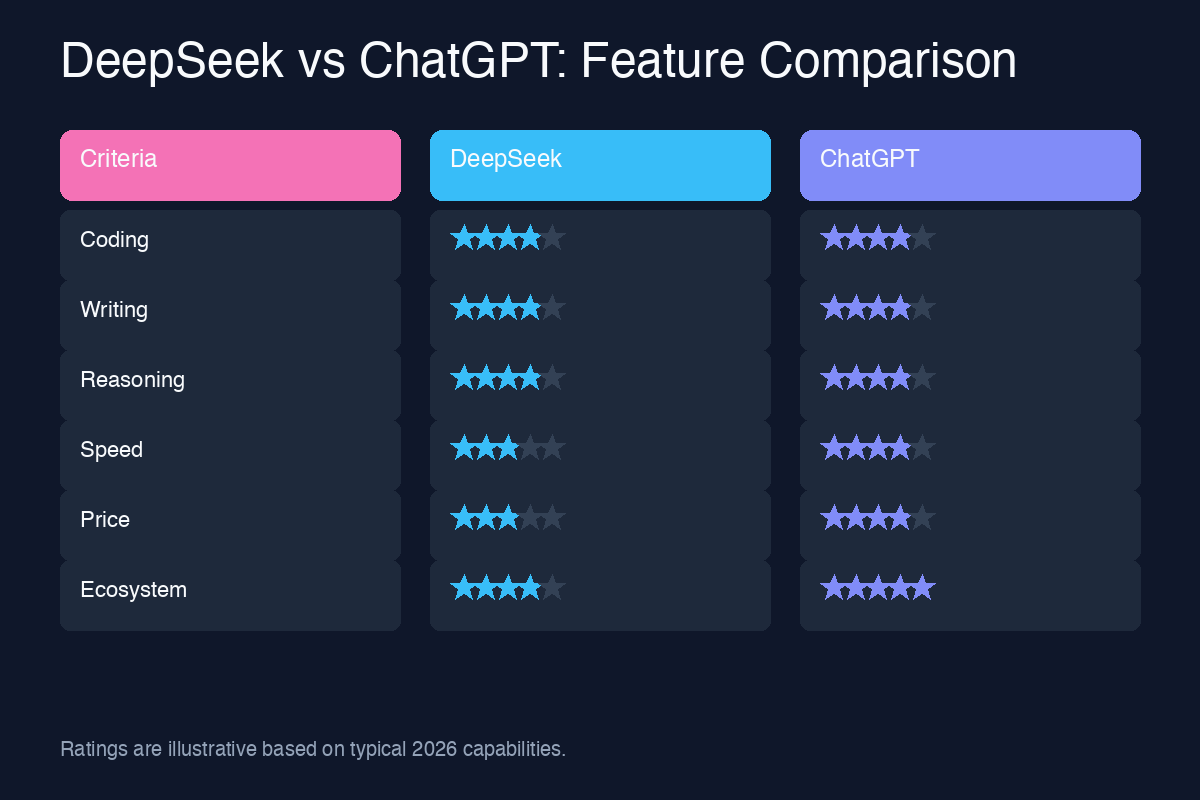
This table captures the central tension between the two platforms. DeepSeek prioritizes openness, efficiency, and affordability, while ChatGPT prioritizes polish, ecosystem reach, and cutting-edge capabilities. The right choice depends heavily on your specific use case.
What Is DeepSeek?
DeepSeek is an artificial intelligence company founded in 2023 by High-Flyer Quant, a Chinese quantitative hedge fund. Based in Hangzhou, DeepSeek was created with the goal of building advanced large language models using efficient training techniques and novel architectures. Unlike many Western AI labs, DeepSeek has embraced openness, releasing several of its models as open weights that can be downloaded, fine-tuned, and deployed locally or on private cloud infrastructure.
The company's breakthrough moment came with the release of DeepSeek-V2, which demonstrated that a Mixture-of-Experts model could achieve competitive performance at a fraction of the inference cost of dense models. This was followed by DeepSeek-V3, a 671-billion-parameter MoE model that rivals GPT-4o and Claude 3.5 Sonnet on many benchmarks, and DeepSeek-R1, a reasoning model trained using reinforcement learning that competes with OpenAI's o1.
DeepSeek's open-weight approach has made it particularly popular among:
- Developers who want to run models on their own hardware or cloud accounts.
- Startups looking to reduce AI infrastructure costs without sacrificing capability.
- Researchers who need transparent model weights for reproducibility and experimentation.
- Privacy-focused organizations that cannot send sensitive data to third-party APIs.
DeepSeek models are available through the company's web interface, mobile application, and API, as well as via platforms like Hugging Face, Ollama, and AI aggregators such as Chat-Sonic.
What Is ChatGPT?
ChatGPT is OpenAI's flagship conversational AI product, launched in November 2022. Built on the Generative Pre-trained Transformer architecture, ChatGPT made conversational AI accessible to hundreds of millions of users and became the fastest-growing consumer application in history. It is available through a free web and mobile interface, with premium tiers offering access to more powerful models and advanced features.
ChatGPT is powered by several underlying models, including:
- GPT-4o — OpenAI's flagship multimodal model, capable of reasoning across text, images, audio, and video.
- GPT-4.5 — An enhanced version of GPT-4 with improved reasoning, creativity, and instruction following.
- o1 and o3-mini — Specialized reasoning models that use chain-of-thought techniques to solve complex problems in mathematics, science, and coding.
Beyond raw model capability, ChatGPT's strength lies in its ecosystem. It integrates with OpenAI's APIs, custom GPTs, DALL-E image generation, advanced data analysis, code interpreter, web browsing, and third-party plugins. For businesses, ChatGPT Enterprise and Team plans offer admin controls, SSO, audit logs, and data privacy assurances.
ChatGPT remains the default choice for many users because of its reliability, polished interface, broad availability, and continuous improvements from one of the best-funded AI research labs in the world.
Coding: Which AI Writes Better Code?
For software developers, coding assistance is often the most important use case for a large language model. Both DeepSeek and ChatGPT offer strong coding capabilities, but they shine in different areas.
DeepSeek for Coding
DeepSeek has made coding a core focus. The company released DeepSeek-Coder and later DeepSeek-Coder-V2, models specifically pretrained and fine-tuned on code. These models support hundreds of programming languages and excel at tasks like:
- Writing functions and algorithms from natural language descriptions.
- Translating code between languages, such as Python to Rust or JavaScript to Go.
- Debugging error-prone code by identifying logical and syntax issues.
- Generating unit tests and documentation.
- Solving competitive programming problems.
DeepSeek-R1 takes coding performance even further. Because R1 is trained with reinforcement learning to produce detailed chain-of-thought reasoning, it can work through complex algorithmic challenges step by step. On benchmarks like LiveCodeBench and Codeforces, DeepSeek-R1 scores competitively with OpenAI's o1 model, sometimes surpassing it on specific problem sets.
One of DeepSeek's biggest coding advantages is cost. Developers running high-volume code completion or synthesis workloads can use the DeepSeek API at a small fraction of OpenAI's price. This makes DeepSeek attractive for:
- AI-powered coding agents and autonomous development tools.
- Startups building code review and documentation automation.
- Educational platforms generating programming exercises and explanations.
DeepSeek's open weights also allow developers to fine-tune the model on proprietary codebases, creating specialized coding assistants tailored to internal APIs and conventions.
ChatGPT for Coding
ChatGPT, particularly with GPT-4o and the o-series models, is an exceptional coding companion. OpenAI has invested heavily in making its models useful for software engineering tasks, and the results show in areas like:
- Context understanding: GPT-4o can process large codebases, architectural descriptions, and multi-file projects.
- Debugging: ChatGPT often explains not just what is wrong, but why it is wrong, and suggests multiple ways to fix it.
- IDE integration: Through tools like GitHub Copilot, Cursor, and numerous VS Code extensions powered by OpenAI models, ChatGPT's capabilities are embedded directly into developer workflows.
- Documentation and refactoring: ChatGPT is excellent at rewriting legacy code, modernizing syntax, and producing clear explanations.
- Multimodal coding: With GPT-4o, users can share screenshots of UI components, diagrams, or hand-drawn sketches and ask ChatGPT to generate matching code.
OpenAI's o1 and o3-mini reasoning models are specifically strong on hard coding problems that require planning. For example, when asked to design a distributed system, implement a tricky dynamic programming solution, or reason about concurrency, these models often outperform standard instruction-tuned models.
Coding Verdict
Choose DeepSeek if you want a low-cost, high-performance coding model, especially for API-driven automation, competitive programming, or self-hosted deployments. Choose ChatGPT if you value deep IDE integration, polished debugging explanations, multimodal coding assistance, and the broadest ecosystem of developer tools.
For many teams, the ideal setup is using both: DeepSeek for high-volume, cost-sensitive coding tasks, and ChatGPT for complex architecture discussions and interactive debugging.
Math and Reasoning: Solving Complex Problems
Reasoning capability separates good language models from truly useful ones. Math problems, logic puzzles, scientific reasoning, and multi-step planning all require models to think carefully rather than simply pattern-match.
DeepSeek-R1 Reasoning
DeepSeek-R1 is the company's answer to OpenAI's o-series reasoning models. It was trained using large-scale reinforcement learning with group relative policy optimization, encouraging the model to explore long chains of thought before producing a final answer. The result is a model that shows its work, revises intermediate steps, and often arrives at correct answers on problems that stump standard models.
On benchmarks like AMC 12, AIME, and MATH-500, DeepSeek-R1 performs at or near the level of OpenAI o1. It is particularly strong on:
- Algebraic manipulation and equation solving.
- Competition mathematics.
- Logical deduction puzzles.
- Scientific reasoning when provided with clear problem statements.
Because DeepSeek-R1 is open-weight, researchers can inspect its reasoning traces and even fine-tune it for specialized domains like physics, engineering, or finance.
ChatGPT and OpenAI o-Series Reasoning
OpenAI's o1 model introduced a new paradigm in large language model reasoning. Unlike standard GPT models that produce answers in a single pass, o1 spends additional compute time thinking before responding. This internal deliberation allows it to solve problems in mathematics, coding, and science at a level closer to human experts.
o3-mini extends this capability with improved efficiency, making advanced reasoning more accessible. ChatGPT users with Plus, Team, or Enterprise subscriptions can access these reasoning models for tasks like:
- Advanced calculus and linear algebra.
- Statistical analysis and probability.
- Formal logic and proof sketching.
- Scientific hypothesis generation and experimental design.
- Multi-step business strategy and planning.
OpenAI's reasoning models tend to be more polished and less verbose than DeepSeek-R1. They also benefit from OpenAI's broader safety training, making them less likely to produce misleading or overconfident answers on ambiguous questions.
Math and Reasoning Verdict
Both DeepSeek-R1 and ChatGPT's o-series models are excellent at mathematical and logical reasoning. OpenAI's models currently have a slight edge on the hardest academic benchmarks, and they are generally more reliable for scientific research. However, DeepSeek-R1 offers comparable capability at a much lower cost, making it a compelling choice for educational tools, automated tutoring, and large-scale reasoning applications.
Cost: Which AI Offers Better Value?
Cost is one of the biggest differentiators between DeepSeek and ChatGPT. For individual users, the difference may seem small. For businesses processing millions or billions of tokens, it can be transformational.
DeepSeek Pricing
DeepSeek built its reputation partly on aggressive pricing. Its Mixture-of-Experts architecture allows it to activate only a subset of parameters for each token, dramatically reducing inference costs. Typical DeepSeek API pricing has been roughly:
- DeepSeek-V3: Around $0.14 to $0.55 per million input tokens, depending on context length and cache usage.
- DeepSeek-R1: Around $0.55 to $2.19 per million input tokens, significantly cheaper than OpenAI o1.
These prices are often an order of magnitude lower than equivalent OpenAI models. DeepSeek also offers discounts for cached context and off-peak usage, further reducing costs for applications with repetitive prompts.
For self-hosted deployments, the economics depend on hardware. Running a 671-billion-parameter MoE model requires multiple high-end GPUs, but smaller quantized versions can run on consumer hardware for experimentation. For companies with existing GPU infrastructure, self-hosting can eliminate per-token costs entirely after the initial setup.
ChatGPT Pricing
OpenAI's pricing varies by model and use case. As of 2026, typical API pricing includes:
- GPT-4o: Around $2.50 per million input tokens and $10 per million output tokens.
- GPT-4.5: Around $15 to $75 per million tokens, depending on input or output.
- o1: Around $15 per million input tokens and $60 per million output tokens.
- o3-mini: Lower than o1, roughly $1.10 per million input tokens and $4.40 per million output tokens.
For consumers, ChatGPT Plus costs around $20 per month, Team plans cost around $25 to $30 per user per month, and Enterprise pricing is negotiated. The free tier provides access to GPT-4o mini and limited GPT-4o usage, with restrictions on message volume and advanced features.
Cost Verdict
DeepSeek wins clearly on API cost, especially for high-volume applications. It is one of the best options for startups and developers who need capable AI without enterprise budgets. ChatGPT offers better value for individual users and small teams who prioritize ease of use, reliability, and feature breadth over raw per-token pricing.
Open Source vs Closed Source
The philosophical divide between DeepSeek and ChatGPT may be as important as the technical one. It determines who controls the model, where your data goes, and what you are allowed to do with the technology.
DeepSeek's Open-Weight Approach
DeepSeek publishes many of its models as open weights. This means anyone can download the trained model parameters and use them under permissive licenses. Open-weight models offer several advantages:
- Self-hosting: You can run the model on your own servers or private cloud, keeping sensitive data in-house.
- Fine-tuning: You can adapt the model to your domain using your own datasets.
- No vendor lock-in: You are not dependent on DeepSeek's API uptime, pricing changes, or availability.
- Transparency: Researchers and engineers can inspect model behavior, biases, and failure modes.
- Community innovation: Open models foster derivative work, optimizations, and integrations across the AI ecosystem.
However, open-weight models also come with responsibilities. You must manage infrastructure, security, updates, and compliance yourself. Running large models requires technical expertise and capital investment in hardware.
ChatGPT's Closed-Source Model
OpenAI keeps its most capable models closed-source. Users access them through ChatGPT's web interface, mobile apps, or the OpenAI API. The closed-source approach has its own benefits:
- Simplicity: No infrastructure to manage. You send a prompt and receive a response.
- Reliability: OpenAI operates globally distributed infrastructure with high availability.
- Continuous updates: New features, safety improvements, and model versions are rolled out automatically.
- Integrated ecosystem: ChatGPT connects with web search, image generation, data analysis, and enterprise tools.
- Support and SLAs: Paid plans include customer support and service level agreements for businesses.
The downside is reduced control. You cannot inspect the model weights, customize the model for your needs, or run it offline. You must also accept OpenAI's terms of service, usage policies, and data handling practices.
Open vs Closed Verdict
Choose DeepSeek if openness, customization, and data sovereignty are priorities. Choose ChatGPT if you prefer a managed service with the latest features and minimal operational overhead.
Privacy and Data Security
Privacy is a growing concern for anyone using AI. Where your prompts are stored, how they are used, and who can access them vary significantly between DeepSeek and ChatGPT.
DeepSeek Privacy Considerations
When using DeepSeek through its official API or web interface, prompts are processed on DeepSeek's servers. The company's privacy policies outline how data is collected, stored, and used for service improvement. For organizations with strict compliance requirements, this may raise concerns.
The key privacy advantage of DeepSeek is self-hosting. Because the model weights are available, you can deploy DeepSeek entirely within your own environment. This means:
- Prompts never leave your network.
- You control logs, backups, and access policies.
- You can comply with regulations like GDPR, HIPAA, and SOC 2 more easily.
- You decide whether and how to retain conversation history.
This makes DeepSeek attractive to healthcare, finance, legal, and government organizations that handle sensitive information.
ChatGPT Privacy Considerations
OpenAI processes all ChatGPT interactions through its cloud infrastructure. By default, conversations may be reviewed and used to improve models, though users can opt out of data use for model training in many regions.
For business users, OpenAI offers stronger privacy protections:
- ChatGPT Team and Enterprise: Data is not used to train models by default.
- API: Data sent via the OpenAI API is not used to train models unless explicitly opted in.
- SOC 2 compliance, encryption, and admin controls are available for enterprise customers.
Despite these controls, ChatGPT cannot match the data sovereignty of a fully self-hosted model. For organizations that require absolute control, DeepSeek's open-weight option is unbeatable.
Privacy Verdict
DeepSeek is the better choice for maximum privacy, especially when self-hosted. ChatGPT offers strong privacy protections for business and API users, but ultimate data control requires trusting OpenAI's infrastructure and policies.
Speed and Latency
Speed matters. A model that produces brilliant answers slowly may be less useful than a slightly weaker model that responds instantly. Latency affects user experience, real-time applications, and the feasibility of AI agents.
DeepSeek Speed
DeepSeek-V3's MoE architecture is designed for efficiency. Because only a fraction of parameters is activated per token, inference can be faster and cheaper than dense models of similar size. However, actual speed depends on infrastructure. The DeepSeek API has generally offered competitive latency, though peak usage periods have sometimes caused slowdowns.
DeepSeek-R1, being a reasoning model, naturally takes longer because it generates extensive chain-of-thought tokens before answering. This is similar to OpenAI's o1 and o3-mini. For applications requiring quick responses, non-reasoning models like DeepSeek-V3 are faster.
ChatGPT Speed
OpenAI has invested enormous resources in global inference infrastructure. ChatGPT typically delivers low-latency responses for GPT-4o and GPT-4o mini. Even the larger GPT-4.5 model is optimized for fast interaction. The o-series reasoning models take longer by design, but OpenAI has worked to minimize overhead.
For consumers, ChatGPT generally feels snappier and more reliable, especially during high-traffic periods. For developers, OpenAI's API offers consistent performance and scaling.
Speed Verdict
ChatGPT has the edge in consistent speed and global availability, particularly for consumer and enterprise use. DeepSeek is highly efficient and can be faster in self-hosted environments or for specific MoE workloads, but API performance can vary under load.
Availability and Accessibility
A model is only useful if you can actually access it. Availability varies by region, platform, and subscription tier.
DeepSeek Availability
DeepSeek offers access through:
- Its official website and mobile applications.
- The DeepSeek API for developers.
- Open-source platforms like Hugging Face, Ollama, and vLLM.
- Third-party AI aggregators like Chat-Sonic.
DeepSeek has gained significant global traction, especially in Asia, Europe, and among the open-source community. However, it has faced regulatory scrutiny and occasional restrictions in certain markets. Users should verify availability in their country before building dependencies on the service.
ChatGPT Availability
ChatGPT is available in most countries through:
- The ChatGPT website and mobile apps for iOS and Android.
- The Mac and Windows desktop applications.
- The OpenAI API for developers.
- Integration with Microsoft Copilot, GitHub Copilot, and numerous third-party tools.
While ChatGPT is widely available, OpenAI restricts access in some countries due to regulatory and geopolitical reasons. Enterprise customers generally have the most reliable access and support.
Availability Verdict
ChatGPT is more broadly accessible for casual and business users worldwide. DeepSeek is highly accessible for developers and open-source users, though regional restrictions and capacity constraints can affect some users.
Multimodal Capabilities and General Productivity
Beyond coding and reasoning, AI assistants are used for writing, analysis, brainstorming, image understanding, voice interaction, and more.
DeepSeek for General Use
DeepSeek-V3 is a capable general-purpose assistant. It writes well, answers questions, summarizes documents, and engages in extended conversations. However, DeepSeek models are primarily text-based. They do not natively process images, audio, or video in the same way as GPT-4o. This limits their usefulness for tasks like analyzing screenshots, transcribing audio, or generating images.
ChatGPT for General Use
ChatGPT excels as a general productivity tool. With GPT-4o, users can:
- Upload images and ask questions about them.
- Engage in voice conversations with natural-sounding speech.
- Analyze PDFs, spreadsheets, and other documents.
- Generate images with DALL-E integration.
- Build custom GPTs for specific workflows.
- Browse the web for up-to-date information.
For users who want one AI assistant for many types of tasks, ChatGPT's multimodal breadth is a significant advantage.
General Productivity Verdict
ChatGPT is the better all-around productivity assistant thanks to its multimodal capabilities and rich feature set. DeepSeek is a strong text-based assistant but lacks the breadth of ChatGPT for non-text tasks.
Chat-Sonic: Use DeepSeek and ChatGPT Together
Choosing between DeepSeek and ChatGPT does not have to be an either-or decision. Chat-Sonic is an AI model aggregator that brings together the best models from multiple providers in one unified platform. With Chat-Sonic, you can access DeepSeek, ChatGPT, Claude, Gemini, and many other leading models without maintaining separate subscriptions or switching between applications.
Why Use Chat-Sonic?
- Unified access: Switch between DeepSeek and ChatGPT based on the task, all within one interface.
- Cost optimization: Route simple tasks to cheaper models and reserve premium models for complex work.
- Comparison: Run the same prompt through multiple models to compare outputs side by side.
- No lock-in: Use the best model for each job instead of depending on a single provider.
- Simplified billing: Manage AI usage through a single account and subscription.
- Broader availability: Access models that might be restricted or inconvenient to use directly in your region.
For developers, Chat-Sonic offers API access to multiple models through a single endpoint. For businesses, it provides a centralized way to manage AI usage, monitor costs, and enforce policies. For individual users, it removes the friction of deciding which tool to open for which question.
How Chat-Sonic Compares DeepSeek and ChatGPT
On Chat-Sonic, you can select DeepSeek-V3 for fast, affordable text generation, DeepSeek-R1 for deep reasoning and coding, GPT-4o for multimodal tasks, or o1/o3-mini for advanced problem-solving. This flexibility means you are never stuck with a model that is overkill or underpowered for your current task.
For example, a product team might use Chat-Sonic like this:
- Drafting documentation: DeepSeek-V3 for fast, low-cost writing.
- Debugging a complex bug: ChatGPT with GPT-4o for interactive analysis.
- Solving a math optimization problem: DeepSeek-R1 or o1 for step-by-step reasoning.
- Creating marketing visuals: DALL-E through ChatGPT integration.
By combining models, Chat-Sonic helps users get the best of both worlds: DeepSeek's affordability and openness, and ChatGPT's polish and multimodal power.
Which Should You Choose?
The DeepSeek vs ChatGPT decision ultimately depends on your priorities.
Choose DeepSeek If:
- You want the lowest possible API costs for high-volume AI workloads.
- You need open-weight models for self-hosting, fine-tuning, or compliance.
- You are building coding agents, automated development tools, or programming tutors.
- You value transparency and want to avoid vendor lock-in.
- You need strong reasoning performance without paying premium OpenAI prices.
Choose ChatGPT If:
- You want the most polished, reliable, and feature-rich AI assistant.
- You need multimodal capabilities like image analysis, voice chat, and document parsing.
- You are a business user who needs enterprise support, admin controls, and SLAs.
- You rely on integrations with Microsoft, GitHub, and other major platforms.
- You want the simplest experience without managing infrastructure.
Choose Chat-Sonic If:
- You want access to both DeepSeek and ChatGPT without separate subscriptions.
- You want to compare models and pick the best one for each task.
- You want to optimize costs by routing tasks to cheaper models.
- You want a single platform for all your AI needs.
Final Thoughts
The rise of DeepSeek represents a major shift in the AI industry. It proves that world-class language models can be built efficiently, priced affordably, and shared openly. ChatGPT, meanwhile, continues to lead in usability, multimodal innovation, and enterprise integration.
For most users, the smartest approach is not to commit to one model forever, but to use each where it excels. DeepSeek is ideal for cost-efficient coding, open-weight deployment, and reasoning tasks. ChatGPT is ideal for general productivity, multimodal work, and business workflows.
With Chat-Sonic, you do not have to make a permanent choice. You can use DeepSeek when you need efficiency and openness, and ChatGPT when you need power and polish. As the AI model landscape continues to evolve, having access to multiple models through a single aggregator will only become more valuable.
Whether you are a developer, researcher, business leader, or curious user, understanding the strengths and trade-offs of DeepSeek vs ChatGPT will help you make better decisions in 2026 and beyond.