

Claude vs ChatGPT: Which AI is Better in 2026?
Choosing the right AI assistant in 2026 is harder than ever. Large language models have evolved from simple chatbots into full-featured productivity engines that can write code, draft reports, analyze images, reason through complex problems, and even act as autonomous agents. At the center of the conversation are two leaders: Claude, developed by Anthropic, and ChatGPT, powered by OpenAI's GPT family. Both are exceptionally capable, but they are not identical. Their differences in tone, reasoning style, pricing, ecosystem, and safety philosophy can have a real impact on your daily workflow.
If you have been asking yourself whether Claude or ChatGPT is the better choice for your needs, this guide will give you a clear, balanced answer. We compare the two platforms across the categories that matter most in real-world use: coding ability, writing quality, reasoning and problem-solving, multimodal features, pricing, context window, speed, and safety. We also explain how Chat-Sonic removes the need to choose just one by giving you access to Claude, ChatGPT, Gemini, DeepSeek, Grok, and many other models inside a single subscription.
By the end of this article, you will understand exactly when Claude shines, when ChatGPT is the better fit, and how to combine the strengths of both models without paying for multiple AI subscriptions.
Key Takeaways
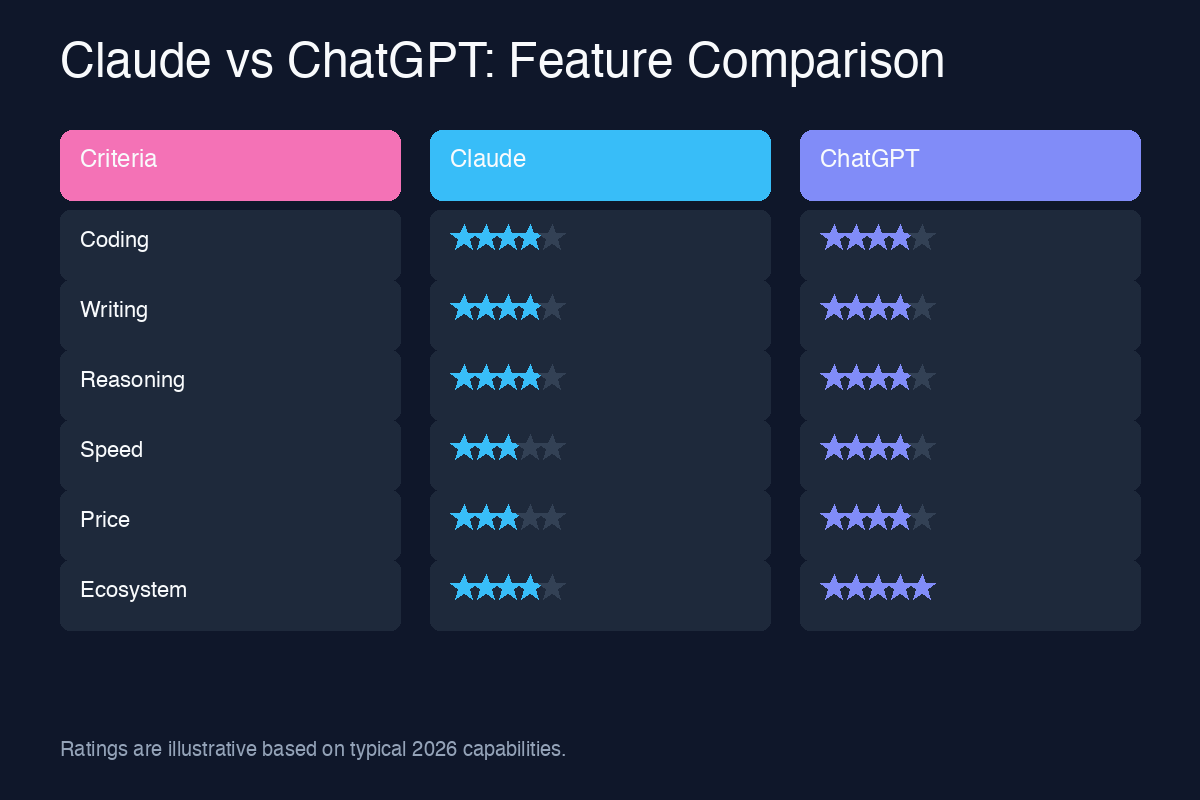
- Claude is widely recognized for producing thoughtful, nuanced, and naturally human-like writing. It is a strong choice for long-form content, editing, research, and tasks that require careful judgment.
- ChatGPT offers a larger ecosystem with broader third-party integrations, custom GPTs, voice mode, image generation, and a more playful, flexible personality that appeals to creative professionals and power users.
- For coding, both models are excellent. ChatGPT tends to be faster at producing boilerplate and working within plugin-heavy workflows, while Claude often generates cleaner, more maintainable, and better-documented code.
- Pricing is competitive, but ChatGPT's Pro and Teams tiers typically bundle more tools, while Claude's plans focus on higher usage limits and access to its latest reasoning models.
- Context windows have grown dramatically on both sides, making it possible to analyze entire books, codebases, or lengthy conversations in a single prompt.
- Neither model is perfect for every task. Many advanced users now rely on an aggregator such as Chat-Sonic to switch between Claude, ChatGPT, and other leading models depending on the job.
The AI Landscape in 2026
The year 2026 marks a mature phase for generative AI. Models have become faster, cheaper, and more reliable. Businesses, students, developers, and creators now treat AI assistants as essential tools rather than experimental toys. The leading models can handle multimodal inputs, maintain context across tens of thousands of tokens, and execute complex chains of reasoning that would have seemed impossible just a few years ago.
Within this landscape, Anthropic and OpenAI remain two of the most influential labs. Anthropic has built its reputation on AI safety, careful scaling, and a conversational style that feels measured and helpful. OpenAI has focused on broad capability, ecosystem expansion, and user-facing features that make ChatGPT a versatile platform for everything from casual questions to enterprise automation.
The result is that Claude and ChatGPT are both world-class, but they are optimized for slightly different users. Understanding those differences is the key to getting the most value out of either tool.
Claude vs ChatGPT: At a Glance
Before diving into each category, the following comparison table summarizes the most important differences between Claude and ChatGPT in 2026.
| Feature | Claude | ChatGPT |
|---|---|---|
| Developer | Anthropic | OpenAI |
| Latest Model Family | Claude 4 series | GPT-5 series |
| Best Known For | Natural writing, reasoning, safety | Versatility, integrations, creative tools |
| Coding Strength | Clean, maintainable, well-explained code | Rapid boilerplate, plugin support, broad language coverage |
| Writing Style | Nuanced, structured, human-like | Adaptable, energetic, configurable |
| Multimodal Support | Strong text and image understanding | Text, image, voice, video, and image generation |
| Context Window | Up to 200K+ tokens | Up to 128K–256K tokens depending on plan |
| Pricing Model | Free tier + Pro/Team/Enterprise plans | Free tier + Plus/Pro/Team/Enterprise plans |
| Best For | Writers, researchers, careful developers | Power users, creatives, automation builders |
This table provides a useful overview, but the real differences become clear only when you look at each category in detail.
Coding Ability
For software developers, an AI assistant is only as valuable as the quality of the code it produces. In 2026, both Claude and ChatGPT can write functions, debug errors, explain algorithms, generate tests, refactor legacy code, and even build small applications from natural language descriptions. Still, experienced developers often report meaningful differences in coding style and reliability.
Claude tends to write code that is conservative, readable, and well-structured. It often includes thoughtful comments, explains its assumptions, and avoids overly clever shortcuts. When given a complex task, Claude is more likely to break the problem into smaller steps, ask clarifying questions, and produce code that is easy to maintain. This makes Claude especially valuable for production code, code reviews, and onboarding junior developers.
ChatGPT tends to be faster and more prolific. It can generate large amounts of boilerplate in seconds, scaffold entire projects, and integrate with third-party tools such as code interpreters, retrieval systems, and plugin APIs. ChatGPT is often the preferred choice for rapid prototyping, one-off scripts, and situations where speed matters more than long-term maintainability.
Some practical coding scenarios include:
- Debugging: Both models can trace errors, but Claude often provides more context about why an error occurred and how to prevent it in the future.
- Refactoring: Claude usually produces cleaner refactored code, while ChatGPT may add more features than requested.
- Learning: Claude's explanations are typically more detailed and pedagogical, which can help beginners understand the reasoning behind each line.
- Automation: ChatGPT's broader plugin ecosystem makes it better for workflows that involve external APIs, databases, or no-code tools.
Ultimately, the best coding assistant depends on your priorities. If you value maintainability and clarity, Claude is often the better fit. If you value speed, breadth, and integration, ChatGPT usually wins.
Writing Quality
Writing is one of the most common uses for AI assistants, and it is also where Claude and ChatGPT differ most noticeably. Both can draft emails, blog posts, essays, marketing copy, social media updates, and technical documentation, but the tone and structure they produce are not the same.
Claude is frequently praised for producing prose that feels human, balanced, and carefully considered. It avoids hype, resists overuse of clichés, and tends to match the register of the prompt. Claude is especially good at long-form content that requires coherence across many paragraphs, such as white papers, research summaries, and in-depth articles. It also handles sensitive topics with a level of tact that many writers appreciate.
ChatGPT is more flexible in tone. It can be playful, persuasive, technical, or casual depending on the instructions. This adaptability makes it a favorite for marketing copy, brainstorming, creative fiction, and social content. However, some users find that ChatGPT can occasionally sound generic or overly enthusiastic unless given very specific style guidance.
When evaluating writing quality, consider the following:
- Long-form coherence: Claude often maintains a consistent thread across longer documents.
- Style adaptation: ChatGPT responds very well to explicit tone and formatting instructions.
- Editing: Claude excels at tightening prose, improving flow, and preserving the author's voice.
- Creativity: ChatGPT can generate a wider range of creative ideas and formats.
For professional writers, editors, and academics, Claude often feels like a thoughtful collaborator. For marketers, creators, and entrepreneurs who need high volume and variety, ChatGPT is usually the more versatile tool.
Reasoning and Problem-Solving
Beyond writing and coding, both Claude and ChatGPT are used as reasoning engines. They can analyze data, compare options, evaluate arguments, solve logic puzzles, and assist with research. Reasoning quality is increasingly important for users who rely on AI for decision support, academic work, financial analysis, and strategic planning.
Claude has a reputation for careful, step-by-step reasoning. It often breaks problems into parts, considers edge cases, and acknowledges uncertainty. This makes Claude well suited for tasks that require nuance, such as legal analysis, policy evaluation, ethical reasoning, and complex research synthesis. Claude is also less likely to hallucinate confidently when it does not know the answer.
ChatGPT is highly capable in reasoning as well, especially when using its latest models and built-in tools. It can perform calculations, run code, generate charts, and combine multiple sources of information. ChatGPT's reasoning style is often more direct and action-oriented, which can be an advantage when you need a fast answer or a practical recommendation.
Some key reasoning comparisons include:
- Step-by-step math: Both models handle math well, but Claude often shows more intermediate steps.
- Logical puzzles: ChatGPT can be faster at pattern recognition, while Claude may be more thorough in exploring alternatives.
- Research synthesis: Claude tends to produce more balanced summaries of conflicting viewpoints.
- Decision support: ChatGPT is generally better at producing actionable pros-and-cons lists and implementation plans.
For users who need deep, careful reasoning, Claude is often the preferred partner. For users who need fast, practical answers with tools, ChatGPT frequently delivers.
Multimodal Features
Modern AI is no longer limited to text. In 2026, users expect models to understand images, audio, video, and even generate visual content. Multimodal capabilities have become a major differentiator between platforms.
Claude supports image understanding, allowing users to upload screenshots, photographs, diagrams, and documents for analysis. It can read charts, interpret user interfaces, and extract information from visual materials. Claude's multimodal capabilities are strong and reliable, particularly for academic and professional use cases where accuracy matters.
ChatGPT has pushed multimodal features further. In addition to image understanding, ChatGPT offers voice conversations, video analysis, and image generation through integrated models. These features make ChatGPT a more complete creative platform. Users can sketch an idea, describe it verbally, and receive generated images, written explanations, and code all in one place.
When comparing multimodal features, keep in mind:
- Image analysis: Both models perform well, though ChatGPT's broader toolset may offer more convenience.
- Voice interaction: ChatGPT offers a polished voice mode that feels closer to a natural conversation.
- Image generation: ChatGPT includes native image generation; Claude focuses on understanding rather than creation.
- Video understanding: ChatGPT generally leads in video analysis and cross-modal reasoning.
If your workflow depends heavily on image generation, voice, or video, ChatGPT currently has the edge. If you primarily need accurate image and document analysis, Claude is more than capable.
Pricing and Value
Pricing is often the deciding factor for individuals and teams choosing between Claude and ChatGPT. Both platforms offer free tiers, but serious users usually upgrade to paid plans for higher limits and better models.
Claude's pricing is straightforward. The free tier provides access to capable models with daily usage limits. The Pro plan unlocks higher message limits, priority bandwidth, and early access to new features. Team and Enterprise plans add administrative controls, shared usage, and enhanced support. Claude's value proposition centers on quality, safety, and reliable access to its best reasoning models.
ChatGPT's pricing is tiered more granularly. The free tier includes access to standard models with some restrictions. Plus and Pro plans unlock faster responses, higher usage caps, and access to the most advanced models. Team and Enterprise plans add collaboration features, data controls, and administrative tooling. ChatGPT also bundles features such as image generation, advanced voice, and web browsing, which can add significant value for creative and business users.
Key pricing considerations include:
- Daily usage: Check message limits carefully if you plan to use the AI heavily.
- Feature bundles: ChatGPT includes more non-text features, while Claude focuses on core conversation quality.
- Team collaboration: Both offer team plans, but ChatGPT's ecosystem integrations may be more useful for larger organizations.
- API costs: Developers using the API should compare token pricing, which changes frequently and depends on model choice.
For individual power users, the choice often comes down to which extra features matter most. For teams, the decision may depend on existing software ecosystems and security requirements.
Context Window
The context window determines how much information a model can consider at once. A larger context window means you can paste long documents, entire code files, or lengthy conversation histories without losing coherence.
Claude has been a leader in long-context modeling. Its context window supports hundreds of thousands of tokens, making it possible to analyze entire books, large legal contracts, or substantial codebases in a single conversation. Claude's handling of long context is often praised for maintaining attention to details that appear early in the prompt.
ChatGPT has also expanded its context window significantly in 2026. Depending on the plan and model, users can work with very long inputs. While ChatGPT's absolute context size may vary, its retrieval features and memory capabilities help manage long conversations by recalling earlier topics and integrating relevant information.
Consider context window when:
- Analyzing long documents: Claude's large window is ideal for legal, academic, and literary analysis.
- Working with large codebases: Both models can handle substantial code, but Claude often retains more details across the full file.
- Maintaining conversation memory: ChatGPT's memory features help personalize ongoing interactions.
- Cost management: Longer inputs use more tokens, which can affect API and subscription usage.
If your work involves massive documents or codebases, Claude's generous context window is a major advantage. If you value conversation memory and retrieval over raw input length, ChatGPT is highly competitive.
Speed and Latency
Speed matters when you are iterating quickly, running multiple queries, or working under time pressure. In 2026, both Claude and ChatGPT have improved response times, but differences remain depending on the model, plan, and task complexity.
Claude sometimes feels more deliberate. Its responses can take slightly longer because the model tends to produce more complete and carefully structured answers. For users who prioritize quality over speed, this trade-off is usually acceptable. On paid tiers, Claude offers faster response times and priority access during high-demand periods.
ChatGPT is often faster for short, straightforward prompts. Its infrastructure is heavily optimized, and the platform can stream responses smoothly even during busy periods. For users who run many quick queries throughout the day, ChatGPT's responsiveness can improve overall productivity.
Factors that affect speed include:
- Model size: Larger reasoning models may be slower than smaller, general-purpose models.
- Plan tier: Paid plans usually offer faster response times and priority access.
- Task complexity: Long coding or reasoning tasks take longer on any platform.
- Server load: Peak usage can cause delays, especially on free tiers.
If speed is your top priority, ChatGPT often has the advantage. If you are willing to wait a little longer for higher-quality responses, Claude is usually worth the extra seconds.
Safety, Filters, and Refusals
AI safety is one of the most debated topics in the industry, and it is also a practical concern for everyday users. Safety filters determine what topics the model will discuss, how it handles sensitive content, and how often it refuses legitimate requests.
Claude was built by Anthropic with a strong emphasis on safety, constitutional AI, and harmlessness. Claude tends to be more cautious, thoughtful, and transparent about its limitations. It often refuses requests that could be used to cause harm, spread misinformation, or violate privacy. Many users appreciate Claude's careful approach, although it can occasionally refuse borderline requests that a human would consider reasonable.
ChatGPT also has robust safety measures, but its filters are generally more lenient in creative and professional contexts. OpenAI has worked to reduce false positives and to make the model more helpful across a wide range of legitimate use cases. ChatGPT still refuses harmful or illegal requests, but users often report fewer unexpected refusals for creative writing, research, and technical tasks.
When comparing safety and filters, consider:
- Harmful content: Both models refuse requests that could cause real-world harm.
- Creative freedom: ChatGPT may allow more flexibility in fiction, satire, and hypothetical scenarios.
- Transparency: Claude often explains its reasoning when refusing a request.
- Enterprise controls: Both platforms offer admin controls for teams that need custom safety policies.
For users in sensitive industries such as healthcare, law, or finance, Claude's cautious approach may provide extra peace of mind. For creative professionals and general users, ChatGPT's balance of safety and flexibility is often more convenient.
Access Both with Chat-Sonic
One of the biggest frustrations for AI users in 2026 is the need to subscribe to multiple services. If you want the writing quality of Claude, the creative tools of ChatGPT, and the specialized strengths of Gemini, DeepSeek, or Grok, signing up for each platform separately becomes expensive and inefficient. Switching between tabs, copying prompts, and comparing outputs wastes valuable time.
Chat-Sonic solves this problem by bringing the world's best AI models into a single platform. With one subscription, you can access Claude, ChatGPT, GPT-4, Gemini, Grok, DeepSeek, and more from a unified dashboard. Instead of choosing one model, you can pick the right model for each task, compare responses side by side, and build workflows that leverage the unique strengths of every AI.
Key benefits of using Chat-Sonic include:
- Multiple models in one place: Switch between Claude, ChatGPT, Gemini, Grok, DeepSeek, and other leading AIs without leaving the app.
- Cost savings: Avoid paying for separate subscriptions from multiple AI providers.
- Unified chat history: Keep all your conversations organized in one location, regardless of which model you used.
- Side-by-side comparison: Run the same prompt through Claude and ChatGPT to see which response works best.
- Productivity workflows: Use the right model for coding, writing, image analysis, research, and automation.
For anyone comparing Claude vs ChatGPT, Chat-Sonic removes the dilemma. You do not have to commit to one model forever. You can use Claude for long-form writing, ChatGPT for brainstorming and image generation, and other models for specialized tasks, all within the same interface.
Final Verdict: Which AI Should You Use?
There is no universal winner in the Claude vs ChatGPT debate. Both are outstanding AI assistants, and the right choice depends on what you value most.
Choose Claude if you want:
- Natural, nuanced, and human-like writing.
- Careful reasoning and balanced analysis.
- Clean, maintainable code with strong explanations.
- A large context window for long documents and codebases.
- A cautious approach to safety and sensitive topics.
Choose ChatGPT if you want:
- A broad ecosystem with plugins, custom GPTs, and integrations.
- Voice conversations, image generation, and multimodal creativity.
- Fast responses and high-volume productivity.
- Flexible tone and style for marketing, fiction, and experimentation.
- Strong collaboration features for teams.
If you want the best of both worlds, the smartest solution is to use an aggregator. Chat-Sonic gives you access to Claude, ChatGPT, and many other leading models under one subscription. Instead of settling for one AI, you can use the right AI for every task.
Frequently Asked Questions
Is Claude better than ChatGPT for coding?
Claude often produces cleaner and more maintainable code, while ChatGPT is faster at generating boilerplate and working with plugins. The best choice depends on whether you prioritize code quality or development speed.
Which model writes more naturally?
Many writers prefer Claude for long-form and nuanced writing because its prose tends to feel more human and balanced. ChatGPT is highly adaptable and can match many styles when given clear instructions.
Is ChatGPT cheaper than Claude?
Pricing is similar at the entry level, but the value differs. ChatGPT bundles more features such as image generation and voice mode, while Claude focuses on conversation quality and reasoning. Compare current plans before subscribing.
Can I use Claude and ChatGPT together?
Yes. With Chat-Sonic, you can access both Claude and ChatGPT, along with Gemini, Grok, DeepSeek, and more, from a single platform and subscription.
Which AI has the larger context window?
Claude generally offers one of the largest context windows available, making it ideal for very long documents and large codebases. ChatGPT's context window is also large and is complemented by memory and retrieval features.
Is Claude safer than ChatGPT?
Claude is known for its strong safety focus and may be more cautious with sensitive topics. ChatGPT also has robust safety measures but tends to be more flexible in creative and professional contexts.