

Claude Sonnet vs Opus: Which Anthropic Model is Right for You?
Anthropic's Claude family has become one of the most respected names in generative AI. Among its flagship offerings, two models consistently spark debate: Claude Sonnet and Claude Opus. One is engineered for speed, cost-efficiency, and broad everyday use. The other is built for the hardest reasoning, coding, and analysis tasks money can buy. If you are trying to decide which Anthropic model fits your workflow, this guide breaks down the differences in plain language.
Whether you are a developer choosing a coding assistant, a content strategist evaluating writing quality, a researcher running multi-step analysis, or a business leader budgeting AI spend, the Claude Sonnet vs Opus comparison matters. In this article, we compare benchmark performance, coding ability, writing quality, reasoning depth, context window, latency, and pricing. We also explain how Chat-Sonic gives you instant access to both models so you can switch based on the task at hand.
Key Takeaways
- Claude Opus is Anthropic's most capable model, designed for complex reasoning, advanced coding, long-form analysis, and tasks where accuracy is non-negotiable.
- Claude Sonnet offers a strong balance of intelligence and speed, making it ideal for everyday productivity, chat, summarization, and most coding tasks.
- On many standard benchmarks, Opus outperforms Sonnet, especially in mathematics, coding competitions, and graduate-level reasoning.
- Sonnet is significantly faster and cheaper, so it is the better default for high-volume or real-time applications.
- Both models share the same large context window and strong safety features, so the main trade-off is capability versus cost and latency.
- Chat-Sonic lets you test Claude Sonnet and Claude Opus side by side without separate subscriptions or API keys.
What Are Claude Sonnet and Claude Opus?
Claude is Anthropic's family of large language models. The lineup typically includes three tiers: Haiku, Sonnet, and Opus. Haiku is the fastest and most affordable. Sonnet sits in the middle. Opus is the flagship, built for maximum capability.
Claude Sonnet is positioned as the workhorse model. It handles brainstorming, drafting, editing, coding help, data extraction, and general Q&A with impressive competence. It is also Anthropic's most broadly recommended model for production applications where latency and cost matter.
Claude Opus represents the cutting edge of Anthropic's research. It excels at tasks requiring deep reasoning, long-horizon planning, advanced mathematics, competitive programming, and nuanced analysis of complex documents. Opus is the model you reach for when a mistake is expensive.
How They Fit Into the Claude Family
Understanding the full Claude family helps clarify the Sonnet versus Opus decision. Haiku is optimized for near-instant responses. Sonnet extends that speed with much stronger reasoning and writing. Opus sacrifices some speed and affordability for the highest possible quality.
Anthropic releases new generations under version names. For example, Claude 3 introduced Opus, Sonnet, and Haiku. Claude 3.5 brought updated Sonnet and Haiku variants, while later releases continued to push Opus forward. Because Anthropic updates the models regularly, the exact leaderboards shift, but the relative positioning remains consistent: Opus is strongest, Sonnet is the balanced choice, and Haiku is the fastest.
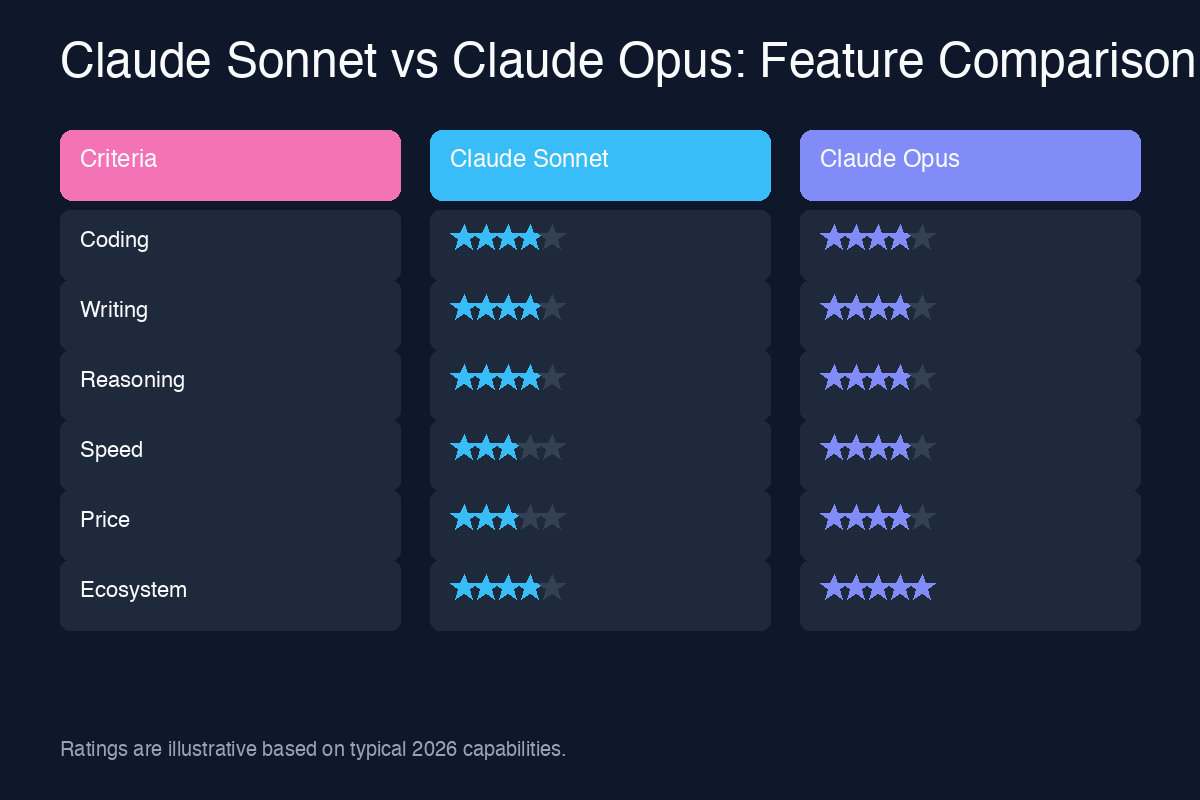
Claude Sonnet vs Opus: Quick Comparison Table
| Feature | Claude Sonnet | Claude Opus |
|---|---|---|
| Positioning | Balanced intelligence, speed, and cost | Maximum capability for complex tasks |
| Best For | Everyday chat, coding, writing, summaries | Deep reasoning, advanced coding, research |
| Reasoning Depth | Strong | Best-in-class |
| Coding Ability | Excellent for most tasks | Exceptional for complex architecture and debugging |
| Writing Quality | Clear, engaging, fast drafts | More nuanced, structured, and polished |
| Context Window | Up to 200,000 tokens | Up to 200,000 tokens |
| Speed | Faster | Slower but more thorough |
| Pricing | Lower per-token cost | Higher per-token cost |
| API Availability | Widely available | Widely available |
| Safety | Constitutional AI and RLHF | Constitutional AI and RLHF |
Benchmark Performance
Benchmarks are not the full story, but they provide a useful baseline. On most standard evaluations, Claude Opus scores higher than Claude Sonnet. The gap is especially visible in reasoning, mathematics, and coding.
Reasoning and Knowledge Benchmarks
On MMLU, a broad test of knowledge across dozens of subjects, both models score very well. Opus typically leads by a few percentage points, reflecting its deeper comprehension and broader knowledge synthesis. On graduate-level reasoning benchmarks like Graduate-Level Google-Proof Q&A, or GPQA, Opus shows a larger advantage, demonstrating stronger performance on expert-level questions.
Claude Sonnet still scores highly on these tests. For most practical questions, the difference is imperceptible. The advantage of Opus appears when the query requires combining facts across domains, evaluating ambiguous evidence, or resolving contradictions.
Mathematical Reasoning
Math benchmarks such as MATH and GSM8K highlight one of Opus's biggest strengths. Opus tends to outperform Sonnet on multi-step mathematical problems, especially those that require careful symbolic manipulation or proof-like reasoning.
Sonnet handles straightforward calculations, algebra, and many word problems competently. However, when a problem involves several layers of abstraction or requires catching subtle errors in intermediate steps, Opus is more reliable. If your work involves quantitative analysis, financial modeling, or scientific computation, Opus may justify its higher cost.
Coding Benchmarks
Coding evaluations such as HumanEval and SWE-bench show Opus ahead, particularly on difficult or open-ended software engineering tasks. Opus is better at understanding large codebases, designing architectures, and debugging intricate issues.
Sonnet is also a strong coder. It performs well on common coding interview questions, scripting, refactoring, and writing unit tests. For many developers, Sonnet is the default choice, with Opus reserved for the toughest debugging sessions or system design challenges.
Vision and Multimodal Benchmarks
Both Claude Sonnet and Claude Opus support image understanding. They can read charts, diagrams, screenshots, and photographs. Opus generally extracts more detail and makes fewer mistakes on complex visual reasoning tasks. Sonnet is still highly capable for everyday image Q&A, document scanning, and interpreting user interface screenshots.
Coding: Which Model Writes Better Code?
Developers often ask whether Claude Sonnet or Claude Opus is the better coding assistant. The honest answer depends on the complexity of the codebase and the stakes of the output.
Everyday Coding Tasks
For writing scripts, generating boilerplate, explaining functions, and creating test cases, Claude Sonnet is excellent. It produces clean, idiomatic code in many languages including Python, JavaScript, TypeScript, Go, Rust, Java, and C++. It is fast enough to use interactively and cheap enough to leave running in an editor or chat window all day.
Many developers find Sonnet sufficient for roughly eighty percent of coding work. It understands requirements well, asks clarifying questions when needed, and produces code that is easy to review and modify.
Complex Software Engineering
When the task involves architecting a new service, debugging a race condition, refactoring a monolith, or reasoning across thousands of lines of code, Claude Opus pulls ahead. Opus maintains context over longer spans of code and is less likely to miss subtle interactions between modules.
Opus also tends to produce more comprehensive solutions. It will often include error handling, logging, configuration, and tests in a single pass. This can save time on large features, though it may also produce more output than needed for small tasks.
Debugging and Code Review
Both models can debug errors and review code. Sonnet quickly spots common bugs, style issues, and obvious logic errors. Opus is more thorough. It can trace through multi-step execution paths, identify root causes of intermittent failures, and suggest architectural improvements rather than just surface-level fixes.
If you are dealing with a production incident or a security-sensitive code review, Opus is the safer choice. For routine linting and quick sanity checks, Sonnet is faster and more economical.
Pair Programming Feel
Some developers prefer Sonnet for pair programming because the lower latency makes conversation feel natural. You can iterate rapidly without waiting several seconds between turns. Opus feels more deliberate. Each response is more thorough, but the pace is slower. The best workflow is often to start with Sonnet and escalate to Opus when stuck.
Writing: Which Model Produces Better Content?
Both Claude Sonnet and Claude Opus are strong writers. They can draft blog posts, emails, marketing copy, technical documentation, reports, and creative fiction. The difference is most noticeable in tone control, nuance, and long-form structure.
Drafting Speed and Volume
Claude Sonnet generates drafts quickly. If you need a first version of an email, social post, or article outline, Sonnet delivers in seconds. It is particularly good at concise, direct writing. For content marketers and communication professionals, Sonnet is often the preferred daily driver.
Depth and Polish
Claude Opus produces writing with more depth, transitions, and rhetorical structure. Long-form content from Opus tends to flow better across sections, maintain a consistent voice, and introduce ideas in a more deliberate order. It is also better at adapting to subtle stylistic instructions.
If you are writing a white paper, a thought leadership article, a complex proposal, or anything where polish matters, Opus is worth the extra cost and time. For internal memos, quick drafts, and high-volume content production, Sonnet is usually sufficient.
Editing and Rewriting
Both models are helpful editors. Sonnet is great for tightening prose, fixing grammar, and suggesting simpler phrasing. Opus goes further. It can restructure an argument, identify logical gaps, and suggest substantive improvements. For important documents, running the draft through Opus for a final review can raise quality noticeably.
Creative Writing
Opus generally produces more creative and varied output in fiction, poetry, and scenario writing. Sonnet can also be creative, but its output can feel more predictable. If you are generating story ideas, dialogue, or worldbuilding material, Opus offers more imaginative results.
Reasoning: How Deep Can Each Model Go?
Reasoning is where the Claude Sonnet vs Opus distinction becomes clearest. Opus is explicitly designed for deeper, more careful reasoning, while Sonnet targets fast, reliable inference for most practical questions.
Multi-Step Problem Solving
Opus performs better on tasks that require many reasoning steps. It can plan a sequence of actions, evaluate intermediate results, and revise its approach. This is useful in fields like legal analysis, scientific research, strategy consulting, and advanced mathematics.
Sonnet handles multi-step problems too, but it is more likely to make small errors or take shortcuts on very complex chains. For tasks where every step must be correct, Opus is more trustworthy.
Abstraction and Conceptual Thinking
Opus is stronger at abstract reasoning. It can compare frameworks, identify underlying principles, and transfer knowledge across domains. This makes it useful for philosophy, theory building, and cross-disciplinary research.
Sonnet understands abstract concepts but is more grounded in practical application. It excels at explaining complex ideas in accessible terms, which makes it a better choice for teaching and communication.
Long-Horizon Planning
For tasks that involve planning over many steps, such as project roadmaps, research agendas, or game strategies, Opus produces more coherent plans. It considers constraints, dependencies, and edge cases more thoroughly. Sonnet produces reasonable plans but may overlook second-order effects.
Context Window and Long Documents
Both Claude Sonnet and Claude Opus support Anthropic's large context window, typically up to two hundred thousand tokens. This is enough for hundreds of pages of text, long codebases, or extensive conversation history.
Working with Long Inputs
The context window is one of Claude's strongest selling points. You can paste entire reports, legal contracts, code repositories, or books into a single prompt. Both Sonnet and Opus can summarize, extract facts, compare sections, and answer questions across the full length of the document.
Opus tends to use the context window more effectively on the hardest tasks. It is better at retrieving details buried deep in a long document and at synthesizing information scattered across many sections. Sonnet is still very capable for most long-document tasks, especially summaries and Q&A.
Needle in a Haystack
Needle-in-a-haystack tests measure whether a model can find a specific fact placed deep inside a long prompt. Both Sonnet and Opus perform well on these tests, though Opus often shows slightly better recall at extreme lengths. For real-world use, both are reliable enough that context retrieval is rarely the deciding factor.
Conversation Memory
In long conversations, both models maintain context across many turns. Opus may remember nuances and earlier constraints more reliably over very long chats. Sonnet is sufficient for standard-length interactions. If you are conducting a multi-hour research session or an extended coding project, Opus's stronger memory can be helpful.
Speed and Latency
Speed is one of the biggest practical differences between Claude Sonnet and Claude Opus. Sonnet is noticeably faster, making it better suited for interactive applications, chatbots, and high-volume automation.
Time to First Token
Time to first token measures how quickly the model starts responding after receiving a prompt. Sonnet typically has a shorter time to first token than Opus. This makes conversations feel snappier and reduces perceived wait time for users.
Throughput
Throughput, or tokens generated per second, is also higher for Sonnet. If you are streaming long responses or running many parallel requests, Sonnet can handle more load at lower latency. This is important for production systems serving many users.
When Speed Matters Most
Speed matters most in real-time applications such as customer support chatbots, live coding assistants, and interactive brainstorming tools. In these cases, Sonnet is usually the right choice. Opus is better for background tasks, batch processing, and deep analysis where a few extra seconds are acceptable.
Balancing Speed and Quality
A common strategy is to use Sonnet for first drafts and quick answers, then route difficult or important tasks to Opus. This tiered approach captures most of the quality benefits of Opus while keeping average latency and cost low.
Pricing and Cost Considerations
Pricing is a practical factor in the Claude Sonnet vs Opus decision. Opus is more expensive than Sonnet for both input and output tokens. The exact prices depend on the model version and whether you use the API or a consumer plan, but the relative difference is consistent.
API Pricing
On Anthropic's API, Opus generally costs several times more per token than Sonnet. Input tokens and output tokens are both priced higher. For applications that process large volumes of text, this cost difference can add up quickly.
Sonnet's lower price makes it attractive for production workloads, batch jobs, and any scenario where you need to control costs. Many businesses use Sonnet as their default model and call Opus only for tasks that clearly benefit from the extra capability.
Consumer Subscriptions
Anthropic's consumer subscription, Claude Pro, provides access to premium models with higher usage limits. Depending on the current plan structure, Opus usage may be more heavily rate-limited than Sonnet usage. If you expect to send many messages, Sonnet may give you more throughput within your subscription.
Total Cost of Ownership
When evaluating cost, consider more than the per-token price. A more capable model may solve a problem in fewer interactions, reducing the total number of tokens consumed. Opus can sometimes complete a complex task in one attempt that Sonnet needs several tries to finish. For hard tasks, the premium model may actually be cheaper overall.
For easy and medium tasks, Sonnet is almost always more economical. The key is matching the model to the task rather than using one model for everything.
When to Use Claude Sonnet
Claude Sonnet is the right choice for most everyday tasks. Its combination of speed, quality, and affordability makes it the best default model for many users and applications.
- General chat and Q&A: Answering questions, explaining concepts, and casual brainstorming.
- Content drafting: Blog posts, emails, social media copy, and outlines.
- Everyday coding: Scripting, refactoring, writing tests, and learning new languages.
- Summarization: Meeting notes, articles, reports, and long documents.
- Customer support: Fast responses in chatbots and helpdesk workflows.
- High-volume automation: Any workflow that processes many requests at scale.
- Interactive applications: Tools where low latency improves user experience.
If you are unsure which model to use, start with Sonnet. It will handle the majority of tasks well, and you can switch to Opus only when you need extra capability.
When to Use Claude Opus
Claude Opus is the right choice when the stakes are high or the task is unusually complex. Its superior reasoning and depth make it worth the extra cost in specific scenarios.
- Advanced coding: System design, complex debugging, architecture reviews, and large codebase understanding.
- Deep research: Multi-step literature reviews, synthesis across sources, and hypothesis generation.
- Mathematical and scientific work: Proofs, quantitative modeling, and data interpretation.
- Legal and financial analysis: Contract review, risk assessment, and scenario analysis.
- High-stakes writing: Executive communications, white papers, and published thought leadership.
- Strategic planning: Long-horizon roadmaps, market analysis, and competitive intelligence.
- Creative projects: Fiction, worldbuilding, and complex narrative design.
Use Opus when an error would be costly or when the task requires sustained reasoning that Sonnet cannot complete reliably.
Claude Sonnet vs Opus for Specific Roles
Different roles benefit from different defaults. Here is how the choice looks from several common perspectives.
Software Engineers
Engineers often prefer Sonnet as their daily coding companion. It is fast enough for interactive use and handles most coding questions well. Opus becomes valuable during deep debugging, system design, and code reviews where subtle issues could cause production problems.
Content Creators and Marketers
For content creators, Sonnet is usually the better default. It produces good drafts quickly and supports high-volume workflows. Opus is useful for flagship content, detailed editing, and projects where tone and structure must be exceptional.
Researchers and Analysts
Researchers benefit from Opus's deeper reasoning and better synthesis across long documents. Sonnet is helpful for quick summaries and initial exploration. Many researchers use Sonnet to scan material and Opus to analyze findings.
Business Leaders
Business leaders may prefer Opus for strategic analysis, board presentations, and important communications. Sonnet works well for routine analysis, scheduling, email drafting, and operational questions.
Students and Educators
Students can use Sonnet for explanations, essay drafting, and homework help. Opus is useful for advanced subjects, research papers, and topics requiring deep conceptual understanding. Educators may use Sonnet for lesson planning and Opus for creating rigorous assessments.
Safety, Helpfulness, and Harmlessness
Anthropic trains Claude models to be helpful, harmless, and honest. Both Sonnet and Opus inherit these values through Constitutional AI and reinforcement learning from human feedback. The models refuse harmful requests, acknowledge uncertainty, and avoid deceptive behavior.
Opus sometimes shows more nuanced judgment in ambiguous situations. It can better navigate conflicting instructions, explain trade-offs, and provide balanced perspectives. Sonnet is also safe and reliable but may give more direct answers with less elaboration.
For organizations with strict safety requirements, both models are strong choices. The decision between them should be based on capability needs rather than safety differences.
How to Access Both Models on Chat-Sonic
Chat-Sonic is an AI model aggregator that gives you access to multiple leading models from a single interface. You do not need separate accounts for Anthropic, OpenAI, Google, and other providers. With Chat-Sonic, you can use Claude Sonnet and Claude Opus side by side, compare their outputs, and choose the best response for each task.
Switch Models Instantly
Chat-Sonic lets you switch between Claude Sonnet and Claude Opus with a single click. This makes it easy to start a conversation with Sonnet for speed and escalate to Opus when you need deeper reasoning. You can also run the same prompt through both models to see which answer you prefer.
No Separate API Keys
Managing API keys and billing across multiple providers is tedious. Chat-Sonic handles the provider integrations for you. You get a unified interface, unified billing, and consistent chat history across models.
Compare Outputs Side by Side
One of the most useful features of Chat-Sonic is the ability to compare models side by side. When you are unsure whether Sonnet or Opus is right for a particular task, you can send the prompt to both and evaluate the results. Over time, you will learn which model fits your workflow best.
Try Chat-Sonic Today
If you want to experience the difference between Claude Sonnet and Claude Opus without juggling subscriptions, sign up for Chat-Sonic. It is the fastest way to explore both models and build an intuition for when to use each one.
Final Verdict: Claude Sonnet vs Opus
There is no universal winner in the Claude Sonnet vs Opus comparison. The best model depends on what you are trying to do.
Choose Claude Sonnet if you want a fast, affordable, and capable model for everyday tasks. It is the best default for chat, drafting, coding, summarization, and any high-volume workflow.
Choose Claude Opus if you need the highest reasoning quality for complex, high-stakes tasks. It is the right tool for advanced coding, deep research, mathematical work, and polished long-form writing.
Smart users do not pick one model forever. They use both, matching each task to the right tool. With Chat-Sonic, that switching is effortless.