

Claude.ai vs ChatGPT: Which AI Assistant Wins in 2026?
If you are trying to choose between Claude.ai and ChatGPT in 2026, you are not alone. These two AI assistants dominate the market, and both have evolved dramatically over the past year. Whether you are a developer, writer, marketer, business owner, or casual user, understanding the real differences between the Claude.ai web app and the ChatGPT web app can save you money, time, and frustration.
In this comprehensive guide, we compare Claude.ai vs ChatGPT across every dimension that matters: user interface, core features, available models, coding ability, writing quality, pricing, web app experience, and practical use cases. By the end, you will know which assistant fits your workflow best and how a platform like Chat-Sonic lets you access both without juggling multiple subscriptions.
Key Takeaways
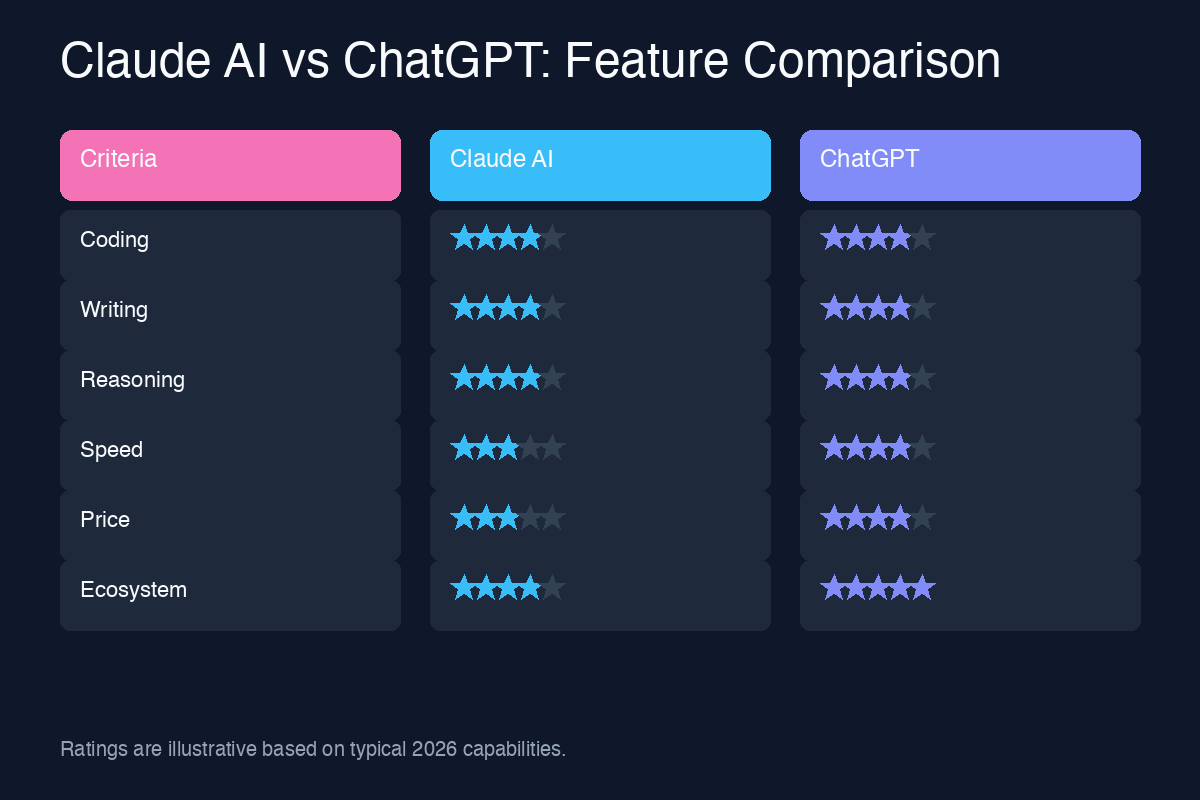
- Claude.ai is built by Anthropic and is known for nuanced reasoning, long context handling, and a clean, minimalist web app focused on productivity.
- ChatGPT, created by OpenAI, offers a broader feature ecosystem, including image generation, web browsing, voice mode, plugins, and deep workspace integrations.
- For pure coding and technical problem solving, both models are competitive, but ChatGPT often wins on ecosystem tooling while Claude.ai impresses with careful, readable explanations.
- For long-form writing, creative storytelling, and document analysis, Claude.ai frequently produces more natural, structured, and human-sounding output.
- ChatGPT's Pro plan unlocks GPT-5, advanced tools, and higher message limits, while Claude.ai's Pro plan focuses on expanded usage and access to Claude 4 Opus.
- If you want the best of both worlds, Chat-Sonic is an AI aggregator that lets you compare Claude.ai vs ChatGPT side by side in a single interface.
Quick Comparison: Claude.ai vs ChatGPT
| Feature | Claude.ai | ChatGPT |
|---|---|---|
| Maker | Anthropic | OpenAI |
| Flagship Model (2026) | Claude 4 Opus | GPT-5 |
| Web App Design | Minimalist, distraction-free | Feature-rich, multi-modal |
| Context Window | Up to 200K tokens | Up to 128K tokens |
| Image Generation | Limited / integrated in some tiers | DALL-E 4 / native image tools |
| Web Browsing | Yes, in newer releases | Yes, built-in |
| Voice Mode | No native voice conversation | Yes, Advanced Voice Mode |
| Coding Strength | Excellent, thoughtful explanations | Excellent, broad tool support |
| Writing Style | Natural, nuanced, structured | Versatile, concise, direct |
| Free Plan | Limited daily messages | Limited daily messages |
| Paid Plan | Claude Pro ~$20/month | ChatGPT Plus ~$20/month, Pro higher tiers |
| API Availability | Yes, Anthropic API | Yes, OpenAI API |
| Best For | Deep work, long docs, analysis | General productivity, creativity, integrations |
What Is Claude.ai?
Claude.ai is the consumer-facing web application for Anthropic's Claude family of large language models. First launched in 2023, Claude quickly gained a reputation for being safe, helpful, and honest. Anthropic's constitutional AI approach trains models to be helpful while avoiding deceptive or harmful outputs.
By 2026, Claude.ai has matured into a serious productivity tool. The web app centers on text-based interaction, document uploads, project organization, and analysis. It does not try to be everything at once. Instead, it doubles down on what it does best: understanding complex instructions, maintaining coherence across very long conversations, and producing high-quality written output.
Claude.ai Core Strengths
- Long context mastery: Claude's ability to process up to 200,000 tokens means you can paste entire reports, legal contracts, codebases, or books into the chat and ask detailed questions.
- Reasoning quality: Claude 4 Opus often breaks problems into clear steps and explains its thinking in a way that feels collaborative rather than robotic.
- Writing fluency: Blog posts, emails, scripts, and marketing copy generated by Claude tend to sound natural and well organized.
- Honesty and caution: Claude is less likely to hallucinate confidently or make up facts when it is uncertain.
- Clean interface: The Claude.ai web app is visually simple, making it easy to focus on the work.
What Is ChatGPT?
ChatGPT is OpenAI's flagship conversational AI and arguably the product that started the generative AI boom. Built on the GPT architecture, ChatGPT has evolved from a simple chatbot into a multi-modal productivity platform. The ChatGPT web app offers text chat, image generation, voice conversations, file uploads, web browsing, custom GPTs, and third-party integrations.
For many users, ChatGPT is the default AI assistant because it is versatile and constantly expanding. OpenAI pushes regular updates, new models, and new tools, making the platform feel like a Swiss Army knife for knowledge work.
ChatGPT Core Strengths
- Ecosystem breadth: From code execution to image creation to spreadsheet analysis, ChatGPT packs more features into one app.
- Voice and vision: Advanced Voice Mode and image understanding make ChatGPT feel more interactive.
- Custom GPTs: Users can build specialized assistants for specific tasks, workflows, or knowledge bases.
- Integration reach: OpenAI's partnerships bring ChatGPT into Microsoft products, Apple ecosystems, and many SaaS tools.
- Speed and scale: GPT-5 is optimized for fast responses across a wide range of prompts.
Claude.ai vs ChatGPT: User Interface and Web App Experience
When you open Claude.ai and ChatGPT side by side, the design philosophies are immediately clear. Claude.ai feels like a focused writing and thinking environment. ChatGPT feels like a command center for every AI task you can imagine.
Claude.ai Interface
The Claude.ai web app uses a clean, spacious layout with a light color scheme and minimal chrome. The sidebar lists your conversations, the main area is dominated by the chat input, and there are no noisy banners or upsell prompts cluttering the screen.
Navigation is straightforward. You can start a new chat, view previous conversations, organize conversations into projects, and upload files for analysis. The projects feature is especially useful for users who want to keep related chats and documents together, such as a marketing campaign or a research initiative.
One area where Claude.ai excels is reading comfort. Responses are formatted with generous line spacing, clear headings, and well-structured lists. If you spend hours reading AI-generated analysis, Claude's output is easier on the eyes.
ChatGPT Interface
The ChatGPT web app is more visually dense. The sidebar shows chat history, model selection, and custom GPTs. The main interface includes the message composer, file upload, web toggle, and voice input. Depending on your plan, you may also see memory settings, temporary chat options, and workflow shortcuts.
ChatGPT gives you more control but also more options to navigate. For power users, this is an advantage. For users who want a calm environment, it can feel slightly overwhelming. Still, OpenAI has improved the layout over time, and the interface remains intuitive for most people.
Mobile and Cross-Platform Experience
Both Claude.ai and ChatGPT offer mobile apps for iOS and Android. ChatGPT's mobile app is more mature, with voice mode, widgets, and deeper system integrations. Claude.ai's mobile app is functional and clean but lacks some of the advanced mobile features found in ChatGPT.
If you primarily use AI on desktop, both web apps are excellent. If mobile AI usage matters to you, ChatGPT currently has the edge.
Claude.ai vs ChatGPT: Available Models
The model is the engine under the hood. In 2026, both companies offer tiered model families designed for different tasks and price points.
Claude Model Family
- Claude 4 Opus: Anthropic's most capable model, optimized for complex reasoning, coding, and long-document analysis. Available on Pro plans.
- Claude 4 Sonnet: A balanced model that offers strong performance at a lower cost and faster speed.
- Claude 4 Haiku: A lightweight, fast model for simple tasks and high-volume applications.
Claude 4 Opus is particularly strong at tasks that require deep understanding. It performs well on graduate-level reasoning benchmarks, legal document review, and multi-step coding challenges. If your work involves complexity, Opus is a compelling reason to choose Claude.ai.
ChatGPT Model Family
- GPT-5: OpenAI's most advanced model, available on higher-tier plans. It integrates text, image, and tool use natively.
- GPT-4o: A fast, capable multimodal model used by default on Plus plans.
- GPT-4o mini: A smaller, cheaper model for lighter tasks.
GPT-5 represents a major leap in general intelligence and tool orchestration. It can plan multi-step tasks, generate images, browse the web, run code, and converse naturally through voice. For users who want one AI that can do almost everything, GPT-5 is hard to beat.
Which Model Should You Use?
Choose Claude 4 Opus when you need careful reasoning, long-context work, nuanced writing, or detailed analysis. Choose GPT-5 when you need speed, multi-modal capabilities, broad tool access, or general-purpose productivity.
Claude.ai vs ChatGPT: Features Comparison
Beyond the models, the features available in each web app define the daily user experience.
Document Uploads and Analysis
Both Claude.ai and ChatGPT allow you to upload PDFs, Word documents, images, spreadsheets, and code files. Claude.ai's longer context window gives it an advantage for very large documents. You can upload a 100-page PDF and ask specific questions about any part of it.
ChatGPT handles document analysis well too, and its integration with tools like code interpreter adds extra power for data-heavy files. For most documents, both are sufficient. For extreme document length, Claude.ai wins.
Image Generation
ChatGPT has a clear advantage here. Native DALL-E integration lets you generate, edit, and refine images directly in the chat. You can create illustrations, marketing visuals, concept art, and diagrams without leaving the app.
Claude.ai has limited image generation capabilities depending on the plan and region. It is primarily a text-focused assistant, so visual creatives will likely prefer ChatGPT.
Web Browsing
Both assistants can browse the web to retrieve current information. ChatGPT's browsing is more deeply integrated and faster in most cases. Claude.ai's browsing works but feels like a newer addition to the platform.
Memory and Personalization
ChatGPT offers memory features that let it remember facts about you across conversations. This is useful for ongoing projects, preferences, and personalization. Claude.ai has project-level context but does not yet offer the same persistent memory.
Custom Assistants
ChatGPT's custom GPTs allow users to create tailored assistants with specific instructions, knowledge files, and actions. This is a major strength for businesses and power users. Claude.ai offers projects and artifacts but does not have an equivalent marketplace of custom assistants.
Voice and Multimodal Input
ChatGPT supports voice conversations, image input, and audio output. Claude.ai is mostly text-based, with some support for image understanding but no native voice mode.
Claude.ai vs ChatGPT: Coding Ability
Developers often choose an AI assistant based on coding performance. Both Claude.ai and ChatGPT are excellent coding companions, but they have different strengths.
Claude.ai for Coding
Claude 4 Opus is widely praised for coding tasks that require deep reasoning. It can understand large codebases, suggest architecture improvements, debug complex issues, and explain code in plain English. Many developers prefer Claude for:
- Refactoring and code review
- Understanding legacy code
- Designing system architecture
- Writing detailed technical documentation
- Debugging multi-step errors
Claude tends to produce code that is readable, well-commented, and follows best practices. It also asks clarifying questions when requirements are ambiguous, which reduces rework.
ChatGPT for Coding
GPT-5 and GPT-4o are fast, accurate, and well-integrated with coding workflows. ChatGPT can execute code in a sandbox, generate scripts, write tests, and connect with tools via custom actions. Developers like ChatGPT for:
- Rapid prototyping
- Writing boilerplate code
- Explaining error messages
- Learning new frameworks
- Automating repetitive tasks
ChatGPT's code interpreter and plugin ecosystem make it a stronger choice for data science, automation, and workflow integration.
Which Is Better for Coding?
For complex software engineering and deep code analysis, Claude.ai often feels more thoughtful. For speed, tooling, and integration breadth, ChatGPT is the better choice. Many developers keep both open and use Claude for architecture and ChatGPT for quick implementation.
Claude.ai vs ChatGPT: Writing and Content Creation
Writers, marketers, and content creators compare Claude.ai and ChatGPT constantly. Both can draft articles, emails, social posts, and ad copy, but their writing styles differ.
Claude.ai Writing Style
Claude produces writing that feels human, nuanced, and structured. It understands tone, pacing, and narrative flow better than many competitors. If you need long-form content that reads naturally, Claude is often the preferred choice.
Claude is also good at:
- Editing and improving existing drafts
- Brainstorming angles and headlines
- Creating detailed outlines
- Matching a specific brand voice
- Writing persuasive copy without being overly salesy
ChatGPT Writing Style
ChatGPT is more versatile and can adapt to many tones and formats. It is excellent for generating first drafts quickly, producing variations, and handling high-volume content needs. ChatGPT shines at:
- Social media posts
- Short emails and messages
- Product descriptions
- SEO meta descriptions
- Creative writing prompts
With the right prompting, ChatGPT can match almost any style. However, its default output can sometimes feel more generic than Claude's.
Which Is Better for Writing?
For long-form, polished, publication-ready content, Claude.ai has the edge. For speed, volume, and variety, ChatGPT is the stronger choice. Professional writers often use Claude for final drafts and ChatGPT for ideation.
Claude.ai vs ChatGPT: Pricing and Plans
Pricing is a practical factor for most users. Both platforms offer free and paid tiers, but the value proposition differs.
Claude.ai Pricing
- Free: Limited daily messages, access to Claude 4 Sonnet, basic document uploads.
- Claude Pro: Around $20 per month. Includes significantly more messages, priority access during peak times, early access to new features, and access to Claude 4 Opus.
- Team and Enterprise: Higher-tier plans for organizations with centralized billing, usage management, and enhanced security.
Claude's free tier is more restrictive than ChatGPT's in some regions, but the Pro plan is straightforward and reasonably priced.
ChatGPT Pricing
- Free: Access to GPT-4o with daily message limits, limited browsing, and basic image input.
- Plus: Around $20 per month. Includes more messages, GPT-5 access depending on rollout, advanced voice, and higher limits on image generation.
- Pro and Enterprise: Higher tiers with increased usage, team collaboration, admin controls, and API access.
ChatGPT offers more features per dollar for general users. Claude Pro is a better value if your work depends on long-context reasoning and high-quality writing.
Free Tier Comparison
Both free tiers are useful for light usage. ChatGPT's free tier tends to be more generous with daily messages, while Claude's free tier may feel limiting if you have heavy daily needs.
Claude.ai vs ChatGPT: Use Case Recommendations
The right choice depends on what you actually do.
Choose Claude.ai If You:
- Analyze long documents, contracts, or research papers
- Write long-form articles, reports, or books
- Need careful, step-by-step reasoning
- Prefer a clean, distraction-free workspace
- Do deep technical work like architecture and code review
- Want an assistant that explains its thinking clearly
Choose ChatGPT If You:
- Want one AI for text, images, voice, and web
- Need custom assistants for repetitive workflows
- Use AI heavily on mobile
- Depend on integrations with Microsoft, Apple, or SaaS tools
- Create marketing visuals or multimedia content
- Prefer a feature-rich, all-in-one platform
The Case for Using Both Claude.ai and ChatGPT
Here is the truth that many power users have accepted: there is no single best AI assistant. Claude.ai and ChatGPT complement each other. Claude gives you depth, clarity, and writing quality. ChatGPT gives you breadth, speed, and multi-modal power.
Switching between two web apps, however, is inefficient. You have to remember different interfaces, manage separate subscriptions, and copy context back and forth. This is where an AI model aggregator becomes valuable.
Access Claude.ai and ChatGPT Together with Chat-Sonic
Chat-Sonic is an AI model aggregator that brings Claude.ai, ChatGPT, and other leading models into a single, unified chat interface. Instead of paying for multiple subscriptions and jumping between tabs, you can compare responses, switch models, and choose the best output for every task.
Why Chat-Sonic Makes Sense
- One interface, multiple models: Use Claude 4 Opus, GPT-5, and other models without leaving the app.
- Side-by-side comparison: Ask the same question to Claude.ai and ChatGPT and compare answers instantly.
- Cost efficiency: Reduce the need for separate Pro subscriptions by accessing models through a single platform.
- Workflow flexibility: Route creative writing to Claude, image generation to ChatGPT, and coding questions to whichever model performs best.
- No lock-in: Experiment with new models as they are released without switching platforms.
For teams and individuals who depend on AI every day, Chat-Sonic removes the friction of model selection. You get the depth of Claude.ai and the versatility of ChatGPT in one place.
How to Get Started
Visit chat-sonic.ai and start a conversation. You can explore different models, test prompts, and discover which AI assistant works best for your specific tasks. Whether you are writing a report, debugging code, or generating visuals, Chat-Sonic puts the right model at your fingertips.
Claude.ai vs ChatGPT: Privacy, Security, and Enterprise Readiness
As AI assistants handle more sensitive business data, privacy and security have become deciding factors. Both Anthropic and OpenAI have introduced enterprise-grade controls, but their approaches differ.
Claude.ai for Enterprise
Anthropic markets Claude as a safe and responsible AI partner. Enterprise plans include SSO, admin controls, audit logs, and data retention policies. Anthropic states that it does not train on customer data from API or enterprise conversations by default. For organizations in regulated industries, this commitment to data protection is a significant advantage.
Claude's constitutional AI training also reduces the risk of generating harmful or biased content, which matters for customer-facing applications and internal communications.
ChatGPT for Enterprise
OpenAI offers ChatGPT Enterprise and Team plans with similar security features: SSO, domain verification, admin dashboards, and encryption. OpenAI also promises not to train on business data in enterprise plans. The broader integration ecosystem means ChatGPT can fit into existing Microsoft 365 and Google Workspace environments more smoothly.
For large organizations already embedded in the Microsoft ecosystem, ChatGPT Enterprise may be easier to deploy at scale.
Which Is More Secure?
Both platforms meet high security standards. Claude.ai appeals to companies that prioritize AI safety and transparent data policies. ChatGPT appeals to companies that want deep integration with productivity suites and collaboration tools. Evaluate each vendor's SOC 2 reports, data processing agreements, and compliance certifications before making a final decision.
Future Outlook: Where Are Claude.ai and ChatGPT Headed?
Looking beyond 2026, both Anthropic and OpenAI are racing toward more capable, agentic AI systems. Anthropic is likely to continue refining Claude's reasoning, safety, and long-context abilities while expanding enterprise features. OpenAI is likely to push deeper multi-modal experiences, autonomous agents, and platform integrations.
For users, the key trend is convergence. Claude.ai is adding more tools and capabilities, while ChatGPT is improving reasoning and output quality. The gap between them will probably shrink over time, but their core identities will remain distinct. Claude will stay focused on thoughtful, reliable assistance. ChatGPT will stay focused on broad, multi-modal productivity.
Regardless of how each platform evolves, the best strategy is to stay flexible. Use an aggregator like Chat-Sonic to avoid vendor lock-in and always have access to the best model for any task.
Final Verdict: Claude.ai vs ChatGPT in 2026
So, which AI assistant wins in 2026? The answer depends on your priorities.
Claude.ai wins for users who value depth, clarity, long-context handling, and high-quality writing. It is the better choice for researchers, writers, developers working on complex systems, and anyone who wants a focused, distraction-free AI workspace.
ChatGPT wins for users who want an all-in-one platform with image generation, voice, web browsing, custom assistants, and broad integrations. It is the better choice for marketers, generalists, mobile users, and anyone who needs maximum versatility.
The smartest move is not to choose one forever. It is to use both where they shine. With Chat-Sonic, you do not have to choose. You can access Claude.ai, ChatGPT, and other leading models in a single interface, compare their responses, and pick the best one for every task.
In the battle of Claude.ai vs ChatGPT, the real winner is the user who knows how to use both.