

Twenty dollars a month has become the standard price of admission for serious AI use. ChatGPT Plus and Claude Pro both sit at that price point, both unlock frontier models, and both promise to make you faster at writing, coding, research, and analysis. On the surface they look interchangeable. In daily use they are not.
The two subscriptions are built around different assumptions about what people want from an assistant. ChatGPT Plus is the broader product: more features, more modalities, more ways to extend it. Claude Pro is the narrower one: fewer bells and whistles, but a model many writers and engineers prefer for sustained, careful work. Which one is worth your money depends less on benchmark scores than on what you actually do all day.
This guide compares ChatGPT Plus and Claude Pro across pricing, usage limits, model access, writing, coding, file handling, integrations, and privacy. It also covers the option most comparison articles skip: not subscribing to either one directly, and instead using an aggregator such as Chat-Sonic to reach both models, plus Gemini, DeepSeek, and Grok, through a single account.
Key Takeaways
- Both plans cost roughly $20 per month, so the decision is about fit, not price.
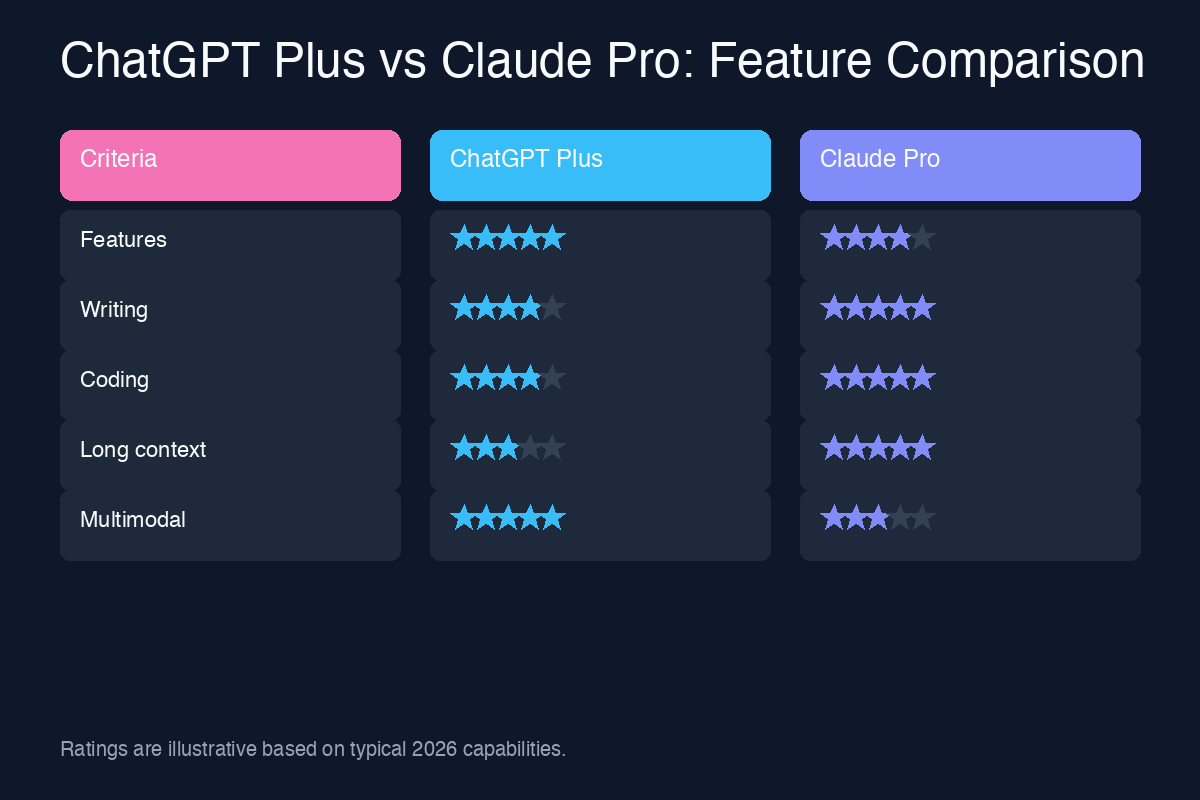
- ChatGPT Plus is the more feature-dense product: voice, image generation, custom GPTs, and a large third-party ecosystem.
- Claude Pro is the more focused product: long-document handling, careful prose, and a coding workflow many engineers prefer.
- Usage limits, not raw capability, are what most subscribers actually run into.
- If you regularly need both, paying two subscriptions is the expensive way to solve it. An aggregator like Chat-Sonic covers both from one plan.
Pricing at a Glance
Both companies use a similar ladder: a free tier to try the product, a roughly $20 individual tier, a high-usage tier for power users, and per-seat team plans. Prices and limits change frequently, so treat the figures below as the shape of the market rather than a permanent quote, and confirm on the provider's pricing page before you buy.
| Tier | OpenAI | Anthropic |
|---|---|---|
| Free | ChatGPT Free: capped access to current models | Claude Free: capped daily messages |
| Individual | ChatGPT Plus: about $20/month | Claude Pro: about $20/month, cheaper billed annually |
| Power user | ChatGPT Pro: about $200/month | Claude Max: roughly $100 and $200/month tiers |
| Teams | ChatGPT Business: per seat, minimum seats | Claude Team: per seat, minimum seats |
The headline number is the least interesting part. What separates the two at $20 is how much you can use them before you are throttled, and what surrounds the model once you are inside.
What ChatGPT Plus Actually Includes
ChatGPT Plus is best understood as a bundle. You are not only buying access to a better model; you are buying a suite of tools built on top of it.
Subscribers get priority access to OpenAI's current flagship models, along with higher message limits than the free tier. Beyond raw chat, Plus includes advanced voice conversation, image generation, data analysis that runs Python on files you upload, web browsing, and a research mode that compiles longer sourced reports. Custom GPTs let you save a configured assistant with its own instructions and files, and the GPT directory gives you thousands of pre-built ones. Projects group related chats and files so context carries between sessions, and memory lets the assistant retain preferences across conversations.
The practical effect is breadth. If your work spans slide decks, spreadsheets, images, voice notes, and code, ChatGPT Plus touches all of it without asking you to leave the app. That breadth is also the main critique: the surface area is large, and some features feel more like demos than daily tools.
What Claude Pro Actually Includes
Claude Pro is a narrower product built around the conversation itself. Subscribers get substantially more usage than the free tier and access to Anthropic's stronger models, including the flagship Opus tier at limited volume.
The signature features are Projects, which hold a persistent knowledge base of files and instructions that every chat in that project can draw on, and Artifacts, which render code, documents, and small apps in a side panel you can iterate on rather than scrolling through a wall of text. Claude handles large document uploads well, supports connectors to outside tools, and offers desktop and mobile apps alongside the browser. Pro subscribers also get metered access to Anthropic's terminal-based coding agent, which has become a significant reason engineers choose the plan.
The philosophy is different from OpenAI's. Anthropic ships fewer surfaces and invests in the quality of the core interaction. If you mainly want to think, write, and build with a model that holds a long thread carefully, that trade is usually favorable.
Usage Limits: The Part Nobody Reads Until They Hit It
This is where most subscribers form their real opinion. Neither $20 plan is unlimited. Both meter access to their most expensive models on a rolling window, and both will push you to a smaller, faster model once you exhaust it.
On Claude Pro, the flagship Opus tier is the scarce resource. Heavy users working on long documents or agentic coding sessions can burn through a window in a couple of hours and spend the rest of the day on the mid-tier model. On ChatGPT Plus, limits are spread across more features: reasoning-heavy models, deep research runs, image generation, and video tools each have their own caps.
Two practical implications follow. First, if you consistently hit ceilings on either plan, the honest comparison is no longer $20 versus $20. It is $100 or $200 versus $20, because that is what the next tier costs. Second, limits are the single most common reason people end up paying for both services: they exhaust one and switch to the other to finish the day.
Writing Quality
Claude has a strong reputation among people who write for a living. Its default prose is more restrained, it hedges less awkwardly, and it holds a voice across a long piece rather than drifting into generic marketing cadence. It is also more willing to produce a plain sentence instead of a decorated one, which matters when the output needs editing rather than rewriting.
ChatGPT is more versatile and more eager. It is excellent at structured formats such as outlines, briefs, ad variations, social copy, and summaries, and it will happily generate twenty options when you ask for five. That eagerness is useful in ideation and tiresome in final drafts, where it tends toward list-heavy, subheading-dense output unless you steer it firmly.
A reasonable rule: if you are producing a lot of short-form content and want volume and variety, ChatGPT Plus fits. If you are producing long-form prose that you will edit yourself and want the first draft to sound like a person, Claude Pro fits.
Coding
Both plans are legitimately good at code, and the gap depends on how you work.
ChatGPT Plus is strong at self-contained problems: explain this error, write this function, convert this script, analyze this dataset. Its data-analysis mode is genuinely useful because it executes code against your uploaded file and shows results rather than guessing at them. The ecosystem of editor integrations around OpenAI models is also larger.
Claude Pro is strong at codebase-level work. It holds more of a repository in mind at once, follows existing conventions more reliably, and produces multi-file changes that need less cleanup. Anthropic's terminal coding agent, bundled with Pro at metered volume, changed the calculus for a lot of engineers: it turns the subscription into a tool that edits files and runs commands rather than one that hands you snippets to paste.
If your coding is occasional and question-shaped, ChatGPT Plus is enough. If you are shipping software daily and want an assistant inside your project, Claude Pro is the stronger $20.
Long Documents and Context
Claude has historically led here, and it still shows. Feeding it a long contract, a research paper, or a sprawling thread and asking for a careful summary tends to produce fewer invented details and better retention of material from the middle of the document.
ChatGPT handles long inputs competently, but Plus subscribers work with a smaller effective context than the top-tier plan, which is a common source of confusion when a document that "worked yesterday" gets truncated today. If most of your work involves dropping in large files and interrogating them, that difference is worth more than any feature list.
Images, Voice, and Multimodal Work
This is ChatGPT's clearest advantage. Plus includes image generation, image editing, advanced voice conversation that feels close to a phone call, and video generation at limited volume. Claude reads and analyzes images well but does not generate them, and its voice support is more limited.
If you need to make visual assets or talk to your assistant hands-free, this alone decides it. If images are something you analyze rather than create, it barely matters.
Integrations and Ecosystem
ChatGPT has the larger third-party surface: a public directory of custom GPTs, connectors to common workplace tools, and wide support in other products that ship an "ask ChatGPT" button.
Anthropic's approach centers on the Model Context Protocol, an open standard for connecting assistants to external tools and data. It is more developer-facing and less of a consumer app store, but it is broadly adopted and increasingly the way serious tool integrations get built. Which ecosystem matters depends on whether you want prebuilt assistants or you want to wire the model into your own systems.
Privacy and Training Data
Both companies let individual users opt out of having conversations used to improve models, and both exclude business and API traffic from training by default. Anthropic has generally leaned harder on privacy and safety as a positioning, and its enterprise agreements reflect that. OpenAI offers comparable controls but buries some of them in settings.
If you handle client work, health information, or anything under an NDA, do not rely on defaults on either platform. Check the data-control settings when you sign up, and use a business tier when the material genuinely requires it.
Who Should Choose ChatGPT Plus
- You want one subscription that covers text, images, voice, and data analysis.
- You produce a high volume of short-form content and value variety over restraint.
- You want prebuilt assistants and a large third-party ecosystem.
- You analyze spreadsheets and CSVs and want code actually executed against them.
- You are new to AI tools and want the widest set of capabilities to explore.
Who Should Choose Claude Pro
- You write long-form material and care how the first draft sounds.
- You work with large documents and need reliable retention across them.
- You code daily and want an agent that works inside your project.
- You prefer a focused tool over a broad suite.
- You want a persistent project knowledge base rather than one-off chats.
The Hidden Cost of Subscribing to Both
Plenty of professionals end up paying for both, and the reasoning is sound: use Claude for drafting and code, ChatGPT for images, voice, and data analysis. The problem is that $40 a month buys two half-used subscriptions and two sets of usage limits, and it still leaves out Gemini, DeepSeek, and Grok, each of which is the best option for something.
It also creates friction. Context does not move between the two apps. Files get uploaded twice. Project knowledge lives in one place and not the other. The tax is not only money; it is the constant decision of which tab to open.
The Aggregator Option
An AI model aggregator sits in front of multiple providers and gives you one interface, one bill, and one place to keep your history. Chat-Sonic works this way: a single subscription reaches Claude, ChatGPT, Gemini, DeepSeek, Grok, and other leading models, and you pick the model per conversation rather than per subscription.
The advantages are practical. You can draft in Claude and switch to ChatGPT for the same thread without re-explaining anything. When a new model ships, you can try it the day it appears instead of evaluating whether it justifies a fourth subscription. And when one provider is having a bad day, whether that is degraded quality, an outage, or a limit you just hit, you switch models instead of losing an afternoon.
The trade-off is honest: aggregators generally do not replicate every first-party feature. Deeply integrated extras such as advanced voice, native image generation inside a specific vendor's app, or a vendor's own terminal coding agent live in the first-party product. If one of those specific features is central to your work, keep that one subscription. For everyone else, model access is the thing being paid for, and paying for it once is cheaper than paying for it twice.
How to Decide in Five Minutes
- Write down the three tasks you actually do most with AI.
- If any involves generating images or talking hands-free, ChatGPT Plus wins on features alone.
- If any involves long documents or daily coding inside a project, Claude Pro wins.
- If your list splits across both columns, you are an aggregator user, so do not buy two subscriptions before trying one.
- Whatever you pick, use the free tiers for a week first. Both are generous enough to reveal which model you reach for.
Frequently Asked Questions
Is Claude Pro better than ChatGPT Plus?
Neither is better across the board. Claude Pro is generally preferred for long-form writing, large documents, and project-level coding. ChatGPT Plus is generally preferred for multimodal work, data analysis, and breadth of features. The right answer depends on your three most common tasks.
Can I use both for less than $40 a month?
Yes. An aggregator such as Chat-Sonic provides access to both providers' models under one subscription, which is the usual way people avoid stacking two $20 plans. You give up some first-party extras in exchange.
Do either of these plans include unlimited usage?
No. Both meter access to their most capable models on a rolling window and fall back to lighter models when you exceed it. Unlimited-feeling usage is what the $100 to $200 tiers are selling.
Which is better for coding?
For daily software work inside an existing codebase, most engineers report better results from Claude Pro, particularly because of its bundled terminal coding agent. For isolated scripting questions and data analysis on uploaded files, ChatGPT Plus is very strong.
Will my conversations be used to train the models?
Both providers let individual users opt out, and both exclude business and API traffic by default. Check the data controls in settings rather than assuming, especially for client or confidential work.
Should I pay annually?
Only after a month of daily use. Anthropic discounts annual billing on Claude Pro, but this market changes fast enough that a twelve-month commitment on your first week is a bad bet.
Conclusion
ChatGPT Plus and Claude Pro cost the same and solve overlapping problems, but they are not the same product. ChatGPT Plus buys breadth: images, voice, data analysis, a large ecosystem, and a tool for nearly every situation. Claude Pro buys depth: better long-document handling, prose that needs less rewriting, and a coding workflow that fits inside real projects.
If your work sits clearly in one of those columns, buy that plan and stop optimizing. If it sits in both, which is true for most people doing varied knowledge work, the expensive answer is two subscriptions and the sensible one is a single plan that reaches both. That is the gap platforms like Chat-Sonic exist to fill: one subscription, every major model, and the freedom to switch as the field keeps moving.